ISO Certification for Startups and How It Delivers High-Impact Growth?
Introduction
Startups run on tight cash, short timelines and constant pressure to prove credibility. Customers, investors and partners want more than a pitch deck. They want proof that you can deliver consistently, handle data safely and keep service running when things go wrong. ISO certification is often seen as “corporate” or “too heavy” for early-stage companies, yet it is increasingly appearing in vendor checks even for small suppliers.
Used correctly, ISO certification does not mean piles of paperwork. It means simple, documented ways of working that match how your team already operates, then turning those into an auditable system. For startups, a focused ISO scope can support early revenue, investor confidence and smoother scale-up without building a large compliance department.
If your startup wants to plan low-cost, high-impact ISO certification for 2026, you can request an audit plan from Pacific Certifications to discuss scope, timelines and evidence requirements.
Quick summary
ISO certification for startups is about choosing a narrow, high-value scope and building simple processes that match real workflows. Standards such as ISO 9001, ISO/IEC 27001 and ISO 22301 can help your startup win deals, handle data responsibly and keep services steady. The key is to keep the system lean, assign clear responsibilities and use existing tools as evidence instead of creating separate records.
Why ISO certification matters for startups?
Many startups lose deals not because their product is weak but because buyers worry about reliability, data handling, or service continuity. Large customers often ask small suppliers the same questions they ask big vendors. Without a structured answer, a startup looks risky even if the technology is strong.
ISO certification helps turn your “we are serious” message into something verifiable. It shows that you have defined processes, assigned responsibilities and a basic cycle of planning, doing, checking and improving. For founders, it also reduces reliance on individual heroics.
What are the requirements for ISO certification for startups?
ISO standards do not demand big teams or complex software. They expect clarity about what is in scope, who is responsible, how risks are handled and how evidence is recorded and reviewed. For startups, the art is keeping this as simple as possible while still meeting the requirements. Below are some of the key requirements:
- Define a focused scope that covers the core product or service, key locations and critical support activities.
- Establish a policy and clear objectives such as quality, information security, or continuity targets that fit your stage.
- Identify interested parties, including customers, users, employees, investors and key partners and understand their needs.
- Map main processes end to end, from lead to delivery and support and keep descriptions short and realistic.
- Identify risks and opportunities that could affect your product, data, service, or reputation and record how you handle them.
How to prepare for ISO certification as a startup?
Preparation for startups should focus on doing the minimum that still works well. You do not need a separate compliance team. You do need one person who coordinates the system and a leadership team that uses ISO reviews as real decision time, not a formality. Below are some of the key preparation steps:
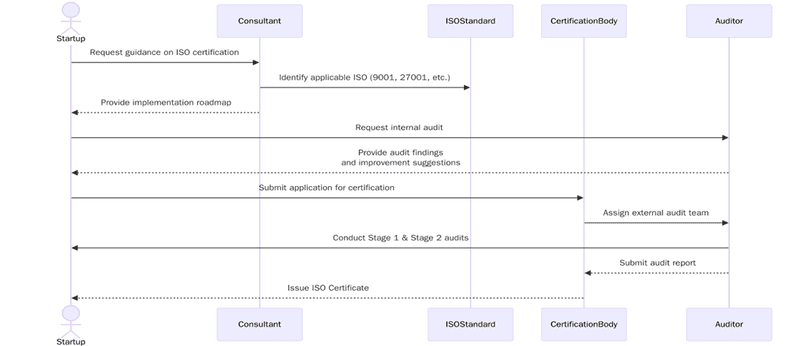
- Choose which standard or standards matter most now, such as ISO 9001 for quality or ISO/IEC 27001 for security.
- Decide the narrowest scope that still makes sense for customers, for example one product line or one main site.
- Document key processes in simple flow form or short descriptions, based on what teams actually do.
- Carry out one or two internal audits on high-impact areas to test whether records and controls are in place.
- Fix obvious gaps early, such as missing approvals, undefined handoffs, or inconsistent record keeping.
- Align the certification timeline with real business milestones, such as a major customer onboarding or funding round.
Certification audit
Stage 1 audit: Review of scope, context, documented processes, risk approach, objectives and readiness for Stage 2. For startups this often includes simple process descriptions, use of digital tools and an overview of how founders supervise work.
Stage 2 audit: Verification of implementation across selected processes, such as sales to delivery to support, including evidence from tickets, repositories, checklists and meeting records.
Nonconformities: Must be corrected with clear root cause analysis, updated controls or documentation, improved records and proof that new practices are in use.
Management review: Confirms that founders or leadership regularly review performance, risks, incidents, customer feedback and resource needs and decide what to adjust.
Recertification audits: Required every three years to review the full system, expanded scope, new products and major shifts in technology or markets.
What are the benefits of ISO certification for startups?
For startups, ISO certification is most valuable when it helps win business, avoid repeated customer questionnaires and keep growing teams aligned. A small, well-targeted scope can deliver these gains without heavy overhead. Below are some of the key benefits:
- Stronger credibility with enterprise customers who see an independent certificate instead of only claims in sales slides.
- Shorter vendor approval cycles because ISO evidence answers many standard security, quality, or continuity questions.
- Clearer internal processes, so new hires ramp up faster and handoffs between teams create fewer gaps.
- Lower risk of service issues or data mishandling, because responsibilities, checks and responses are defined.
- Better structure for handling incidents, learning from them and avoiding repeat problems.
- A more confident story for investors who want to know that the startup can scale without losing control.
- Easier integration of new products or regions, since there is already a pattern for documenting and reviewing changes.
Market Trends
By 2026, more startups will treat ISO certification as part of their go-to-market toolkit rather than a late-stage activity. Buyers expect even small companies to show basic control over data, continuity and quality. Remote work and heavy reliance on cloud tools also mean that early structure around access, incidents and changes helps avoid later crises.
Many young companies will choose one or two core standards first, then add others when contracts or risk exposure grow. There is also a move toward using product and engineering tools themselves as ISO evidence, instead of separate “compliance portals”. Startups that build lean, realistic systems now will find it easier to pass due diligence, enter regulated markets and scale without rework.
Training and courses
Pacific Certifications provides accredited training programs for startups building their first management systems:
- Lead Auditor Training: helps professionals and senior staff understand how external audits work, what auditors look for and how to read findings.
- Lead Implementer Training: supports teams that design and roll out ISO systems that stay lean and fit startup workflows.
Pacific Certifications provides accredited training programs. If your startup is looking for ISO training, our team is equipped to help you. Contact us at [email protected].
How Pacific Certifications can help?
Pacific Certifications provides accredited audit and certification services for startups and growing companies across different sectors. We focus on clear, realistic scopes, simple audit planning and impartial assessment of how your system works in practice. Our audits review processes, records, digital tools, supplier control, internal audits and management reviews, then issue Certificates of Conformity only when requirements are met. We do not provide consultancy or build your system for you.
To request an ISO audit plan tailored for startups, or to discuss low-cost, high-impact certification options, contact [email protected] or visit www.pacificcert.com.
Ready to get ISO certified?
Contact Pacific Certifications to begin your certification journey today!
Author: Alina Ansari
Suggested Certifications –
Read more: Pacific Blogs