Introduction
ISO certification provides schools and educational organizations with internationally recognized management system frameworks that strengthen governance, improve educational processes, enhance learner satisfaction and build institutional credibility. Whether a school is seeking to improve administrative efficiency, align its processes with international best practice, or demonstrate structured quality management to accreditation bodies and institutional funders, ISO certification is both a practical management tool and a powerful credibility signal.
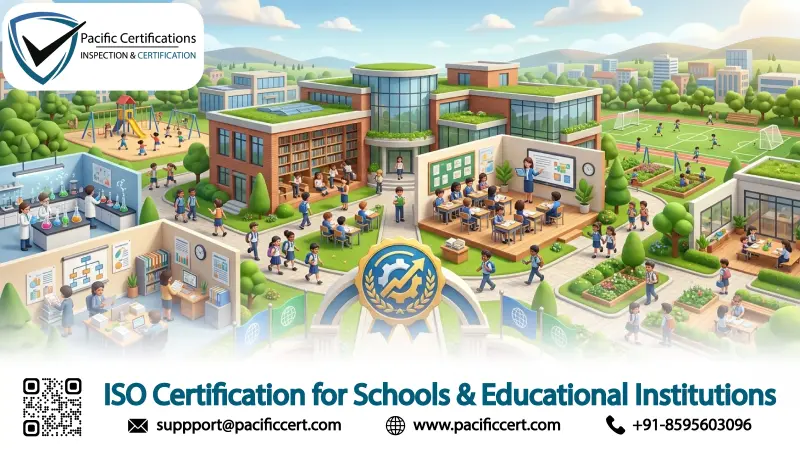
ISO certification helps schools and educational institutions turn learning quality, student safety, data protection and institutional governance into documented trust - Pacific Certifications
Why Schools Seek ISO Certification?
Key drivers include:
Accountability to parents and students - ISO certification demonstrates that the institution's educational processes, administrative functions and learner support systems are managed to defined and audited standards
Regulatory and accreditation alignment - ISO-certified management systems support compliance with national education authority requirements, accreditation body expectations and government quality assurance frameworks
Competitive differentiation - In markets where institutions compete for enrolment, ISO certification signals quality, seriousness of purpose and operational maturity to prospective students, parents and partner organizations
Operational efficiency - Documented, controlled processes reduce administrative errors, communication failures and resource waste - freeing staff to focus on educational delivery rather than managing avoidable problems
Continuous improvement culture - ISO management systems embed a formal cycle of monitoring, measurement, internal audit and management review - driving systematic improvement in teaching processes, learner outcomes and institutional performance
International recognition - For institutions with international students, exchange programs or overseas campuses, ISO certification provides a globally recognized mark of quality that resonates across jurisdictions
Practical Tip: Schools seek ISO certification to prove that learning quality, student safety, administration, data protection and continual improvement are managed through documented systems.
ISO 21001 for Education Organizations
ISO 21001 is structurally aligned with ISO 9001:2015 through the ISO High Level Structure - sharing the same framework of context, leadership, planning, support, operation, performance evaluation and improvement - but extends the generic quality management requirements with education-specific clauses that address the unique characteristics of educational service delivery.
Learner-Centred Approach
ISO 21001 places learners and other beneficiaries - including parents, employers and society - at the centre of the management system. It requires that the institution understands learner needs and expectations, designs educational processes that support competence development, and systematically monitors learner satisfaction and educational outcomes.
Inclusive Education
ISO 21001 specifically addresses inclusive and equitable access to education - requiring that the institution's processes support all learners regardless of cultural background, language, disability, gender or learning style. This is a distinctive feature of ISO 21001 that goes beyond the generic quality management framework of ISO 9001.
Curriculum and Learning Design
ISO 21001 requires that curriculum design and delivery processes are planned and controlled - ensuring that learning objectives are defined, instructional methods are appropriate for the intended learners, and assessment processes are fair, consistent and aligned with learning objectives.
Stakeholder Communication
ISO 21001 requires structured communication processes with all relevant stakeholders - learners, parents, staff, employers and regulatory bodies - ensuring that information about educational programs, performance and improvement activities is managed transparently.
Competence of Educators
The standard requires that the competence of teaching staff - their qualifications, professional development and pedagogical effectiveness - is defined, monitored and maintained. This provides a systematic framework for educator performance management and continuing professional development.
Read more: ISO 21001
Practical Tip: Use ISO 21001 to align curriculum delivery, learner needs, staff competence and institutional improvement into one structured education management system.
ISO 9001 for Administrative Quality
For schools and colleges, ISO 9001 governs:
Admissions and Enrolment Management
ISO 9001 requires that admissions processes are defined, documented and executed consistently - ensuring that enrolment criteria are applied fairly, application processing is timely and communication with prospective students and parents is managed professionally.
Supplier and Vendor Management
Educational institutions rely on a wide range of external suppliers - textbook publishers, technology providers, facility maintenance contractors, catering services. ISO 9001 requires that these suppliers are evaluated, selected and monitored against defined performance criteria - reducing the risk of supplier-related failures affecting the student experience.
Infrastructure and Resource Management
ISO 9001 requires that the physical and digital infrastructure needed for educational delivery - classrooms, laboratories, IT systems, libraries - is planned, maintained and monitored to ensure it remains fit for purpose.
Complaints and Feedback Handling
ISO 9001 provides a structured framework for managing complaints from students, parents and staff - requiring that complaints are recorded, investigated, resolved and analyzed to identify systemic issues and drive improvement.
Document and Records Management
ISO 9001 requires that documents and records - academic records, staff files, policy documents, assessment records - are controlled, retained and protected in accordance with defined procedures.
Read more: ISO 9001
Practical Tip: Use ISO 9001 to control administrative accuracy, response times, document handling and internal workflows that directly affect customer service quality.
Implementation Roadmap & Documentation
Step 1 – Gap Analysis
Assess the institution's current processes against the requirements of ISO 21001 or ISO 9001, identifying gaps in documentation, process control, measurement and governance.
Step 2 – Scope Definition
Define the scope of the management system - which campuses, programs and functions are included - and document the institutional context, interested parties and their requirements.
Step 3 – Policy and Objectives
Develop the institution's quality policy and measurable objectives aligned with the mission, vision and stakeholder needs of the organization.
Step 4 – Process Documentation
Document the core processes of the management system including admissions, curriculum delivery, assessment, learner support, complaints handling and supplier management. Process maps, procedures and work instructions are developed to the level of detail necessary to ensure consistent execution.
Step 5 – Staff Training and Awareness
Train all relevant staff on the requirements of the management system, their roles and responsibilities within it, and the importance of adherence to documented procedures.
Step 6 – Internal Audit
Conduct the management system's internal audit program assessing conformity to ISO requirements and identifying nonconformities for corrective action before the external certification audit.
Step 7 – Management Review
Conduct a formal management review, evaluating the performance of the management system, reviewing internal audit results and complaints data, and making decisions about improvement actions and resource allocation.
Step 8 – Stage 1 and Stage 2 Certification Audit
Submit to the Stage 1 (document review) and Stage 2 (on-site audit) conducted by Pacific Certifications to assess conformity with the applicable standard and issue the certification decision.
Practical Tip: Build the implementation roadmap around call flow controls, agent training, data security procedures, escalation rules, performance records and audit-ready documentation.
Audit Process
Stage 1 Audit – Document Review
The Stage 1 audit is a review of the institution's management system documentation - policies, procedures, scope statement, context analysis, risk register and internal audit records.
The auditor assesses whether the documented system is designed to meet the requirements of the standard and identifies any significant gaps that must be addressed before the Stage 2 audit. The Stage 1 is typically conducted remotely or on-site at the institution.
Stage 2 Audit – On-Site Assessment
The Stage 2 audit is the main conformity assessment conducted on-site at the institution's premises. The auditor assesses whether the documented management system is effectively implemented and operational - through interviews with leadership and staff, review of records, observation of processes and sampling of evidence across the scope of the management system.
Nonconformities identified during Stage 2 must be addressed through corrective action before the certificate is issued.
Surveillance Audits
Following initial certification, Pacific Certifications conducts annual surveillance audits to verify that the management system continues to operate effectively and that the institution maintains conformity with the applicable standard throughout the three-year certification cycle.
Recertification Audit
At the end of the three-year certification cycle, a full recertification audit is conducted to renew the certificate for a further three years.
Practical Tip: Educational institutions should plan the ISO certification audit by confirming the right standard, defining the campus or program scope, preparing academic and administrative records, and completing internal reviews before the external audit.
Benefits for Schools and Colleges
Structured curriculum design, competence-based teaching and systematic feedback management, as required by ISO 21001, support better and more consistent learning results
ISO certification provides an independent, internationally recognized signal of quality that strengthens the institution's standing with parents, students, employers and partner institutions
Documented, controlled administrative processes reduce errors, duplication and delays improving the efficiency of admissions, enrolment, records management and reporting
ISO management systems provide clear roles, responsibilities and competence requirements for all staff - supporting professional development planning and staff accountability
Formal risk assessment and corrective action processes reduce the likelihood of operational failures, compliance breaches and stakeholder complaints reaching critical levels
ISO-certified management systems provide documented evidence of quality governance that supports applications for national and international accreditation
The Plan-Do-Check-Act cycle embedded in ISO management systems creates a systematic engine for ongoing improvement in teaching, administration and learner support
Final Remark: ISO certification helps call centers prove consistent service delivery, stronger data protection and better readiness for global outsourcing contracts.
Certification Cost
A small to medium-sized school or college pursuing ISO 21001 or ISO 9001 as a standalone certification will incur a fixed-fee audit investment covering Stage 1, Stage 2 and certificate issuance. Institutions pursuing both ISO 21001 and ISO 9001 together benefit from an integrated audit approach that assesses both standards in coordinated audit visits - reducing the total audit investment compared to pursuing each standard independently.
Internal implementation costs - including staff time for gap analysis, documentation and training vary based on the institution's size and existing process maturity. Institutions that already have documented quality procedures, academic policies and performance monitoring systems in place typically require less effort than those building management systems from the ground up.
Cost planning should consider student strength, employee count, campus size, number of sites, selected standards and existing documentation maturity.
Certification Timeline
Institutions with existing quality procedures, academic handbooks and performance measurement processes in place will generally move through implementation faster than those starting without any formal management system documentation.
For institutions pursuing ISO 21001 and ISO 9001 together as an integrated management system, the combined implementation timeline is typically 3 to 5 months. The most effective approach is to align the implementation program with a suitable point in the academic calendar avoiding peak examination periods and enrolment cycles where staff availability is constrained.
Assigning a dedicated internal project lead for the implementation and engaging heads of department early in the process definition stage are the most effective ways to maintain momentum and ensure that the management system reflects actual institutional practice rather than becoming a documentation exercise.
A Practical Tip from Pacific Certifications: Schools can avoid delays by preparing policies, training records, internal audit reports, safety evidence and student data controls early.
How Pacific Certifications Can Help?
Accredited by ABIS, Pacific Certifications conducts impartial, evidence-based audits against applicable ISO standards in full conformance with ISO/IEC 17021. Our services for educational institutions include:
Independent certification audits for ISO 21001, ISO 9001, ISO 14001, ISO 45001 and ISO 27001
Integrated management system audits covering multiple standards in coordinated, efficient audit visits
Stage 1 and Stage 2 audit execution across schools, colleges, universities and training organizations
Clear, transparent audit reports with conformity findings and certification decisions
Issuance of internationally recognized ISO certificates upon successful audit completion
Annual surveillance and triennial recertification audits to maintain certificate validity
Contact Us
To get started with your ISO certification program or to initiate your audit, contact us at support@pacificcert.com or +91-8595603096.
For training programs related to ISO standards applicable to educational institutions, contact us at trainings@pacificcert.com.
Also read: ISO 21001 Certification for Educational Organizations