Why ISO Certification Is a Market Access Requirement, Not Just a Quality Signal?
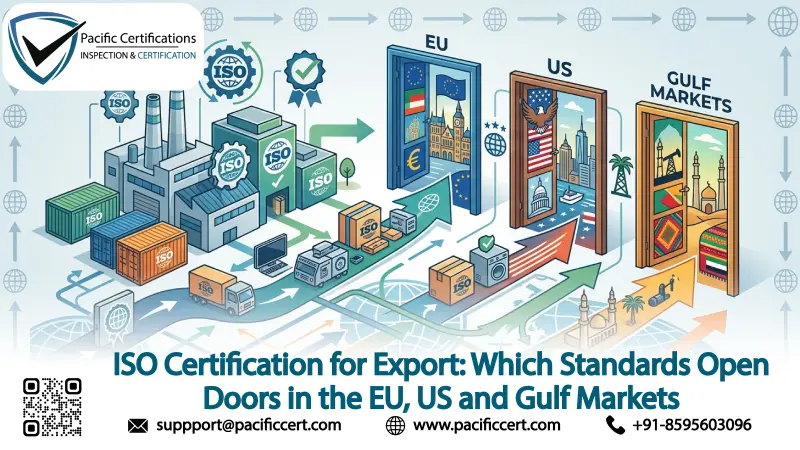
The global export certification landscape in 2026 is more standardized than ever, driven by regulatory convergence in the EU, procurement policy reform in the Gulf, and supply chain due diligence requirements from US enterprise buyers. Exporters from India, Southeast Asia, MENA and other high-growth manufacturing regions consistently identify certification gaps as the primary non-tariff barrier to entering regulated markets.
Understanding exactly which certification each market requires for each product and service category eliminates wasted investment in certifications that do not open the specific doors the exporter is targeting.
Match your target market, product category and buyer requirements before investing in certification to avoid unnecessary costs and delays - Pacific Certifications
Exporting to the EU: CE Marking, ISO 9001 and the Regulatory Framework
The EU market operates a dual-layer quality and safety requirement for most goods: CE marking demonstrating conformity with EU product safety directives, and ISO 9001 certification demonstrating quality management system governance. These are not alternatives: CE marking is a legal requirement for market access, and ISO 9001 is increasingly required by EU buyers as a vendor qualification standard above and beyond the legal CE mark threshold.
CE marking is mandatory for products covered by EU harmonized legislation including machinery, electronics, medical devices, personal protective equipment, construction products and pressure equipment. CE marking is not issued by a certification body: it is a manufacturer's self-declaration or, for higher-risk categories, a conformity assessment by a Notified Body, confirming that the product meets applicable EU directives and regulations. ISO 9001 certification does not replace CE marking but is required alongside it by EU enterprise and government buyers who want evidence that the manufacturer's quality management system governing the production of CE-marked products is independently audited and certified. For EU market access, the certification requirements by product and service category are:
Tip:If your product requires CE marking, confirm which EU directive or regulation applies and whether conformity assessment requires a Notified Body or permits self-declaration. Pursue ISO 9001 certification in parallel: EU enterprise buyers will require it as a vendor qualification standard regardless of CE mark status.
Exporting to the US: ISO 9001, AS9100 and the Sector-Specific Landscape
The US market does not have a unified mandatory certification framework equivalent to CE marking. Market access requirements are sector-specific, with ISO 9001 as the most widely recognized general quality standard and sector-specific extensions including AS9100 for aerospace, IATF 16949 for automotive, ISO 13485 for medical devices and CMMC for defense supply chain cybersecurity.
US enterprise procurement does not universally mandate ISO 9001, but large manufacturers, tier-one defense and aerospace contractors and healthcare organizations increasingly specify it in vendor qualification requirements. US government and defense procurement applies a different framework: defense contractors must achieve Cybersecurity Maturity Model Certification, and aerospace suppliers to Boeing, Lockheed Martin and other prime contractors must hold AS9100 certification, which incorporates ISO 9001 requirements with additional aerospace-specific quality management controls. The US market certification requirements by sector:
For Indian and Southeast Asian manufacturers targeting US supply chain entry, ISO 9001 is the most efficient first certification: it is recognized across general manufacturing, professional services and technology sectors, satisfies the quality management requirements of most non-sector-specific US enterprise buyers, and provides the management system foundation that AS9100 and IATF 16949 build upon.
Takeaway:Identify your specific US buyer type before choosing your certification. If you are targeting aerospace prime contractors, AS9100 is the requirement, not ISO 9001 alone.
Exporting to the Gulf: Saudi Arabia, UAE and Infrastructure Procurement
The Gulf Cooperation Council market, particularly Saudi Arabia and the UAE, has the most rapidly evolving ISO certification requirements of the three target markets, driven by Saudi Vision 2030 and UAE Net Zero 2050 infrastructure development programs that are generating hundreds of billions of dollars in procurement activity with specific certification qualification criteria embedded in tender requirements.
Saudi Arabia's Vision 2030 mega-projects, including NEOM, Red Sea Project, Diriyah Gate and the broader giga-project portfolio, specify ISO 9001 and ISO 45001 as mandatory qualification requirements for contractors and key suppliers in infrastructure, construction and engineering project procurement. ISO 45001 occupational health and safety certification is not optional for Gulf infrastructure project qualification: worker safety governance is a non-negotiable procurement criterion following regional and international scrutiny of construction safety standards in the Gulf. Gulf market certification requirements by sector:
Tip:If you are targeting Gulf infrastructure, construction or engineering project procurement, treat ISO 9001 and ISO 45001 as a combined first certification program rather than sequential investments.
Decision Framework by Target Market and Product Type
The most efficient certification investment decision starts with target market, then product category, then buyer type. The framework below provides a practical decision path for exporters from India, Southeast Asia and MENA targeting the EU, US and Gulf markets.
For EU-targeted manufactured goods exporters:
Start with CE marking conformity assessment for your specific product directive, pursue ISO 9001 certification simultaneously, add ISO 14001 if your EU buyers are subject to CSRD and require supply chain environmental governance evidence.
For US-targeted manufacturers:
Identify your specific US sector first. General manufacturing: ISO 9001. Aerospace: AS9100. Automotive: IATF 16949. Medical devices: ISO 13485. IT and software: SOC 2 Type II or ISO 27001 depending on client geography mix.
For Gulf-targeted infrastructure and construction companies:
Implement ISO 9001 and ISO 45001 as an integrated management system in a single program. Add ISO 14001 for green-designated projects and UAE sustainability-aligned tenders.
For exporters targeting multiple markets simultaneously:
ISO 9001 is the universal foundation recognized across all three markets. Certify to ISO 9001 first, then add market-specific extensions: ISO 45001 for Gulf, sector extensions for US, ISO 14001 for EU sustainability-aligned buyers.
Actionable Takeaway:If your export strategy covers more than one target market, build your certification program around ISO 9001 as the common foundation and identify the one market-specific extension that will unlock the highest-value near-term opportunity.
Integrated Management Systems for Multi-Market Exporters
Exporters targeting multiple markets simultaneously can implement ISO 9001, ISO 14001 and ISO 45001 as a single Integrated Management System rather than three separate programs, significantly reducing documentation duplication, internal audit effort and certification audit costs.
The Annex SL High Level Structure shared by ISO 9001, ISO 14001 and ISO 45001 means that Clauses 4 through 10, covering organizational context, leadership, planning, support, operations, performance evaluation and improvement, are structurally identical across all three standards. An integrated management system implements these shared clauses once and adds only the standard-specific requirements for quality, environment and occupational health and safety as distinct operational layers. The efficiency gains are substantial: organizations implementing an integrated ISO 9001, ISO 14001 and ISO 45001 management system typically achieve certification in 30 to 40 per cent less time than organizations pursuing each standard sequentially.
Takeaway:If your target markets include both EU buyers requiring ISO 14001 evidence and Gulf buyers requiring ISO 45001, implement all three standards as an integrated management system from the start rather than certifying ISO 9001 alone and adding the other standards later.
Author's Views
The export certification landscape in 2026 rewards exporters who approach certification as a market strategy decision rather than a compliance obligation. The organizations that win export qualification most efficiently are those that identify their specific target market requirements before committing to any certification investment, match their certification program to their actual commercial pipeline rather than pursuing the most prestigious certification regardless of market relevance, and build their initial certification on ISO 9001 as the universal foundation that opens doors across all three target markets.
How Pacific Certifications Can Help?
Pacific Certifications is an ABIS-accredited independent certification body providing ISO 9001, ISO 14001, ISO 45001 and integrated management system certification audit services to exporters and manufacturers globally. Accredited by ABIS, Pacific Certifications conducts impartial, evidence-based audits in full conformance with ISO/IEC 17021, with certificates recognized by buyers across the EU, US, Gulf and Asia Pacific markets. Services include:
ISO 9001, ISO 14001 and ISO 45001 initial certification and surveillance audits
Integrated management system audits covering multiple standards in coordinated visits
ISO 27001, ISO 37001 and ISO 22301 certification for service and technology exporters
Stage 1 and Stage 2 audit execution with internationally recognized certificate issuance
Annual surveillance and triennial recertification audits