Introduction
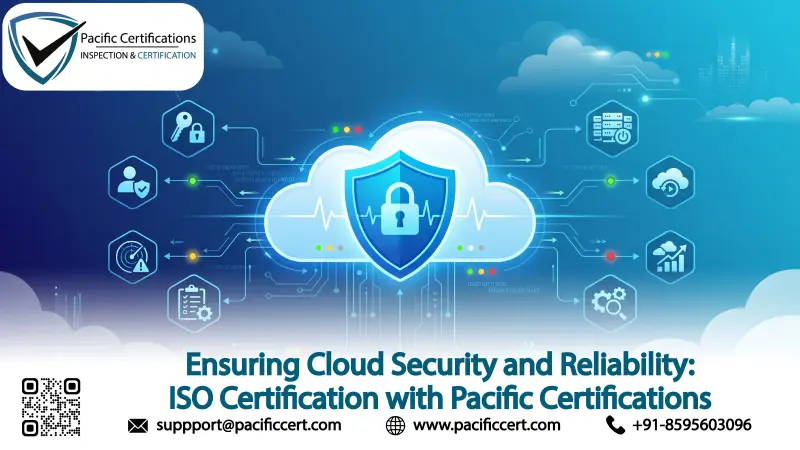
Cloud computing underpins critical business operations across finance, healthcare, manufacturing, and more, making security and reliability non‑negotiable priorities for service providers . As enterprises migrate to SaaS, IaaS, and PaaS environments, they demand verified proof that cloud vendors can protect data, uphold privacy, maintain service availability, and manage risks effectively. ISO cloud certification provides an internationally recognized, auditable framework to demonstrate these capabilities, helping providers build trust, meet contractual and regulatory requirements, and operate with confidence
Pacific Certifications, an ABIS‑accredited certification body, helps cloud providers navigate the certification journey so they can win trust, meet contractual requirements and operate with confidence .
Why Cloud Security & Reliability Are Essential Now?
Data breach risks – Misconfigured cloud storage, exposed APIs, or weak access controls can lead to massive data leaks .
Regulatory demands – Laws like GDPR, India’s impending Data Protection Bill, and sector‑specific rules (e.g., PCI DSS) require verifiable security and privacy controls .
Service‑level expectations – Enterprise clients expect uptime guarantees, rapid incident response, and transparent change management; failures trigger SLA penalties and reputational harm .
Supplier due diligence – Large organisations often mandate proof of mature information security, cloud‑specific controls, privacy safeguards, and business continuity before signing contracts .
Key ISO Standards for Cloud Computing
Benefits of ISO Certification for Cloud Service Providers
Stronger customer trust during onboarding – Enterprise procurement teams view ISO certificates as evidence of mature security and service‑management practices, shortening sales cycles .
Better protection of cloud data – Systematic risk assessments and controls under ISO 27001 reduce the likelihood of breaches, key leakage or unauthorized access .
Clearer cloud‑control proof – ISO 27017 certification demonstrates that provider‑specific controls (e.g., configuration baselines, segregation techniques) are implemented and effective .
Enhanced privacy credibility – ISO 27018 shows compliance with international privacy principles, a decisive factor when handling EU or Indian personal data .
More predictable service operations – ISO 20000‑1 standardises incident and change management, leading to faster resolution times and fewer repeat incidents .
Improved readiness for outages – ISO 22301 forces regular testing of backup, fail‑over and communication plans, cutting downtime during real incidents .
Stronger vendor and supplier oversight – The standards require evaluation of subcontractors and upstream cloud dependencies, reducing supply‑chain risk .
Competitive advantage in tenders – Many government and B2B RFPs explicitly list ISO 27001, 27017, 27018 or 20000‑1 as mandatory or weighted criteria .
Together, these benefits translate into higher win‑rates, lower insurance premiums and a reputation for reliability that attracts enterprise clients .
Pacific Certifications’ Role: Audit and Certification
Pacific Certifications delivers audit and certification services exclusively. Their work includes:
Stage 1 audit – Review of documented policies, procedures, and controls for conformity to ISO requirements.
Stage 2 audit – On‑site or remote assessment to verify that documented practices are implemented and effective in operations (e.g., checking access‑review logs, change‑approval records, backup verification, privacy impact assessments).
Certification issuance – Granting of ISO certificates (typically valid for three years) upon successful closure of all audit findings.
Surveillance audits – Annual checks to confirm ongoing conformity.
Recertification audits – Full reassessment every three years to renew certification.
Pacific Certifications does not:
Conduct gap analysis or system design.
Develop documentation, policies, or procedures.
Provide implementation support, training, or consulting for the standards it certifies.
Offer advice on how to achieve compliance beyond audit feedback.
How to Proceed: Correct Path to Certification
Organizations seeking ISO certification for cloud services should:
Engage independent consultants – For gap analysis, system design, documentation development, implementation support, and training, hire specialist consulting firms separate from the certification body.
Implement and operationalize – Build and run the management system (ISMS, cloud controls, privacy framework, ITSM, continuity plans) using consultant support or internal resources.
Approach an accredited certification body – Once the system is fully implemented and evidence of conformity exists, engage Pacific Certifications (or another ABIS‑accredited body) for the formal Stage 1 and Stage 2 audits.
Maintain the system – After certification, continue internal audits, management reviews, and continual improvement; Pacific Certifications will conduct periodic surveillance audits to verify ongoing conformity.
Conclusion
Cloud security and reliability are foundational to winning enterprise trust, meeting regulatory obligations, and ensuring service continuity. ISO standards, particularly ISO/IEC 27001, 27017, 27018, 20000‑1, and 22301, provide a clear, auditable framework for managing information security, cloud‑specific controls, privacy, service management, and business continuity. By pursuing these certifications through the proper channels, cloud providers demonstrate mature, risk‑based controls, reduce the likelihood of breaches or outages, and gain a competitive edge in tenders and contracts.
Contact us
Pacific Certifications stands ready to conduct impartial audits and issue accredited certificates for organizations that have independently implemented their cloud security and reliability management systems. For implementation support, engage specialist consultants; for the final audit and certification, contact Pacific Certifications.
Email: suppport@pacificcert.com
Call/WhatsApp: +91‑8595603096
Author: Alina
Read More at: Blogs by Pacific Certifications