# ISO 9001, ISO 14001 and ISO 45001: Key Differences Explained
Author: Pacific Certifications
Author URL: https://blog.pacificcert.com/author/pacific-certifications/
Published: 2025-10-14
Meta Title: ISO 9001 vs 14001 vs 45001 | Key 2026 Differences & Updates
Meta Description: Master the differences between ISO 9001:2026, 14001:2026, and 45001. Expert guide to 2026 revisions, Climate Action Amendments, and integrated management.
Tags: ISO 9001:2015, ISO 9001, ISO 14001, ISO 45001, ISO 14001:2015, ISO 45001:2018
Tag URLs: ISO 9001:2015 (https://blog.pacificcert.com/tag/iso-90012015-2/), ISO 9001, ISO 14001, ISO 45001 (https://blog.pacificcert.com/tag/iso-9001-iso-14001-iso-45001/), ISO 14001:2015 (https://blog.pacificcert.com/tag/iso-140012015/), ISO 45001:2018 (https://blog.pacificcert.com/tag/iso-450012018/)
URL: https://blog.pacificcert.com/iso-9001-14001-45001-key-differences-explained/
## Introduction
In today’s global business landscape, organizations are **expected** to not only deliver quality products and services but also operate responsibly and ensure employee safety. Three of the most recognized ISO standards- [ISO 9001](https://pacificcert.com/iso-9001-2015-quality-management-system-certification/) (Quality Management), [ISO 14001](https://pacificcert.com/iso-14001-2015-environmental-management-systems/) (Environmental Management) and [ISO 45001](https://pacificcert.com/iso-45001-2018-health-safety/) (Occupational Health & Safety Management), together form the foundation of modern integrated management systems.
These standards share a **unified** structure under Annex SL, enabling seamless integration within a single organizational framework. When applied collectively, they help businesses improve quality consistency, reduce environmental impact and minimize workplace risks, driving operational efficiency and sustainability.
Apply for ISO Certification
## **Quick summary**
[ISO 9001](https://pacificcert.com/iso-9001-2015-quality-management-system-certification/), [ISO 14001](https://pacificcert.com/iso-14001-2015-environmental-management-systems/) and [ISO 45001](https://pacificcert.com/iso-45001-2018-health-safety/) work together to strengthen an organization’s overall management framework. ISO 9001 focuses on quality and customer satisfaction, ISO 14001 addresses environmental performance and sustainability, while ISO 45001 ensures occupational health and safety. Combined, they deliver a balanced approach to excellence - protecting customers, employees and the planet simultaneously _._
[Explore which of ISO 9001, 14001 or 45001 should come first for you](https://pacificcert.com/contact-us/): Reflect on whether quality, environmental impact, or worker safety is currently your most pressing priority.
Contact us at [support@pacificcert.com](mailto:support@pacificcert.com) to get started with your certification process.
## **Why integrating ISO 9001, ISO 14001 and ISO 45001 matters?**
Organizations no longer operate in **isolation** from social and environmental expectations. Customers demand consistent quality, regulators require environmental responsibility and employees expect safe workplaces. Implementing these three standards allows institutions to address all these expectations under one system.
**Integrated** certification streamlines internal audits, document control and risk assessments. It also enhances brand credibility and reduces the administrative burden of maintaining multiple stand-alone systems. The result is a lean, transparent and accountable organization that balances profitability with sustainability and safety.
> _When ISO 9001, ISO 14001 and ISO 45001 work together, organizations move from isolated compliance to integrated performance, achieving operational excellence, sustainability and workforce safety within a single management culture._
## **ISO 9001 vs ISO 14001 vs ISO 45001- key comparison**
**Aspect**
**ISO 9001**
**ISO 14001**
**ISO 45001**
Focus
Quality management and customer satisfaction
Environmental management and sustainability
Occupational health & safety management
Objective
Deliver consistent quality and continual improvement
Reduce environmental impact and meet compliance
Prevent work-related injuries and illnesses
Core principle
Process approach and customer focus
Life-cycle perspective and pollution prevention
Risk elimination and worker participation
Risk approach
Process-based risk management
Environmental aspect and impact evaluation
Hazard identification and risk control
Legal emphasis
Product, service and customer requirements
Environmental laws, emissions and waste management
Health and safety regulations
Key processes
Nonconformity control, corrective actions, customer feedback
Environmental policy, compliance evaluation, emergency response
Hazard control, emergency preparedness, incident investigation
Primary metrics
Defect rate, customer satisfaction, audit closure time
Waste reduction, energy use, emission control, compliance status
Lost time injury frequency rate (LTIFR), near-miss ratio, training completion
Common structure
PDCA model with continuous improvement
PDCA model aligned with sustainability goals
PDCA model focusing on safety and prevention
## **What are the requirements for ISO 9001, ISO 14001 and ISO 45001?**
Implementing these standards together requires structured planning and clear documentation. The goal is to build one integrated management system that addresses quality, environmental and occupational safety aspects simultaneously. Below are the key requirements:
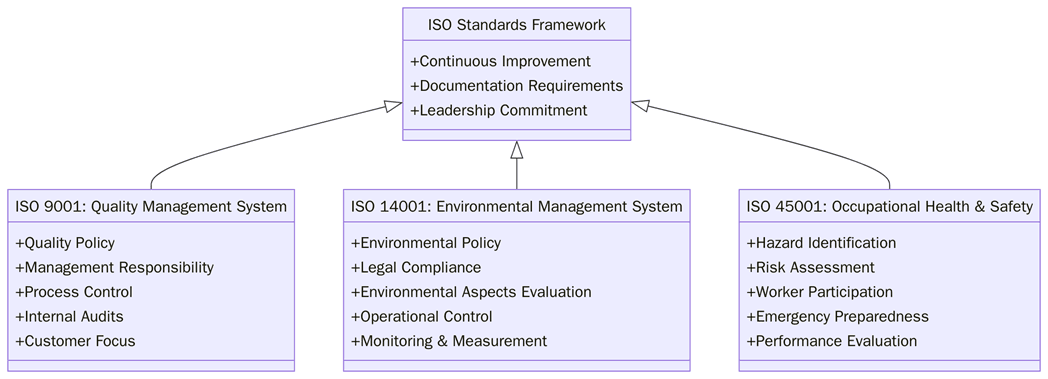
01. **Define** the scope and context of the organization, including internal and external factors affecting quality, environment and safety.
02. **Establish** leadership commitment, top management must define policies, assign roles and provide resources for each area.
03. **Identify** risks and opportunities related to customer satisfaction, environmental impact and worker health.
04. **Develop** integrated policies and objectives for quality, environment and safety.
05. **Maintain** documented procedures for control of processes, emissions, waste handling and emergency response.
06. **Conduct** training and competence programs to ensure employee awareness of quality and safety responsibilities.
07. **Carry** out internal audits and management reviews covering all three standards to track performance and ensure continual improvement.
08. **Engage** in communication and consultation with stakeholders, including employees, suppliers and local authorities.
09. **Implement** corrective and preventive actions for nonconformities identified during internal or external audits.
10. **Prepare** for Stage 1 and Stage 2 certification audits under an accredited body like Pacific Certifications.
**Tip:** _Build one risk register that includes process risks (ISO 9001), environmental aspects (ISO 14001) and safety hazards (ISO 45001). This integrated approach minimizes duplication and ensures a unified review process._
For more information, contact us at [support@pacificcert.com.](mailto:support@pacificcert.com)
## **How to prepare for certification?**
Integrating these systems requires coordination between departments and leadership support. Start by analyzing current processes and identifying overlaps.
1. **Perform** a gap analysis against each standard’s requirements.
2. **Align** policies and procedures to ensure consistency across all management areas.
3. **Conduct** employee workshops on integrated risk management.
4. **Develop** shared documentation — one manual, one audit program and one management review.
5. **Verify** legal compliance for environmental and safety obligations.
6. **Review** key performance indicators (KPIs) for quality, environment and safety together.
7. **Schedule** internal audits that assess all three systems in one cycle before external certification.
## **Certification audit**
**Stage 1 audit:** Review of documentation, scope and readiness for integrated management systems.
**Stage 2 audit:** On-site assessment of implementation and effectiveness across quality, environmental and safety processes.
**Nonconformities:** Identified issues must be corrected with evidence before certification approval.
**Management review:** Confirms leadership involvement and alignment with strategic direction.
**Final certification:** Granted after successful closure of findings.
**Surveillance audits:** Conducted annually to ensure sustained compliance.
**Recertification audits:** Required every three years.
Start your certification process
## **What are the benefits of integrated certification?**
Organizations that combine ISO 9001, ISO 14001 and ISO 45001 gain measurable advantages that extend beyond compliance. Below are the key benefits:
- **Unified** management system that reduces duplication and administrative effort.
- **Stronger** organizational consistency across departments and processes.
- **Improved** compliance with quality, environmental and safety regulations.
- **Cost** savings from shared audits, documentation and training resources.
- **Enhanced** brand reputation through demonstrated commitment to quality, sustainability and safety.
- **Reduced** incidents, waste and rework through standardized risk controls.
- **Measurable** KPIs such as reduced defect rates, lower emissions and improved LTIFR.
- **Improved** employee morale and engagement through clear safety and quality objectives.
- **Easier** integration with ESG reporting and sustainability frameworks.
- **Long**-term business resilience through data-driven performance evaluation.
Integrated systems also improve communication and accountability between departments, leading to faster decision-making and stronger customer trust.
## Market Trends
In recent years, industries are adopting integrated management systems to meet growing ESG expectations and supply chain transparency requirements. More organizations are linking **ISO 9001**, **ISO 14001** and **ISO 45001** with **ISO 27001** (information security) and **ISO 22301**(business continuity) to create enterprise-wide governance models. Digital audit platforms, KPI dashboards and AI-based risk analytics are also gaining traction to monitor performance in real time.
By **2030**, the convergence of management systems will become standard practice. Organizations will rely on data-driven compliance monitoring and real-time reporting to maintain certification. Sustainability metrics and workforce well-being indicators will be integrated into **annual audit programs**. Certification to ISO 9001, ISO 14001 and ISO 45001 will become a baseline requirement for global supply chain participation, reinforcing trust, traceability and responsible operations.
## **Training and courses**
Pacific Certifications provides accredited training programs for ISO 9001, ISO 14001 and ISO 45001 to help organizations build the knowledge needed to implement, audit and maintain integrated systems:
- [**Lead Auditor Training**](https://pacificcert.com/lead-auditor-training/) **:** Designed for professionals auditing quality, environmental and safety management systems together. The course covers audit planning, risk-based assessment, performance measurement and reporting across all three standards.
- [**Lead Implementer Training**](https://pacificcert.com/lead-implementer/): For managers and coordinators developing or improving integrated management systems. The course focuses on documentation, risk management and alignment of objectives between quality, environmental and safety requirements.
Contact [support@pacificcert.com](mailto:support@pacificcert.com) to schedule ISO 9001, ISO 14001 and ISO 45001 training sessions and strengthen your organization’s integrated management capabilities.
Book your training
## **How Pacific Certifications can help?**
Pacific Certifications provides accredited certification services for ISO 9001, ISO 14001 and ISO 45001. Our audits help organizations build robust integrated systems that ensure quality, sustainability and safety. As an accredited certification body, we focus purely on impartial assessment and certification, not consultancy.
### Contact Us
Request your ISO audit plan and fee estimate. We will help you map Stage-1/Stage-2 timelines and evidence requirements for your organization. Contact us at [support@pacificcert.com](mailto:support@pacificcert.com) or visit [www.pacificcert.com](https://pacificcert.com/).
Read more: [Pacific Blogs](https://blog.pacificcert.com/)
ISO 9001, ISO 14001 and ISO 45001: Key Differences Explained
## FAQs
Q: Can ISO 9001, ISO 14001 and ISO 45001 be implemented together?
A: Yes, all three share a common Annex SL structure and integrate easily within one management system.
Q: How long does integrated certification take?
A: Typically 9–12 months depending on the organization’s size, complexity and readiness.
Q: What are common KPIs in integrated systems?
A: Defect rate, energy consumption, emission levels, waste reduction, audit closure time and LTIFR.
Q: Is integrated certification cost-effective?
A: Yes, it reduces audit duplication and administrative overhead, lowering overall certification costs.
Q: Who benefits most from integration?
A:
Manufacturing, construction, logistics, energy and engineering companies with overlapping quality, safety and environmental risks.
Q: Can one policy cover all three standards?
A:
Yes, organizations often create an integrated Quality-Environment-Safety (QES) policy aligned with strategic objectives.
Q: How often are audits required?
A: Annual surveillance audits with full recertification every three years.
Q: What documentation is necessary?
A:
Policies, risk registers, legal compliance records, training logs, emergency plans and management review outputs.
Q: What are the advantages of integrated audits?
A:
They save time, reduce disruption and provide a more holistic performance assessment.
Q: Does integration affect regulatory compliance?
A:
No. It strengthens compliance by ensuring that quality, safety and environmental requirements are addressed together.
---
This blog is powered by Superblog. Visit https://superblog.ai to know more.
---