ISO 56001 Innovation Management: Why Companies Are Adopting It?
Introduction
By 2026, many organizations will find that product launches, process improvements and digital changes are not enough unless they are backed by a steady innovation system. Markets shift faster, technologies age quickly and customers expect new value in shorter cycles. Teams often run pilots and ideas, but without structure, these efforts stay scattered and hard to repeat.
ISO 56001 is designed as a management system standard for innovation. It follows a similar logic to ISO 9001, but focuses on how organizations create, select, develop and scale ideas in a controlled way. It supports leadership-led innovation, clear roles, risk-aware experimentation and measurable outcomes rather than one-off projects.
If your organization wants to build a repeatable innovation system, or align existing initiatives with a clear, auditable framework, you can request an ISO 56001 audit plan from Pacific Certifications to discuss scope, timelines and evidence requirements.
Quick summary
ISO 56001 provides a structured framework for managing innovation across strategy, processes, culture and partnerships. It helps organizations link innovation goals with day-to-day activities, manage innovation risks and keep track of ideas from concept to implementation. Companies adopt ISO 56001 to move from random innovation to a repeatable system that supports growth, differentiation and long-term relevance.
Why ISO 56001 matters for companies?
Many businesses already run innovation projects, but results often depend on a few motivated individuals rather than a system. Ideas may not match strategy. Promising concepts get stuck and lessons from pilots are rarely captured. At the same time, boards and investors want clearer evidence that innovation spending turns into usable outcomes, not just prototypes and slide decks.
ISO 56001 matters because it treats innovation as a managed capability, not just creative activity. For companies dealing with digital change, new business models, sustainability demands, or fast customer shifts, ISO 56001 offers a way to align innovation with everyday operations instead of leaving it on the side.
What are the requirements for ISO 56001?
Before implementing ISO 56001, companies should understand that innovation management touches strategy, culture, processes and external partners. A basic level of discipline is needed across idea generation, evaluation, development, piloting and scaling. Below are some of the key requirements:
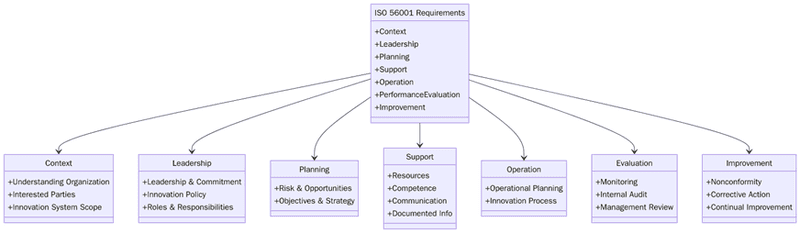
- Define the scope of the innovation management system, including business units, locations and types of innovation (products, services, processes, business models).
- Establish an innovation policy and measurable objectives that link to overall business direction.
- Analyse internal and external context, including market drivers, technology trends, customer needs and competitor activity.
- Identify interested parties relevant to innovation, such as customers, employees, partners, investors and regulators.
- Run internal audits and management reviews focused on innovation performance, risks and improvement actions.
How to prepare for ISO 56001 implementation?
Preparing for ISO 56001 is less about creating new slogans and more about joining up existing innovation efforts. Many organizations already have suggestion schemes, pilots, or labs, but they are not coordinated. The goal is to turn these efforts into one system with clear rules and shared learning. Below are some of the key preparation steps:
- Map current innovation activities, including idea sources, project types, decision forums and budgets.
- Identify gaps, such as missing criteria for selecting ideas, weak stage-gate control, or poor tracking of outcomes.
- Define the scope of your innovation management system for the next three years, focusing on areas where change is most needed.
- Confirm leadership sponsors and set up an innovation steering group with clear decision rights.
- Run internal reviews on a sample of recent projects to test whether your process and records are audit ready.
Certification audit
Stage 1 audit: Review of IMS scope, innovation policy and objectives, context analysis, stakeholder identification, documented innovation processes and readiness for Stage 2.
Stage 2 audit: Verification of implementation across selected innovation projects and business areas, including evidence of idea capture, evaluation, development, piloting, risk handling, learning and portfolio decisions.
Nonconformities: Must be corrected with clear root cause analysis, updated processes or controls, improved records and evidence that changes are in use.
Management review: Confirms leadership oversight of innovation performance, pipeline health, resource needs, risk areas and improvement plans.
Recertification audits: Required every three years to review the full IMS, new strategic directions, added business lines and long-term innovation results.
What are the benefits of ISO 56001?
ISO 56001 helps organizations move from scattered innovation efforts to a consistent approach. It supports better decisions about which ideas to back, how much risk to take and how to scale projects that work. Below are some of the key benefits:
- Clear innovation direction from leadership, linked to business goals and priorities.
- More reliable idea selection, based on agreed criteria instead of informal preference.
- Better use of resources, as projects are prioritised and weak initiatives are stopped earlier.
- Stronger connection between innovation teams and core operations, reducing handover problems.
- Improved learning from pilots and experiments, with lessons captured and shared.
- Easier tracking of innovation performance through defined indicators and reports.
- Better alignment between innovation, risk and compliance teams, especially in regulated sectors.
Market Trends
Innovation is shifting from isolated labs and special projects to everyday practice across departments. Companies are using cross-functional squads, digital tools and external partnerships to speed up development and testing. At the same time, pressure is rising to link innovation with sustainability, data use and responsible AI. Investors and major customers want to see how innovation supports long-term value, not only short-term launches.
Standards like ISO 56001 support this shift by giving leadership and auditors a common view of how innovation is governed, funded and reviewed. In the coming years, many organizations will blend innovation management with quality, information security and sustainability systems, so that new ideas are assessed for value, risk and impact in a single process.
Training and courses
Pacific Certifications provides accredited training programs. If your organization is looking for ISO 56001 innovation management training, our team is equipped to help you. Contact us at [email protected].
Lead Auditor Training: supports professionals who need to assess innovation management systems, including governance, processes and evidence.
Lead Implementer Training: supports teams that are designing or upgrading an innovation management system aligned with ISO 56001.
How Pacific Certifications can help?
Pacific Certifications provides accredited audit and certification services for management system standards, including innovation management frameworks aligned with ISO 56001. We assess scope, innovation policy, governance structures, processes, project evidence, internal audits and management reviews. We issue Certificates of Conformity following impartial audits and we do not provide consultancy or system design services.
To request an ISO 56001 audit plan, or discuss innovation management certification scope for your organization, contact [email protected] or visit www.pacificcert.com.
Ready to get ISO 56001 certified?
Contact Pacific Certifications to begin your certification journey today!
Author: Alina Ansari
Suggested Certifications –
Read more: Pacific Blogs