# ISO 50001 and Energy Efficiency – Still Worth It Today?
Author: Pacific Certifications
Author URL: https://blog.pacificcert.com/author/pacific-certifications/
Published: 2025-10-30
Meta Title: Is ISO 50001 Still Worth It in 2026? | ROI & Energy Efficiency
Meta Description: Explore the 2026 value of ISO 50001. Master energy performance, carbon tax savings, 2025 Climate Amendments, and the ROI of an EnMS for modern industry.
Tags: ISO 50001, ISO 50001 Certification, Energy Efficiency ISO, ISO 5001 for Energy Efficiency
Tag URLs: ISO 50001 (https://blog.pacificcert.com/tag/iso-50001/), ISO 50001 Certification (https://blog.pacificcert.com/tag/iso-50001-certification/), Energy Efficiency ISO (https://blog.pacificcert.com/tag/energy-efficiency-iso/), ISO 5001 for Energy Efficiency (https://blog.pacificcert.com/tag/iso-5001-for-energy-efficiency/)
URL: https://blog.pacificcert.com/iso-50001-and-energy-efficiency-still-worth-it-today/

## Introduction
Energy has now become one of the boardroom issue as electric prices are rising, carbon regulations are tightening and customers across the globe are waiting to hear back from suppliers regarding their sustainability efforts with the use of energy. Since its publication, **ISO 50001** has provided organizations with a systematic approach to have an objective way of measuring and improving energy performance across sites and fleets. ISO 50001 promises organizations with reduced energy consumption, reduced costs, and reduced emissions using a standardized management system. Now, **one decade later**, it is a fair question to ask: does ISO 50001 still have merit? For organizations where ISO 50001 lives as a system that links utility and metered data streams, offers defined responsibilities, and operates a commitment to continual improvement on energy performance, the answer is yes. The payback period is no longer just about energy bills; it is about **accessing markets**, completing the **ESG** template style reporting, or accomplishing net zero program requirements.
## **Quick summary**
[ISO 50001](https://pacificcert.com/iso-50001-energy-management/) is an energy management system standard that embeds policy, metering, analysis, controls and review into one loop so institutions can improve energy performance over time. It aligns people, data and operations to reduce energy intensity and emissions while protecting reliability. When linked with real KPIs and site accountability, the standard continues to meet its original promise, lower cost per unit of output, more predictable consumption and better decision making for upgrades and procurement _._
[**Review your current approach to managing energy performance**](https://pacificcert.com/contact-us/): Reflect on how you measure use, set targets, and follow up on improvement opportunities today.
## **Why ISO 50001 still matters?**
Energy risk touches finance, operations and reputation. ISO 50001 turns siloed initiatives into a **single system**—one policy, one set of objectives, one dashboard. It makes energy performance measurable at the line, building and portfolio levels and ties the results to management review and funding cycles. That discipline improves confidence for investors and buyers who now ask for credible energy and carbon data in tenders and supplier scorecards.
> “ _ISO 50001 shifts energy from ad-hoc projects to a managed process where metering, maintenance and money work in one direction, lower consumption per unit of value.”_
## **What ISO 50001 means**
**Area**
**What it means**
**Useful evidence**
**Sample KPIs and SLAs**
Scope and boundaries
Which sites, meters, processes are included
Site list, one-line diagrams, meter registry
Coverage ratio of metered loads, data completeness SLA
Energy review
How energy is used and where losses occur
Utility bills, submeter trends, load profiles
kWh per unit, baseline variance, peak demand events
Objectives and targets
What the institution aims to improve
Objective register, capex plan
Energy intensity reduction, payback windows, project closeout time
Operational control
Keeping performance steady day to day
SOPs, setpoint logs, maintenance records
Setpoint drift rate, alarm response time SLA
Monitoring and analysis
Turning data into action
Dashboards, M&V plans, exception alerts
Data latency, audit closure days, measure persistence rate
Competence and awareness
People know roles and skills needed
Training matrix, toolbox talks
Training completion, operator response accuracy
Improvement and review
Closing gaps and funding the next steps
CAPA logs, management review minutes
Nonconformity closure time, savings verified vs planned
## **What are the requirements for ISO 50001 certification?**
A strong introduction helps align teams before you move to tasks. ISO 50001 requires a defined scope, a data-driven energy review and controls that hold gains in daily operation. Leadership must set policy and objectives, fund metering and projects and review results on a set cadence. Records, roles and methods bring consistency across shifts and sites. Below are the key requirements:
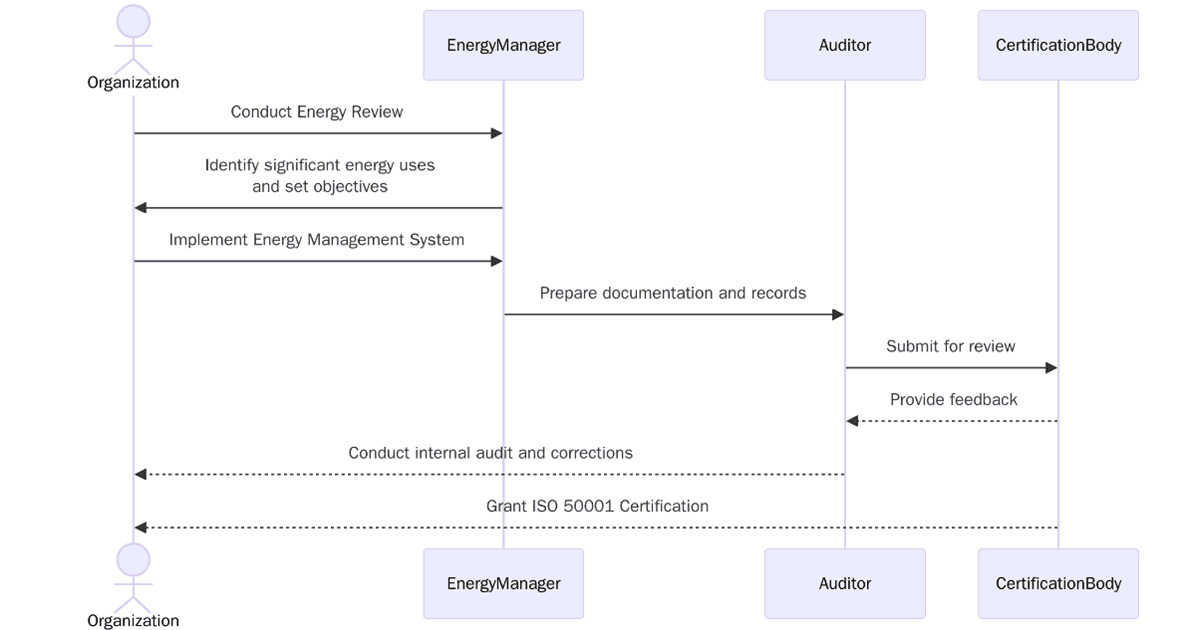
01. **Establish** scope and organizational boundaries for the energy management system.
02. **Create** an energy policy and measurable objectives linked to business goals.
03. **Perform** an energy review with baselines, significant energy uses and opportunity ranking.
04. **Build** an energy data plan covering meters, frequency and quality controls.
05. **Define** operational controls for setpoints, schedules and maintenance that affect energy.
06. **Assign** roles, competence needs and training for operators, engineers and buyers.
07. **Plan** projects with M&V methods, funding paths and persistence checks.
08. **Monitor**, analyse and report KPIs with thresholds and alert logic.
09. **Run** internal audits and management reviews on a fixed schedule.
10. **Address** nonconformities with root cause and time-bound corrective actions.
## **How to prepare for ISO 50001 certification?**
Preparation blends diagnostics and quick wins. Start with metering coverage and a clean baseline, then align projects with a simple payback or IRR screen so savings are bankable and verified. Below are practical steps:
1. **Complete** a gap analysis against ISO 50001 and map current energy workflows.
2. **Confirm** meter hierarchy and data accuracy for the biggest loads first.
3. **Build** a ranked opportunity list with savings, cost and risk notes.
4. **Standardize** setpoints, schedules and shutdown procedures for major assets.
5. **Train** operators on exceptions and escalation rules tied to KPIs.
6. **Pilot** M&V on two or three measures to prove the pipeline approach.
7. **Hold** a management review to lock objectives, budgets and timelines.
## **Certification audit**
**Stage 1 audit**: Review scope, policy, energy review, baselines and documented methods.
**Stage 2 audit**: Verify implementation on the floor—controls, logs, dashboards and operator awareness.
**Nonconformities**: Correct with evidence of fix and persistence checks before approval.
**Management review**: Confirm objectives, resources and decision records support the system.
**Final certification**: Issued after successful closure of findings.
**Surveillance audits**: Annual checks confirm data quality and improvement activity.
**Recertification audits**: Every three years to confirm long-term performance.
## **What are the benefits of ISO 50001 certification?**
Energy programs fail without persistence. ISO 50001 keeps savings alive by combining metering, controls and roles inside one loop. The gains reach beyond bills to reliability and market credibility. Below are the key benefits:
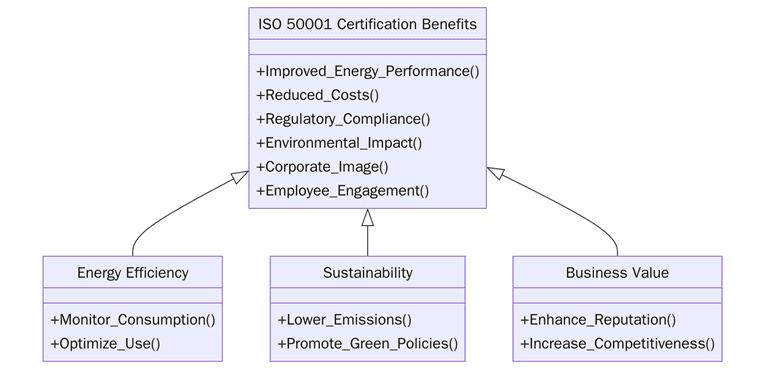
- **Lower** energy intensity and more predictable utility spend across seasons.
- **Verified** savings using agreed M&V methods that finance can trust.
- **Faster** project approval because objectives, baselines and KPIs are already defined.
- **Better** uptime through maintenance tied to energy exceptions and equipment health.
- **Stronger** procurement leverage via performance specs and whole-life cost criteria.
- **Clear** governance with audit trails, review minutes and closure evidence.
- **Easier** ESG reporting with traceable data and site-level KPIs.
- **Integration** with ISO 9001, ISO 14001 and ISO 45001 under the same Annex SL structure.
- **KPIs** that matter: kWh per unit, cost per unit, MTCO reduced, demand charge events avoided, audit closure days and measure persistence rate.
- **SLAs** that hold the line: data availability, alarm response time and corrective action closeout.
## Market Trends
Institutions are pairing **ISO 50001** with submetering, building analytics and AI anomaly detection so exceptions trigger work orders within hours, not months. Power purchase choices now consider **flexibility**, not only price—on-site storage and demand response reduce peak events that inflate bills. Many buyers ask suppliers for energy intensity and reduction targets tied to contracts, so certified systems support sales and retention.
By **2030**, expect deeper integration with carbon accounting and grid flexibility. ISO 50001-driven programs will link asset controls to market signals so loads shift without hurting output. Funding will keep moving to portfolio models—small measures bundled under shared **M&V**. Institutions that lock the basics now, metering, reviews, operator playbook, will pivot faster as tariffs, carbon prices and buyer rules tighten.
## **Training and courses**
Pacific Certifications provides accredited training programs for ISO 50001 to build practical skills from the plant room to the boardroom:
[**Lead Auditor Training**](https://pacificcert.com/lead-auditor-training/) **:** Audit planning, energy review evidence, data quality checks, nonconformity grading and reporting aligned with ISO 19011.
[**Lead Implementer Training**](https://pacificcert.com/lead-implementer/): Scoping, meter hierarchy design, baseline creation, opportunity ranking, M&V methods and persistence controls for long-term savings.
Contact [**support@pacificcert.com**](mailto:support@pacificcert.com) to schedule ISO 50001 training or awareness sessions for your teams.
## **How Pacific Certifications can help?**
Pacific Certifications provides ISO 50001 certification and audit services for single sites and multi-site portfolios. Our independent assessments review policy, energy review, data plans, controls and improvement records. We issue Certificates of Conformity after impartial audits, no consultancy, so your results carry weight with customers and investors.
### Contact Us
Request your ISO 50001 audit plan and site timeline. Write to [**support@pacificcert.com**](mailto:support@pacificcert.com) or visit [**www.pacificcert.com**](https://pacificcert.com/).
Read more: [Pacific Blogs](https://blog.pacificcert.com/)
Energy Management & Climate Action
## FAQs
Q: Is ISO 50001 only for large energy users?
A:
No. The standard scales well for SMEs by focusing on significant energy uses and right-sized metering.
Q: Do we need new meters to start?
A:
Begin with what you have. Add submeters where the biggest uncertainties block decisions.
Q: How soon do savings appear?
A:
Operational fixes and setpoint control often show results in the first quarter. Capital projects follow your funding cycle.
Q: Can ISO 50001 integrate with carbon targets?
A: Yes. The same data streams support emissions tracking and reduction claims.
Q: What KPIs should we track first?
A:
Energy intensity, baseline variance, demand peaks and corrective action closure time.
Q: How does it help maintenance?
A:
Exception alerts point to failing components, so maintenance becomes condition-based rather than calendar-only.
Q: What documents do auditors look for?
A:
Scope, policy, energy review, baselines, data plan, controls, M&V, audits and management review records.
Q: Can we certify a single building first?
A:
Yes. Many portfolios certify a flagship site, refine the model, then scale.
Q: Does it replace engineering studies?
A:
No. It organizes them and ensures measures are verified and kept in tune.
Q: What still causes failures in ISO 50001 programs?
A:
Thin metering, drifting setpoints and management reviews without decisions. Fix those and the promise holds.
---
This blog is powered by Superblog. Visit https://superblog.ai to know more.
---