# ISO 45001: Ensuring Health & Safety Compliance at the Workplace
Author: Pacific Certifications
Author URL: https://blog.pacificcert.com/author/pacific-certifications/
Published: 2026-03-03
Meta Title: ISO 45001:2026 Health & Safety | Psychosocial & Climate Action
Meta Description: Master ISO 45001 compliance in 2026. Expert guide to 2025 Climate Amendments, psychosocial risk management (ISO 45003), and AI safety monitoring.
Tags: Health and safety ISO, ISO 45001 implementation, Health and safety, ISO 45001 for Health & safety, Workplace safety ISO 45001
Tag URLs: Health and safety ISO (https://blog.pacificcert.com/tag/health-and-safety-iso/), ISO 45001 implementation (https://blog.pacificcert.com/tag/iso-45001-implementation/), Health and safety (https://blog.pacificcert.com/tag/health-and-safety/), ISO 45001 for Health & safety (https://blog.pacificcert.com/tag/iso-45001-for-health-and-safety/), Workplace safety ISO 45001 (https://blog.pacificcert.com/tag/workplace-safety-iso-45001/)
URL: https://blog.pacificcert.com/iso-45001-workplace-health-and-safety/

## **Introduction**
Workplace health and safety is as much a **legal duty** as it is a moral obligation, and is important for each organization. Preventing accidents or other injuries, reducing hazards and protecting the health and well-being of employees is so important because it can influence productivity, impact brand reputation and contribute to long-term viability. ISO 45001 provides an organization with a **structured** framework to establish an Occupational Health & Safety Management System (OHSMS) that will identify risk and create safer places of work.
ISO 45001 is the global standard for Occupational Health & Safety Management Systems. It provides organizations with a framework to identify hazards in the workplace, evaluate risks and put in place preventative and corrective actions. **Workers**, customers and stakeholders are safer in organizations of any size and it reduces workplace accidents and work-related illnesses. ISO 45001 takes a systematic approach rather than an ad-hoc safety approach by embedding health and safety into daily operations. ISO 45001 focuses on absurd risk control, continual improvement and ensuring management is engaged, giving good control over what becomes the organizational culture.
Organizations certified to ISO 45001 will demonstrate their commitment to **protecting** their employees and contractors, their commitment to being compliant with both occupational health and safety legislation and regulation and their commitment to building a culture of responsibility.
To begin your ISO 45001 certification journey, contact us at [support@pacificcert.com](mailto:support@pacificcert.com).
## **Why ISO 45001 certification matters?**
Workplace accidents, injuries, or occupational illnesses can bring about large monetary costs, regulatory costs and penalties, and reputational costs. ISO 45001 indicates that an organization has identified **potential** risks to health and safety and has established suitable measures for controlling these risks.
ISO 45001 is not just about complying with the law, but gives increased employee confidence in their work environment, gives more chance to attract business partners, and often is a requirement of tender processes. Many clients and contractors prefer organizations that are able to show a **documented process** for certified occupational health and safety. Also, ISO 45001 can lower insurance costs and provide improved operational reliability through the reduction of operational cost due to accidents or unsafe practices.
## **What are the requirements of ISO 45001?**
Organizations seeking ISO 45001 certification must meet the following key requirements:

1. **Identify** any internal and external factors that may affect occupational health and safety and determine the scope of your OHSMS.
2. **Establish** a clearly defined health and safety policy that reflects top management commitment and support, including the allocation of sufficient resources.
3. **Conduct** hazard identification, risk assessment and put in place preventive measures.
4. **Define** roles, responsibilities and communication mechanisms to support the system.
5. **Train** employees, develop awareness and participation to create a positive safety culture.
6. **Manage** your operational controls, including emergency preparedness, incident management and workplace safety.
7. **Monitor**, measure and evaluate performance against your occupational health and safety objectives.
8. **Conduct** internal audits and management reviews to determine improvement opportunities.
9. **Manage** any nonconformities, implement corrective actions and manage continual improvement.
To begin your ISO 45001 certification journey, contact us at [support@pacificcert.com](mailto:support@pacificcert.com).
## **How to prepare for ISO 45001 certification?**
Preparing for ISO 45001 certification requires careful planning and alignment of current practices with the standard’s framework. Below are important preparation steps:
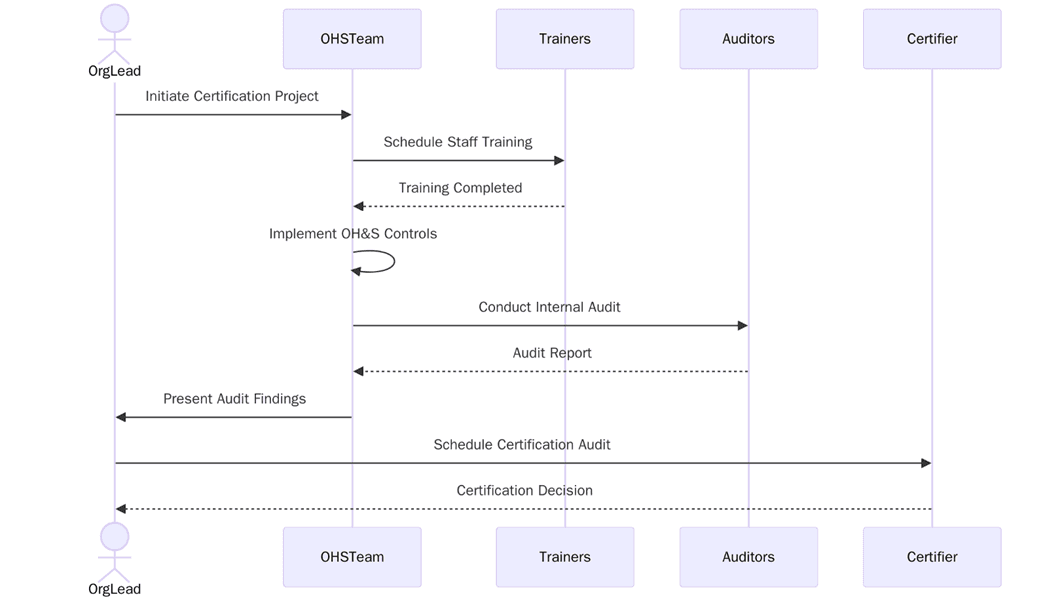
1. **Perform** a gap analysis of current health and safety practices against ISO 45001 requirements.
2. **Develop** an OHS policy to meet organizational objectives and compliance obligations.
3. **Engage** employees through awareness and training to promote safety in the workplace.
4. **Document** procedures, records of incidents, training activities and compliance checks.
5. **Implement** a process of risk management to manage hazards and reduce workplace risks.
6. **Carry** out internal audits to identify gaps and rectify issues prior to the external audit.
7. **Ensure** that top management reviews objectives, risk controls and resource need to provide accountability.
## **Certification audit**
ISO 45001 certification audits are carried out by accredited certification bodies and follow structured stages:
**Stage 1 Audit** – Reviewing documented OHSMS, its policies, risk assessments, emergency procedures, and training records.
**Stage 2 Audit** – On-site evaluation of implementation to ascertain whether policies and procedures are being applied in practice.
**Non-Conformities (NCRs)** – Identified gaps within the OHSMS requiring corrective actions to be addressed prior to certification approval.
**Continual Improvement** – Auditors are evaluating an organization’s ability to monitor incidents, re-evaluate targets and eliminate risks.
**Management Review** – Confirming leadership is providing required resources, directing policy to be enacted and reviewing the effectiveness of safety objectives.
**Final Certification Decision** – Certification is given when NCRs are resolved.
**Surveillance and Recertification Audits** – Non-Conformance audits are typically annual in their surveillance and usually, every three years for recertification to ensure compliance.
## **What are the ISO 45001 benefits?**
Before listing the benefits, it is important to recognize that ISO 45001 not only improves workplace safety but also builds trust among employees, customers, and regulators. Below are some of the key benefits:

- **Engaging** in proactive hazard identification and control reduces the number of incidents and accidents.
- **Helps** organizations be compliant with occupational health and safety regulations, reducing penalties and responsibilities.
- A **safer** workplace improves employee morale and productivity.
- **Lower** accident rates translate to lower compensation costs, insurance premiums and downtime.
- **Certification** demonstrates that organizations are good employers and support of such a commitment.
- **Many** clients prefer working with ISO 45001-certified organizations, positioning organizations to have an advantage in contracts and tenders.
- **Focus** on continual improvement supports the ongoing review and improvement of safety performance.
## **How can** Pacific Certifications help?
Pacific Certifications provides accredited ISO 45001 certification services. We audit organizations to ensure compliance with international occupational health and safety standards and help them achieve certification.
### Contact Us
If your organization is looking to implement or get certified in ISO 45001, reach out to us at [support@pacificcert.com](mailto:support@pacificcert.com) or visit [www.pacificcert.com](https://pacificcert.com/) to get started.
Read more: [Pacific Blogs](https://blog.pacificcert.com/)
ISO 45001: Ensuring Health & Safety Compliance at the Workplace
## FAQs
Q: Who needs ISO 45001 certification?
A: Any organization that wants to reduce workplace risks, comply with health and safety laws, and build a safe environment for employees can benefit from ISO 45001.
Q: How long does ISO 45001 certification take?
A: The timeframe usually ranges from 3 to 6 months depending on organizational size, complexity, and documentation readiness.
Q: Can small businesses implement ISO 45001?
A: Yes, ISO 45001 is scalable and can be applied to businesses of all sizes, including SMEs and startups.
Q: Is consultant support required for certification?
A: Consultants are optional. With adequate training, preparation, and internal audits, organizations can achieve certification independently.
Q: What role does employee participation play in ISO 45001?
A: Employee engagement is central, as staff help identify risks, suggest improvements, and maintain workplace safety practices.
Q: How often are surveillance audits conducted?
A: Surveillance audits are typically conducted once a year to verify ongoing compliance with ISO 45001.
Q: Does ISO 45001 integrate with other management systems?
A: Yes, it can integrate with ISO 9001 and ISO 14001, forming a unified management system for quality, environment, and safety.
Q: What is the difference between OHSAS 18001 and ISO 45001?
A: ISO 45001 replaced OHSAS 18001 and provides a more comprehensive framework aligned with the Annex SL structure used in other ISO standards.
Q: What happens if nonconformities are found during the audit?
A: Nonconformities must be corrected and verified before certification can be issued.
Q: What are the financial benefits of ISO 45001?
A: Cost savings are achieved through reduced accidents, lower insurance costs, improved productivity, and better employee retention.
---
This blog is powered by Superblog. Visit https://superblog.ai to know more.
---