Why Organizations Are Confusing the Two?
The EU AI Act is binding European Union legislation with legal obligations, enforcement timelines, financial penalties and mandatory conformity assessment requirements for specific categories of AI system. Confusing them is understandable but costly.
The confusion arises because both frameworks address AI governance, risk management, transparency and accountability, and because ISO/IEC 42001 certification is increasingly discussed as a route to EU AI Act compliance. That framing is partially correct and partially misleading. ISO/IEC 42001 certification does not automatically satisfy EU AI Act obligations.
The Act imposes specific, legally defined requirements on providers and deployers of high-risk AI systems that go beyond what ISO/IEC 42001 certification requires and that must be met regardless of whether an organization holds any ISO certification. Understanding where the two frameworks genuinely overlap, and where they diverge, is the starting point for building an AI governance program that satisfies both.
Takeaway: Map EU AI Act obligations first, then identify how ISO/IEC 42001 can support your organization’s specific compliance requirements.
What the EU AI Act Actually Requires?
High-risk AI systems are subject to mandatory conformity assessment, quality management systems, technical documentation, registration, transparency and human oversight requirements before market placement. Limited and minimal risk systems face lighter transparency obligations.
The EU AI Act's enforcement timeline is phased. Prohibited AI practices became enforceable in February 2025. General purpose AI model obligations applied from August 2025. High-risk AI system requirements under Annex III apply from August 2026. Understanding which category your AI systems fall into determines which obligations apply and when.
What ISO/IEC 42001 Actually Provides?
ISO/IEC 42001 is not a product certification standard. It certifies that an organization has implemented a structured management system for governing AI, not that any specific AI system meets defined technical requirements. This distinction matters enormously for EU AI Act compliance.
The Act requires conformity assessment of specific AI systems against specific technical requirements, including accuracy, robustness, cybersecurity, bias mitigation and data governance at the system level. ISO/IEC 42001 establishes the organizational governance framework within which those system-level requirements can be managed, but it does not substitute for the technical conformity assessment the Act requires for high-risk systems.
Writer's view: Use ISO/IEC 42001 as the governance layer supporting EU AI Act compliance, not as a substitute for specific legal requirements.
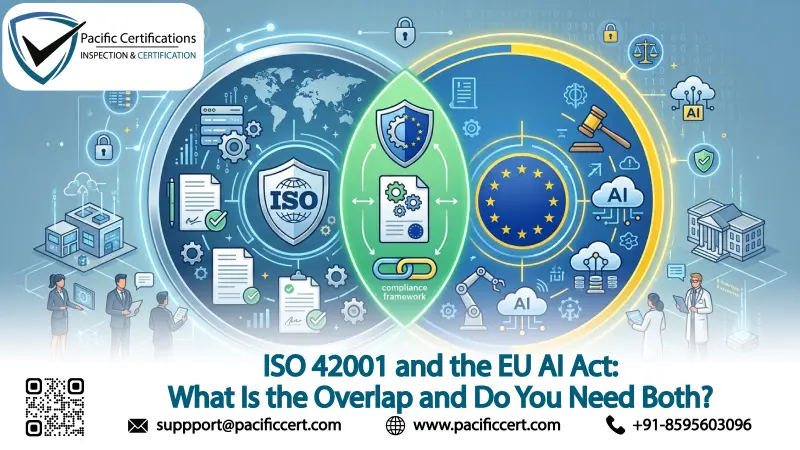
Where ISO/IEC 42001 and the EU AI Act Genuinely Overlap?
ISO/IEC 42001 addresses all of these areas and is structurally compatible with Article 17's requirements.
Who Legally Needs the EU AI Act vs Who Benefits from ISO/IEC 42001?
ISO/IEC 42001 is a voluntary standard that any organization globally can implement regardless of whether EU AI Act obligations apply to them.
Organizations that are not subject to EU AI Act high-risk obligations but that benefit from ISO/IEC 42001 certification include technology companies developing AI tools for global markets who want internationally recognized evidence of responsible AI governance, organizations whose customers or institutional partners require AI governance certification as a supply chain requirement, organizations preparing for future AI regulation in their own jurisdiction as regulatory frameworks proliferate globally, and organizations seeking to differentiate their AI governance practices to investors, customers and talent in an increasingly AI-scrutinized market.
Practical Implementation Steps for Organizations Navigating Both
A practical implementation sequence for organizations subject to both frameworks:
Step 1: AI System Inventory and Classification (Month 1)
Inventory all AI systems in development and deployment. Classify each system against the EU AI Act risk categories. Identify systems subject to high-risk requirements and those outside Act scope.
Step 2: Gap Analysis Against Both Frameworks (Month 1 to 2)
Conduct a gap analysis against ISO/IEC 42001 clauses and Annex A controls, and separately against EU AI Act Article requirements for each high-risk AI system. Document gaps with named owners and priority ratings.
Step 3: Implement the ISO/IEC 42001 Management System (Month 2 to 5)
Establish the AIMS governance structure, AI policy, risk and impact assessment processes, data governance controls, human oversight mechanisms and documented information framework.
Step 4: Layer Act-Specific Compliance Requirements (Month 3 to 6)
For each high-risk AI system, implement the Act-specific requirements not covered by ISO/IEC 42001: conformity assessment procedures, technical documentation to Act specifications, EU AI database registration, deployer transparency documentation and incident reporting processes.
Step 5: Internal Audit and Management Review (Month 5 to 6)
Conduct internal audit against ISO/IEC 42001 requirements. Conduct Act compliance review for each high-risk AI system. Resolve nonconformities and compliance gaps before external assessment.
Step 6: ISO/IEC 42001 Certification Audit and Act Conformity Assessment (Month 6 onwards)
Complete the ISO/IEC 42001 Stage 1 and Stage 2 certification audit with Pacific Certifications. Complete conformity assessment for high-risk AI systems as required by the Act through the appropriate conformity assessment route.
Tip: Build one integrated AI governance program using ISO/IEC 42001 to align governance with EU AI Act compliance and avoid duplication.
What Happens If You Ignore the EU AI Act?
Violations of prohibited AI practice prohibitions carry penalties of up to 6% of global annual turnover or EUR 30 million. Market withdrawal orders and restrictions on AI system deployment can also be imposed by national supervisory authorities.
Beyond financial penalties, the reputational consequences of EU AI Act enforcement action in a market where AI governance credibility is increasingly material to customer and investor relationships are significant. National supervisory authorities in EU member states have enforcement powers from August 2026 for high-risk AI systems, with the European AI Office overseeing general purpose AI model obligations. Organizations that have not completed their high-risk AI system compliance programs by the August 2026 enforcement date are exposed to regulatory action.
Takeaway: Treat EU AI Act compliance for high-risk AI systems as a board-level priority, not solely a technical compliance task.
Author's Views
It is useful because the AIMS framework genuinely addresses the majority of what the Act requires in terms of organizational governance infrastructure, and organizations that implement ISO/IEC 42001 rigorously will be substantially better prepared for Act compliance than those with no AI governance framework at all.
It is dangerous because it can create false confidence: organizations that achieve ISO/IEC 42001 certification and treat that as completing their EU AI Act compliance program will have missed the Act's system-specific technical requirements, conformity assessment procedures, registration obligations and incident reporting requirements.
How Pacific Certifications Can Help?
Accredited by ABIS, Pacific Certifications conducts impartial, evidence-based audits in full conformance with ISO/IEC 17021. Services include:
Initial ISO/IEC 42001 certification audits for organizations implementing an AIMS
Integrated management system audits covering ISO/IEC 42001, ISO/IEC 27001 and ISO 9001
Stage 1 and Stage 2 audit execution and internationally recognized certificate issuance
Annual surveillance and triennial recertification audits throughout the certification cycle
Contact Us
To get started with ISO 42001 certification, contact us at support@pacificcert.com or +91-8595603096.
For training programs, contact us at trainings@pacificcert.com.
Also read: Practical Guide to ISO/IEC 23894 & ISO 42001 for Responsible AI