Post by Alina Ansari | July, 2026
What Is ISO/IEC 33001?
ISO/IEC 33001 is a direct revision and successor to ISO/IEC 15504-1, which was Part 1 of the well-known Software Process Improvement and Capability Determination (SPICE) standard. The entire ISO/IEC 330xx family superseded the ISO/IEC 155xx family, with ISO/IEC 33001 replacing ISO/IEC 15504-1 and ISO/IEC TR 15504-7. Where the older 15504 family addressed primarily software engineering processes, the 330xx family broadened the scope to cover any organizational process domain - including systems engineering, IT services and business management processes - making process assessment applicable far beyond software development.
In practical terms, ISO/IEC 33001 provides organizations, assessors and standard developers with the reference definitions and conceptual model they need to understand what process assessment means, why it is conducted and how the individual standards in the 330xx family work together. It is the starting document - the concepts and terminology layer - that must be understood before applying the assessment requirements in ISO/IEC 33002, the measurement framework in ISO/IEC 33020, or any domain-specific process assessment model.
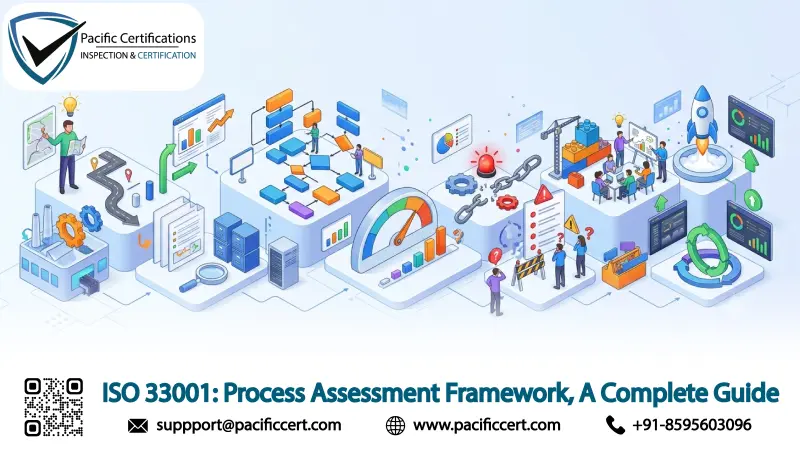
ISO/IEC 33001 helps organizations understand process assessment concepts, terminology and capability structures before applying the wider 330xx framework - Pacific Certifications
Process Assessment Concepts
Process Assessment
Process assessment is a disciplined evaluation of a set of processes against a defined model, producing results that characterize the capability of each assessed process.
The purpose of assessment may be process improvement - understanding the current state of processes in order to plan improvements - or capability determination - evaluating whether an organization's processes are sufficiently capable to meet specific requirements, such as a customer contract or regulatory obligation.
Process Reference Model (PRM)
A Process Reference Model defines a set of processes in terms of their purpose and outcomes. It describes what each process is intended to achieve but does not prescribe how the process should be implemented.
PRMs are domain-specific - the ISO/IEC 12207 software life cycle processes and ISO/IEC 15288 system life cycle processes both serve as PRMs within the 330xx framework.
Process Assessment Model (PAM)
A Process Assessment Model extends a Process Reference Model by adding the performance indicators - base practices and work products - that an assessor uses to collect objective evidence of process implementation and capability. The PAM operationalizes the PRM for assessment purposes.
Assessment Indicators
Assessment indicators are the objective evidence items that assessors look for during an assessment to determine whether a process attribute is being achieved.
They fall into two categories - base practice indicators, which relate to the activities performed within a process and work product indicators, which relate to the documented outputs that provide evidence of process execution.
Assessment Output
The output of a process assessment is a set of process attribute ratings for each assessed process, expressed using the four-point rating scale defined in the applicable measurement framework - Not Achieved (N), Partially Achieved (P), Largely Achieved (L) and Fully Achieved (F). These ratings are then mapped to capability levels.
Practical Tip: Treat process assessment as evidence-based evaluation, where each process is reviewed against clear outcomes, indicators and capability expectations.
Capability Levels
Level 0 - Incomplete Process: The process is not implemented or fails to achieve its defined purpose and outcomes. There is little or no evidence of systematic process execution.
Level 1 - Performed Process: The process is implemented and achieves its defined purpose. Process outcomes are evident, but the process is not managed in a planned or systematic way. This level confirms that the work is being done but not necessarily with consistency or control.
Level 2 - Managed Process: The process is implemented in a managed fashion - it is planned, monitored and adjusted. Work products are established, controlled and maintained. This level demonstrates that the process is under active management rather than being performed ad hoc.
Level 3 - Established Process: The process is implemented using a defined, documented standard process tailored from an organizational process asset. The organization has a standard process that is communicated, understood and used across projects or organizational units.
Level 4 - Predictable Process: The established process operates within defined limits to achieve its process outcomes. Quantitative management is applied - the process is measured and controlled using statistical and other quantitative techniques and its performance is predictable within established bounds.
Level 5 - Innovating Process: The process is continuously improved to meet current and projected business goals. Innovation and process change management are applied proactively to address the root causes of variation and to exploit new opportunities - not merely in response to problems.
Capability levels are most useful when organizations use them to guide improvement priorities, not just to assign maturity scores.
ISO 33001 vs ISO 15504 (SPICE)
Writer’s view: ISO/IEC 33001 modernizes the SPICE approach by expanding process assessment beyond software into broader organizational process domains.
The ISO/IEC 330xx Assessment Framework
ISO/IEC 33001: Concepts and terminology - the foundational definitions and conceptual overview (this standard)
ISO/IEC 33002: Requirements for performing process assessment - defines what a conformant assessment must do
ISO/IEC 33003: Requirements for process measurement frameworks - defines how capability levels and ratings must be structured
ISO/IEC 33004: Requirements for process reference, assessment and maturity models - governs how models are constructed
ISO/IEC 33020: Process measurement framework for assessment of process capability - the primary measurement framework used in most assessments
ISO/IEC TS 33010: Guidance for performing process assessments - practical guidance for assessors
Domain-specific PAMs: Standards such as ISO/IEC 33021 (for ISO/IEC 12207 processes) provide the assessment models used for specific process domains
Together, these standards provide a complete, modular framework that any organization can use to assess, rate and improve the capability of its processes in any domain.
Practical Tip: Use the 330xx family as a connected framework, with ISO/IEC 33001 for concepts, ISO/IEC 33002 for assessment requirements and ISO/IEC 33020 for capability measurement.
Who Should Use ISO/IEC 33001?
Software development organizations assessing the capability of their development, testing and maintenance processes - particularly those supplying to automotive, aerospace, medical device, or defense clients where process capability assessment is a contractual or regulatory requirement.
Systems engineering organizations applying the framework to ISO/IEC 15288 system life cycle processes as part of capability determination for complex engineering programs.
IT service providers using the framework to assess the capability of service management processes against ISO/IEC 20000-related process reference models.
Automotive suppliers implementing Automotive SPICE (A-SPICE) assessments - which are directly based on the 330xx framework - as required by OEM customers such as BMW, Volkswagen Group and Daimler.
Process improvement professionals and assessors responsible for conducting capability assessments, interpreting results and designing improvement programs.
Standard developers building domain-specific Process Assessment Models or Process Reference Models that must conform to the requirements of ISO/IEC 33003 and ISO/IEC 33004.
Procurement and acquisition organizations using capability determination assessments to evaluate supplier process maturity before awarding contracts.
Final Remark: ISO/IEC 33001 is valuable for software, systems engineering, IT service, automotive, defense and procurement teams that need objective process capability evidence.
Implementation Steps
Step 1: Define the Assessment Purpose
Establish whether the assessment is being conducted for process improvement - understanding the current state of your own processes - or for capability determination - evaluating process suitability for a specific contract, regulatory requirement, or client expectation. The purpose determines the assessment scope, the level of rigor required and how results will be used.
Step 2: Select the Process Reference Model
Identify the Process Reference Model applicable to your domain - ISO/IEC 12207 for software life cycle processes, ISO/IEC 15288 for system life cycle processes, or a domain-specific PRM such as Automotive SPICE for automotive software suppliers.
Step 3: Select the Process Assessment Model
Select or develop the Process Assessment Model that extends your chosen PRM with the base practice and work product indicators required for assessment. Confirm that the PAM conforms to ISO/IEC 33004 requirements.
Step 4: Define Assessment Scope
Specify which processes, organizational units, projects and time periods are included in the assessment. Document the scope clearly so that results are interpretable and comparable across assessments.
Step 5: Rate Process Attributes
Apply the four-point rating scale (N, P, L, F) to each process attribute for each assessed process, based on the evidence collected. Map ratings to capability levels using the measurement framework in ISO/IEC 33020.
Step 6: Document and Report Assessment Results
Produce an assessment report covering the assessment scope, evidence collected, process attribute ratings, capability level profiles and - where the purpose is process improvement - identified strengths, weaknesses and improvement recommendations.
Step 7: Implement Improvement Actions
Use assessment results to prioritize and implement process improvements. Schedule a follow-up assessment at a defined interval to measure improvement progress and update capability profiles.
Practical Tip: Begin by defining the assessment purpose, selecting the right PRM and PAM, and setting a clear scope before rating process attributes.
Examples in Software and Engineering
Automotive Software Supplier
An automotive electronics supplier conducts Automotive SPICE assessments - which are directly based on the 330xx framework - across its software development projects for a major OEM customer. The assessment covers software requirements, software design, software construction, software testing and supporting processes.
Results at Level 2 across all assessed processes satisfy the OEM's minimum supplier requirement. The supplier uses the assessment findings to plan improvements targeting Level 3 in software testing and requirements management - capabilities that would qualify them for safety-critical ECU development programs.
Defense Systems Integrator
A defense systems integrator applies the 330xx framework using ISO/IEC 15288 as the process reference model to assess its systems engineering capability ahead of a major government contract. The capability determination assessment is conducted by an independent assessor team and the results are provided to the procurement authority as evidence that the organization's systems engineering processes are capable of delivering the contracted program.
Capability at Level 3 across acquisition, system requirements, architecture, integration and verification processes satisfies the contract qualification threshold.
Enterprise Software Development Organization
A financial services software house uses an internal process assessment program based on ISO/IEC 12207 and the 330xx framework to evaluate the capability of its development and quality assurance processes annually. Assessment results are reviewed by senior management alongside ISO 9001 internal audit findings and improvement targets are built into the annual management review action plan.
The structured assessment approach provides quantitative capability data that supplements the ISO 9001 audit findings with process-level granularity.
Medical Device Software Developer
A medical device manufacturer uses the 330xx framework alongside IEC 62304 - the medical device software life cycle standard - to assess the capability of its software development processes as part of regulatory submission preparation.
Process capability profiles at Level 3 across development, verification and change management processes support the regulatory argument that software is developed in a controlled, repeatable manner - directly contributing to the safety and efficacy documentation required for device approval.
Writer’s view: ISO/IEC 33001 becomes practical when software, engineering, defense and medical device teams use it to assess real project processes and improvement needs.
ISO/IEC 33001 Certification Cost
The cost of conducting a 330xx-based process assessment depends on the number of processes being assessed, the number of projects or organizational units in scope, the experience level of the assessment team and whether the assessment is being conducted for internal improvement purposes or as a formal capability determination for a client or procurement authority. For a small software organization conducting a focused internal assessment across five to eight processes, the effort is relatively contained. For a large systems engineering organization undergoing a formal capability determination across a full project life cycle - covering acquisition, requirements, design, integration, verification and supporting processes - the assessment effort is substantially greater.
For organizations also pursuing management system certification alongside their process assessment program - ISO 9001, ISO/IEC 27001, or ISO/IEC 20000-1 - integrated audits across multiple standards reduce total audit days and provide better value than pursuing each standard independently. Pacific Certifications provides transparent, fixed-fee proposals so your organization has full cost visibility before the process begins.
Cost planning should consider the number of assessed processes, projects, organizational units, assessor effort and whether ISO 9001 or ISO/IEC 27001 certification is included.
ISO/IEC 33001 Certification Timeline
This includes 2 to 4 weeks for scoping, PRM and PAM selection and assessment planning, 4 to 8 weeks for assessor familiarization, evidence collection and process attribute rating and 2 to 3 weeks for results documentation, capability profile production and improvement planning. Organizations implementing Automotive SPICE or other domain-specific PAMs should factor in additional time for assessor training and PAM familiarization before the first formal assessment begins.
For organizations pursuing ISO 9001 or ISO/IEC 27001 management system certification in parallel with the process assessment program, the combined timeline runs approximately 6 to 9 months - with the process assessment implementation feeding directly into the management system evidence base. Organizations where software life cycle processes are largely informal and undocumented should plan for the longer end of this range. Assigning dedicated process owners, documenting assessment procedures before commencing evidence collection and conducting an internal capability assessment before any external audit are the most effective ways to keep the overall program on track.
A Practical Tip from Pacific Certifications: Organizations can avoid delays by selecting the PRM, defining the PAM, assigning process owners and preparing assessment evidence early.
How Pacific Certifications Can Help?
Our services for organizations implementing process assessment programs include:
Independent certification audits for ISO 9001, ISO/IEC 27001, ISO/IEC 20000-1 and ISO 22301
Stage 1 and Stage 2 audit execution across single and multi-site engineering and technology organizations
Clear, transparent audit reports with conformity findings and certification decisions
Issuance of internationally recognized ISO certificates upon successful audit completion
Annual surveillance and triennial recertification audits to maintain certificate validity
Pacific Certifications does not provide consultancy - our role is strictly that of an independent auditor, ensuring your certificate carries full credibility with enterprise clients, government procurement authorities and OEM customers in every market you operate in.
Contact Us
To get started with your process assessment certification program or initiate your audit, contact us at support@pacificcert.com or +91-8595603096.
For training programs, contact us at trainings@pacificcert.com.
Also Read: ISO/IEC TS 33061:2021 – Software Life Cycle Process Assessment Model