What Is ISO/IEC 27400?
The standard defines a set of IoT-specific security and privacy controls applicable to all stakeholders involved in the IoT value chain - including device manufacturers, IoT platform providers, system integrators, service operators and end-user organizations deploying IoT solutions. Unlike ISO/IEC 27001, which provides a general information security management system framework, ISO/IEC 27400 focuses specifically on the characteristics of IoT environments that make conventional security controls insufficient - including resource-constrained devices, heterogeneous communication protocols, complex supply chains, physical accessibility of devices and the convergence of operational technology with information technology.
ISO/IEC 27400:2022 is part of a broader IoT security standards landscape that includes ISO/IEC 30141 for IoT reference architecture and ISO/IEC 27402 for IoT device baseline security requirements. Organizations implementing ISO/IEC 27400 use it as the primary source of IoT-specific security and privacy control guidance within an ISMS framework certified against ISO/IEC 27001.
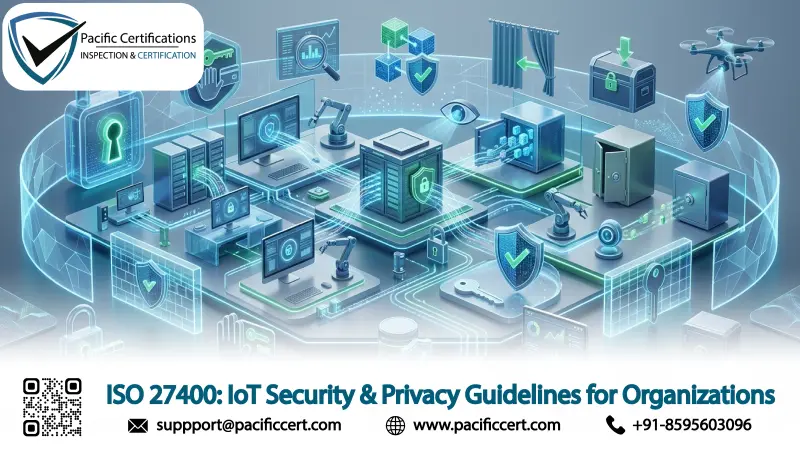
ISO/IEC 27400 helps organizations manage IoT security and privacy risks across devices, platforms, data flows and connected ecosystems - Pacific Certifications
IoT Risk Landscape
Resource-Constrained Devices
Many IoT devices - sensors, actuators, embedded controllers and edge nodes - operate with limited processing power, memory and battery capacity.
These constraints prevent the deployment of conventional security controls such as full-stack encryption, real-time vulnerability scanning and endpoint detection and response agents. Attackers exploit this limitation to compromise devices that cannot adequately defend themselves.
Extended Attack Surface
An IoT deployment may involve thousands or millions of connected endpoints, each representing a potential entry point into the broader network.
Unlike enterprise IT environments where endpoints are relatively homogeneous and centrally managed, IoT deployments involve diverse device types, operating systems, communication protocols and firmware versions - dramatically expanding the attack surface compared to a conventional IT environment.
Supply Chain Complexity
IoT devices typically incorporate components, firmware and software from multiple suppliers across a complex global supply chain.
Each supplier relationship introduces a potential vector for supply chain compromise - whether through malicious component insertion, insecure default firmware, or vulnerabilities introduced during the manufacturing process.
OT/IT Convergence
Industrial IoT deployments connect operational technology - control systems, SCADA infrastructure, industrial sensors - with enterprise IT networks.
This convergence exposes OT systems that were originally designed for isolated operation to IT-originated threats and exposes IT networks to the reliability and safety consequences of OT system compromise.
Data Privacy at Scale
IoT systems collect vast quantities of data - including location data, behavioral data, biometric data and environmental data - often from individuals who have limited visibility into what is being collected and how it is used.
The scale and sensitivity of IoT data collection creates significant privacy risks that extend well beyond the scope of conventional IT data protection programs.
Practical Tip: Assess IoT risks by looking at device limitations, attack surface, supply chain exposure, OT/IT convergence and personal data collection together.
Privacy and Security Controls for IoT
Identity and Authentication
Each IoT device must have a unique identity that is verifiable and cannot be easily spoofed or cloned. Authentication between devices, gateways and cloud platforms must use cryptographic mechanisms appropriate to the device's resource constraints - including certificate-based authentication and pre-shared key schemes where full PKI is not feasible.
Default credentials must be eliminated and credential management procedures must cover the full device lifecycle including decommissioning.
Vulnerability and Patch Management
A mechanism for delivering and applying security updates to IoT devices must be in place throughout the device operational lifetime.
Over-the-air (OTA) update capability must be implemented securely - ensuring that update packages are authenticated, integrity-verified and delivered over encrypted channels.
Data Minimization and Privacy by Design
IoT systems must be designed to collect only the personal data strictly necessary for the defined operational purpose.
Privacy by design principles must be applied from the earliest stages of IoT product and platform design - covering data minimization, purpose limitation, consent management, data subject rights and data retention controls.
Physical Security
IoT devices deployed in physically accessible environments must incorporate hardware security controls appropriate to the deployment context - including tamper detection, tamper resistance, secure element storage for cryptographic keys and hardware-based root of trust where the risk profile justifies it.
Network Segmentation
IoT devices must be segregated from enterprise IT networks and from each other where appropriate, using network segmentation, VLANs and IoT-specific network zones.
This limits the blast radius of a compromised IoT device and prevents lateral movement from the IoT network into core IT infrastructure.
Decommissioning and Data Deletion
Secure decommissioning procedures must ensure that IoT devices are wiped of all locally stored data, credentials and configuration information before disposal or redeployment - preventing data recovery from discarded devices.
IoT controls should cover the full device lifecycle, from identity and authentication to updates, segmentation, privacy and secure decommissioning.
ISO 27400 Implementation Framework
Step 1: IoT Asset Inventory
Establish a comprehensive inventory of all IoT devices and systems in scope - covering device type, manufacturer, firmware version, communication protocols, data collected, physical location and network connectivity.
An accurate, maintained asset inventory is the foundation of every subsequent control implementation activity.
Step 2: IoT Risk Assessment
Conduct a risk assessment specific to the IoT environment, covering the risk categories defined in ISO/IEC 27400 - device security, communication security, data privacy, supply chain, physical security and OT/IT convergence.
Map identified risks to the standard's control areas to prioritize implementation effort.
Step 3: Privacy Impact Assessment
For IoT systems that collect personal data, conduct a Privacy Impact Assessment (PIA) covering the categories of personal data collected, the legal basis for collection, data flows between devices, gateways, platforms and third parties, data subject rights obligations and cross-border data transfer requirements.
Step 4: Implementation and Testing
Implement selected controls across the IoT estate - covering device hardening, network segmentation, communication security, update management and data protection.
Conduct security testing including penetration testing of IoT devices and platforms, firmware analysis and network traffic analysis to validate control effectiveness.
Step 5: Monitoring and Incident Response
Establish continuous monitoring of IoT device behavior, network traffic and security events.
Integrate IoT-specific threat indicators into the security operations function and ensure that incident response procedures cover IoT-specific incident scenarios - including device compromise, firmware manipulation and unauthorized data exfiltration from IoT systems.
Step 6: Review and Improvement
Conduct regular reviews of the IoT security and privacy program against the evolving threat landscape and the organization's changing IoT estate.
Update risk assessments, control implementations and privacy impact assessments as new devices are deployed, new services are activated and new threats emerge.
Writer’s view: ISO/IEC 27400 implementation works best when asset inventory, risk assessment, privacy review, testing and monitoring are built into one program.
Examples for Device Makers and Platform Providers for ISO 27400
Smart Home Device Manufacturer
A manufacturer of consumer smart home devices - including connected cameras, smart speakers and home automation controllers - applies ISO/IEC 27400 controls to its product development process. Secure boot is implemented to prevent unauthorized firmware execution. Unique device identity certificates are provisioned during manufacturing.
Default credentials are eliminated, with first-use credential configuration required during device setup. An OTA update mechanism with firmware signing and integrity verification is implemented to deliver security patches throughout the product lifecycle.
Privacy by design is applied to the data collection architecture - ensuring that audio and video data are processed locally where possible, with clear user consent controls for any cloud transmission.
Industrial IoT Platform Provider
An industrial IoT platform provider serving manufacturing and energy sector clients applies ISO/IEC 27400 to govern the security and privacy architecture of its platform. Device authentication uses X.509 certificates issued through the platform's PKI. All device-to-cloud communications are encrypted using TLS 1.3.
Network segmentation isolates device management traffic from operational data flows. Vulnerability disclosure procedures are published for researchers to report device or platform security issues. A device decommissioning API allows clients to remotely wipe device credentials and configuration data when devices are retired.
Healthcare IoT Deployer
A hospital deploying medical IoT devices - patient monitoring sensors, infusion pumps and connected diagnostic equipment - applies ISO/IEC 27400 in conjunction with healthcare-specific regulatory requirements. An IoT asset inventory is maintained covering all connected medical devices, their network connectivity, firmware versions and data flows.
Medical IoT devices are segregated from the hospital's administrative IT network using dedicated VLANs and firewall rules. A privacy impact assessment is conducted covering patient data collected by monitoring devices, with data minimization controls applied to limit the personal data transmitted to cloud platforms.
Practical Tip: Use practical examples to show how ISO/IEC 27400 applies differently to smart devices, industrial IoT platforms and healthcare IoT deployments.
ISO 27400 vs ISO 27001
Final Remark: ISO/IEC 27400 provides IoT-specific security and privacy guidance, while ISO/IEC 27001 provides the certifiable ISMS framework.
ISO 27400 Compliance Checklist
Governance and Policy
IoT security and privacy policy documented and approved by top management
IoT-specific risk assessment completed covering all device types, communication channels and data flows
Privacy Impact Assessment completed for all IoT systems collecting personal data
Roles and responsibilities defined for IoT security and privacy management
Device Security
Unique device identity provisioned for all IoT devices
Default credentials eliminated across all deployed devices
Secure boot implemented to verify firmware integrity at startup
Hardware security controls appropriate to deployment context implemented
Secure decommissioning procedure documented and tested
Communication Security
All device-to-gateway and device-to-cloud communications encrypted
Certificate or key management procedure in place covering full device lifecycle
Network segmentation implemented isolating IoT devices from enterprise IT networks
Communication protocol security configurations documented and tested
Vulnerability and Update Management
OTA firmware update capability implemented with signing and integrity verification
Vulnerability disclosure policy published for IoT products
Patch management process covering all deployed IoT device types documented
Firmware version inventory maintained and monitored against known vulnerabilities
Data Privacy
Data minimization controls implemented limiting personal data collection to defined purposes
Consent management mechanism in place for consumer IoT data collection
Data retention and deletion controls implemented covering device-stored and cloud-stored data
Cross-border data transfer obligations mapped and addressed
Supply Chain Security
Minimum security requirements defined for IoT device and component suppliers
Supplier security assessment process in place covering IoT hardware and firmware suppliers
Software Bill of Materials (SBOM) maintained for IoT device firmware
Monitoring and Incident Response
IoT device behavior monitoring in place with anomaly detection capability
IoT-specific incident response procedures documented and tested
Security event logging enabled on IoT gateways and platforms with retention controls
Practical Tip: A strong checklist should connect IoT governance, device security, communication protection, vulnerability management, data privacy, supply chain security and incident response.
ISO 27400 Certification Cost
For a device manufacturer embedding ISO/IEC 27400 controls into a new product line from the design stage, the primary cost is in secure development tooling, PKI infrastructure and security testing. For an enterprise retrofitting security controls onto an existing IoT deployment, the cost profile shifts toward network segmentation, monitoring infrastructure and device hardening activities.
For organizations pursuing ISO/IEC 27001 certification as the primary management system certification alongside ISO/IEC 27400 implementation, audit cost is determined by employee count, number of sites and the scope of the ISMS covering the IoT environment. A focused IoT product company with a single development site will have a modest audit investment. A large enterprise deploying IoT across multiple facilities, geographies and business units - or an IoT platform provider serving thousands of enterprise clients - will require proportionally more audit days. Where ISO/IEC 27701 is pursued alongside ISO/IEC 27001 to address the privacy obligations arising from IoT data collection, integrated audits reduce total audit days and provide better value than separate certifications. Pacific Certifications provides transparent, fixed-fee proposals so your organization has full cost visibility before the process begins.
Cost planning should consider IoT scope, device types, sites, security testing, platform complexity and whether ISO/IEC 27001 or ISO/IEC 27701 certification is included.
ISO 27400 Certification Timeline
Device manufacturers embedding ISO/IEC 27400 controls into a new product development program should plan for the implementation phase to run in parallel with the product development timeline rather than as a sequential activity.
For organizations pursuing ISO/IEC 27001 certification in parallel with ISO/IEC 27400 implementation, the full certification process runs approximately 4 to 6 months from initial gap analysis through certificate issuance. Where ISO/IEC 27701 is added to address the privacy obligations of IoT data collection, the timeline extends to 6 to 9 months. Organizations with large, heterogeneous IoT deployments spanning multiple device types, communication protocols and geographic locations should plan for the longer end of this range - the risk assessment and control implementation phases are proportionally more complex than for a standard enterprise ISMS. Assigning dedicated IoT security and privacy program ownership, integrating ISO/IEC 27400 requirements into the product or deployment design process from the outset and conducting a structured internal audit before the Stage 2 certification assessment are the most effective ways to keep the combined program on track.
A Practical Tip from Pacific Certifications: IoT organizations can avoid delays by preparing asset inventory, risk assessments, privacy impact reviews, testing evidence and internal audits early.
How Pacific Certifications Can Help?
Accredited by ABIS, Pacific Certifications conducts impartial, evidence-based audits against applicable ISO standards in full conformance with ISO/IEC 17021. Our services for organizations implementing ISO/IEC 27400-aligned programs include:
Independent certification audits for ISO/IEC 27001, ISO/IEC 27701, ISO 9001, ISO 22301 and ISO/IEC 20000-1
Stage 1 and Stage 2 audit execution across single and multi-site IoT operations
Clear, transparent audit reports with conformity findings and certification decisions
Issuance of internationally recognized ISO certificates upon successful audit completion
Annual surveillance and triennial recertification audits to maintain certificate validity
Pacific Certifications does not provide consultancy - our role is strictly that of an independent auditor, ensuring your certificate carries full credibility with enterprise clients, regulators and procurement authorities in every market you operate in.
Contact Us
To get started with your IoT security certification program or initiate your audit, contact us at support@pacificcert.com or +91-8595603096.
For training programs, contact us at trainings@pacificcert.com.
Also read: ISO/IEC 29100:2020 - Building Privacy Frameworks for Data-Driven Organizations