What Is ISO 22301?
ISO 22301 applies to any organization that needs to protect its operations against disruption, whether from natural disasters, cyberattacks, supply chain failures, pandemics, power outages or any other event that threatens the continuity of critical activities.
The standard follows the Annex SL High Level Structure shared by ISO 9001, ISO 14001 and ISO 27001, making it compatible with existing management systems and straightforward to integrate into a broader governance framework.
Certification to ISO 22301 provides independent, internationally recognized evidence that an organization has implemented a structured, tested and operational business continuity capability.
Takeaway: If your organization has business continuity plans that have never been formally tested against a realistic disruption scenario, you do not have a business continuity management system. You have a document. ISO 22301 exists to close that gap.
Who Should Implement ISO 22301?
It is particularly relevant for organizations in regulated sectors, those with contractual continuity obligations, and those whose operational failures carry reputational or societal consequences.
Organizations with the strongest business case for ISO 22301 certification include financial services institutions, healthcare providers, utilities and critical infrastructure operators, logistics and supply chain businesses, public sector organizations, technology and data center operators, telecommunications providers and any business that is a critical supplier to regulated industries.
Tip: Assess your organization's critical function inventory and estimate the financial, reputational and regulatory impact of losing each function for 24 hours, 72 hours and 7 days. If any scenario produces an unacceptable outcome, that function requires a tested recovery plan governed by a structured BCMS.
Key Requirements of the Standard
The standard follows the Plan-Do-Check-Act cycle embedded in all Annex SL management systems. Key clause-level requirements include:
Business Impact Analysis and Risk Assessment
The risk assessment evaluates the likelihood and consequences of disruption scenarios that could affect those critical activities.
The BIA must cover every function within the BCMS scope and produce, for each critical activity: the minimum business continuity objective defining the minimum acceptable level of service during disruption, the recovery time objective defining the maximum tolerable downtime before the activity must be restored, the recovery point objective defining the maximum tolerable data loss, and the minimum resources required to maintain or restore the activity at the minimum acceptable level.
Takeaway: Validate your recovery time objectives with the business owners of each critical activity, not just the continuity team. Recovery time objectives that have not been endorsed by the function head responsible for the activity are targets on paper, not operational commitments.
Business Continuity Plans and Recovery Strategies
Recovery strategies must address the full range of resource dependencies identified in the BIA: alternative work locations for people, backup technology systems and data recovery processes, alternative supplier arrangements, communication channels for staff, customers and stakeholders during disruption, and arrangements for maintaining leadership decision-making capability during a crisis.
Business continuity plans must be sufficiently detailed to be executed by staff who were not involved in writing them, under the stress of an actual incident.
Common plan deficiencies identified during ISO 22301 audits include plans that assume key personnel are available when the disruption may have directly affected those individuals, plans that reference systems or suppliers that have changed since the plan was written, and plans that specify recovery actions without identifying who is responsible for each action or what they need to do if their first option fails.
Tip: Test your business continuity plans by asking a staff member who was not involved in writing them to walk through the plan for their function. If they cannot follow the plan without assistance from the plan author, the plan needs to be rewritten before it is tested in an exercise.
Testing and Exercising the BCMS
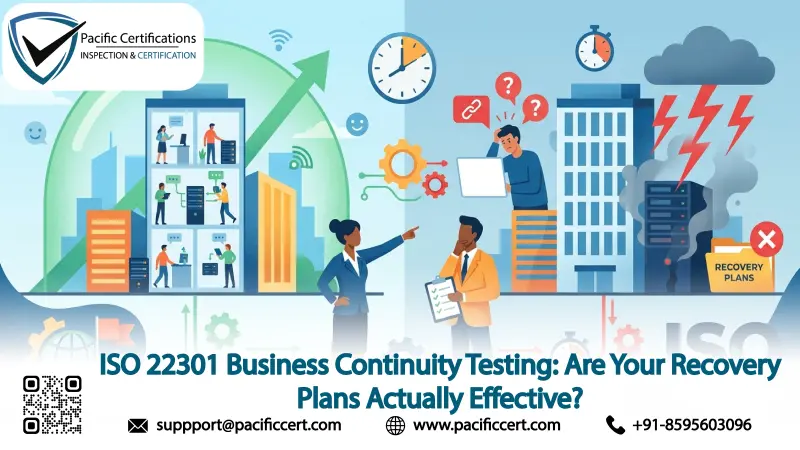
This is the requirement that most often distinguishes organizations with genuine resilience from those with documentation that has never been validated under realistic conditions.
The standard does not prescribe a single exercise format but requires that the exercise program is planned, executed and evaluated, that findings are documented and that improvements are implemented.
Exercise types commonly used under ISO 22301 include tabletop exercises where teams walk through a scenario discussion, functional exercises that test specific plan elements such as IT system recovery or staff communication, and full simulation exercises that test the entire BCMS response under conditions as close to an actual incident as practical.
Takeaway: If your last business continuity exercise was a tabletop discussion that concluded without any improvement actions, schedule a functional exercise within the next 60 days targeting your highest-priority critical activity. A finding-free exercise is almost always a sign that the scenario was not challenging enough, not that the plan is perfect.
ISO 22301 Certification Process
Stage 1 assesses documentation readiness and BCMS design against the standard's requirements, while Stage 2 conducts an on-site assessment verifying that the BCMS is effectively implemented, operational and supported by evidence of exercising and testing.
Stage 1 Audit (Document Review)
The Stage 1 audit reviews the organization's BCMS documentation including the BIA, risk assessment, business continuity strategies, business continuity plans, exercise program and documented information control. primary location.
Stage 2 Audit (On-Site Assessment)
The Stage 2 audit is the main conformity assessment. The auditor verifies that the BCMS is genuinely implemented and operational, assessing evidence of business impact analysis outputs in use, recovery strategies in place, plans accessible and current at the point of use, exercise program executed with documented reports and improvement actions closed.
Certificate Issuance and Surveillance
Upon successful completion of the Stage 2 audit, Pacific Certifications issues the ISO 22301 certificate, valid for three years subject to annual surveillance audits.
Tip: Before scheduling your Stage 2 audit, confirm that your exercise program has produced at least one documented exercise report with findings and closed improvement actions. An exercise program with no documented outputs is one of the most commonly cited Stage 2 nonconformities in ISO 22301 audits.
Certification Cost and Timeline
Organizations building a BCMS from scratch typically require 4 to 9 months from gap analysis to certificate issuance, while organizations with existing business continuity programs can often achieve certification within 3 to 5 months.
Internal implementation costs cover BIA facilitation, strategy development, plan writing, exercise design and execution, staff training and internal audit. Organizations that have existing BIA outputs, documented plans and an exercise history will require less implementation effort than those starting without any formal BCMS foundation. Pacific Certifications provides transparent, fixed-fee certification proposals.
Takeaway: Request a scoping conversation with Pacific Certifications before committing to an implementation timeline. The scope of the BCMS, defined by which critical activities and sites are included, is the single biggest determinant of both implementation effort and certification audit cost.
Author's Views
The exercising and testing requirement is where the standard separates organizations with real resilience from those with a compliance filing cabinet.
In practice, the business impact analysis is the most intellectually demanding element: getting genuine alignment from business function owners on recovery time objectives, minimum resource requirements and acceptable service levels during disruption requires facilitation skill and management sponsorship that documentation exercises alone cannot substitute for. Organizations that invest in a realistic, scenario-based exercise program from the outset, rather than treating exercising as an annual compliance checkbox, consistently demonstrate stronger BCMS performance at certification audit and, more importantly, in actual incidents.
How Pacific Certifications Can Help?
Accredited by ABIS, Pacific Certifications conducts impartial, evidence-based audits in full conformance with ISO/IEC 17021. Services include:
Initial ISO 22301 certification audits
Integrated management system audits covering ISO 22301, ISO 27001 and ISO 9001
Stage 1 and Stage 2 audit execution across financial services, healthcare, technology, logistics and public sector organizations
Clear, transparent audit reports with conformity findings and certification decisions
Annual surveillance and triennial recertification audits to maintain certificate validity
Contact Us
To get started with your Business Continuity Testing, ISO certification program or initiate your audit, contact us at support@pacificcert.com or +91-8595603096.
For training programs, contact us at trainings@pacificcert.com.
Also read: ISO 22301:2019 Certification 2026 | Business Continuity Guide

