Post by Alina Ansari | July, 2026
What Is ISO 22241?
AUS 32 is more commonly known in commercial and consumer markets as AdBlue in Europe and Diesel Exhaust Fluid (DEF) in North America - ISO 22241 is the single internationally recognized technical reference that defines what the product must be, how it is tested, how it is handled and how it is dispensed in order to function correctly in SCR emission control systems.
SCR technology works by injecting AUS 32 into the hot exhaust gas stream upstream of the SCR catalyst - the urea thermally decomposes to ammonia, which then reacts with nitrogen oxides (NOx) in the exhaust over the catalyst surface, converting them to harmless nitrogen and water vapour. The SCR reaction is critically sensitive to the purity and concentration of AUS 32 - contaminated, incorrectly concentrated, or degraded DEF can damage the SCR catalyst, cause SCR system malfunctions, result in vehicles failing emissions compliance and in severe cases lead to costly catalytic converter replacement. ISO 22241 provides the technical framework that protects the integrity of the entire SCR system by ensuring that the AUS 32 entering it consistently meets defined quality parameters.
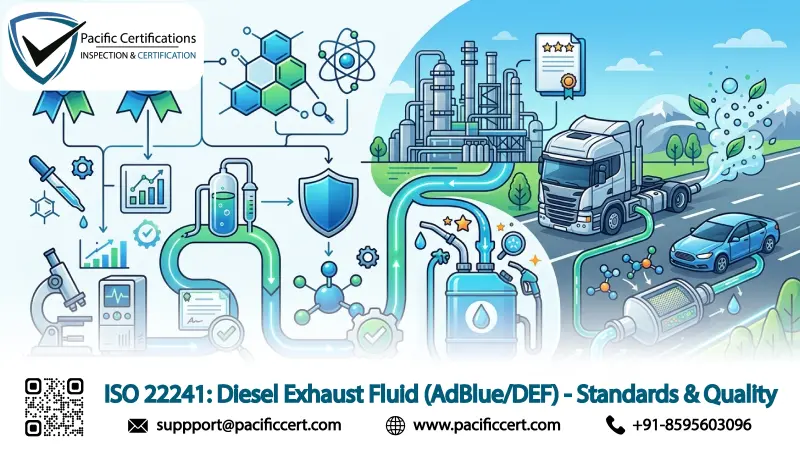
ISO 22241 helps DEF and AdBlue producers protect SCR system performance by controlling AUS 32 quality, purity, testing, handling and dispensing - Pacific Certifications
Parts of ISO 22241 DEF
Practical Tip: Use the ISO 22241 parts together because product quality, test methods, storage, transportation and refilling interfaces all affect DEF performance.
DEF/AdBlue Quality Requirements
Urea Concentration
The urea content of AUS 32 must be within the range of 31.8% to 33.2% by mass - with the nominal specification being 32.5% urea in demineralised water. This narrow concentration range is critical - at concentrations below 31.8%, the NOx conversion efficiency of the SCR system is reduced because insufficient ammonia is generated from the AUS 32 injection.
At concentrations above 33.2%, the risk of urea crystallization and catalyst fouling increases. The SCR system's dosing control software is calibrated for the 32.5% concentration - off-specification concentration directly degrades system performance and emissions compliance.
Physical Properties
ISO 22241-1 specifies the following physical property requirements for conforming AUS 32:
Appearance: Colourless, clear liquid with a slight ammonia odour
Density at 20°C: 1.087 to 1.093 g/cm³
Refractive index at 20°C: 1.3814 to 1.3843
Freezing point: -11°C (AUS 32 freezes at -11°C - a defined characteristic, not a limit)
Boiling point: Approximately 100°C
pH (alkalinity): 9.0 to 10.0
Viscosity at 20°C: 1.4 mPa·s
Impurity Limits
The purity requirements of ISO 22241-1 are highly demanding - reflecting the sensitivity of SCR catalysts to contamination by trace elements and organic impurities. Key impurity limits include:
Biuret: Maximum 0.3% - biuret is a urea degradation product that polymerizes in the exhaust system and forms deposits on the catalyst, reducing its efficiency
Aldehydes: Maximum 5 mg/kg - aldehyde impurities originate from contaminated raw materials and can degrade SCR performance
Insoluble matter: Maximum 20 mg/kg - particulate contamination can block injectors and dosing systems
Phosphate (PO₄): Maximum 0.5 mg/kg - phosphate is a catalyst poison
Metal ions (Al, Ca, Fe, K, Mg, Na): Maximum 0.5 mg/kg each - metal ion contamination, particularly from storage vessel corrosion, is one of the most common quality failures in the DEF supply chain
Copper, zinc, chromium, nickel: Maximum 0.2 mg/kg each - these metals are particularly harmful to SCR catalysts at very low concentrations
DEF quality depends on the right urea concentration, low impurity levels and protection from contamination throughout production and distribution.
Storage and Handling
Correct handling is as important as correct manufacturing - a product that meets all ISO 22241-1 quality parameters at the point of manufacture can fail quality requirements at the point of use if it has been improperly stored, transported, or dispensed.
Material Compatibility
AUS 32 is chemically aggressive toward certain metals - particularly copper, copper alloys, zinc and carbon steel - which it corrodes, leaching metal ions into the solution and causing the product to fail the ISO 22241-1 metal ion impurity limits.
All equipment and infrastructure that contacts AUS 32 - tanks, pipes, fittings, pumps, hoses and dispensing nozzles - must be fabricated from compatible materials.
Temperature Management
AUS 32 freezes at -11°C - storage infrastructure in cold climate regions must incorporate heating provisions to prevent freezing and product quality must be verified after a freeze-thaw cycle before use.
Equally, elevated temperature exposure - sustained storage above 35°C - accelerates urea degradation to biuret and ammonia, reducing both concentration and chemical purity.
Dedicated Infrastructure
ISO 22241-3 requires that DEF storage and distribution infrastructure is dedicated exclusively to AUS 32 - the risk of contamination from other fluids, particularly diesel fuel, lubricating oil, or other chemicals, is a critical quality hazard.
Even trace contamination with diesel fuel or lubricating oil can cause catastrophic SCR system damage.
Labelling of Containers
All packaging and containers for AUS 32 must be clearly labelled with the product designation (AUS 32 / AdBlue / DEF), the applicable ISO 22241 standard, the urea concentration, the date of manufacture, the batch number and the recommended storage conditions and shelf life information - enabling traceability throughout the supply chain and supporting quality verification by distributors, fleet operators and end users.
Writer’s view: A DEF product can meet ISO 22241 at manufacture but fail at use if storage materials, temperature or transfer practices are poorly controlled.
Testing Methods
Urea Content and Refractive Index (Annex C)
Urea concentration is determined by refractive index measurement - the refractive index of AUS 32 has a well-defined relationship with urea concentration and measurement using a precision refractometer provides a rapid and accurate determination of urea content that is suitable for both laboratory quality control and field screening applications.
Alkalinity Determination (Annex D)
The alkalinity of AUS 32 - expressed as ammonia (NH₃) equivalent - is determined by titration, providing a measure of the total base content of the solution. Alkalinity must fall within the defined pH range of 9.0 to 10.0 - excessive alkalinity indicates decomposition of urea to ammonia, which reduces concentration and can cause ammonia odor issues in storage and handling.
Biuret Content (Annex E)
Biuret concentration is determined by UV-visible spectrophotometry - measuring the absorption of the biuret-copper complex at a defined wavelength. This test is particularly important because biuret forms progressively during urea degradation under elevated temperature conditions - monitoring biuret content provides a sensitive indicator of product quality degradation during storage and transport.
Aldehyde Content (Annex F)
Aldehyde content is determined by colorimetric analysis using a defined derivatization reagent - providing detection of aldehyde impurities at the low mg/kg levels specified in ISO 22241-1.
Insoluble Matter (Annex G)
Insoluble particulate matter is determined gravimetrically - filtering a defined volume of AUS 32 through a membrane filter, drying the filter and weighing the retained residue. This test detects particulate contamination from packaging materials, equipment corrosion products and biological growth.
Phosphate Content (Annex H)
Phosphate is determined by photometric analysis - measuring the colour development of the phospho-molybdenum blue complex formed by reaction of phosphate with ammonium molybdate.
Trace Metal Analysis (Annex I)
The comprehensive trace metal analysis covering aluminium, calcium, chromium, copper, iron, potassium, magnesium, sodium, nickel and zinc is performed by Inductively Coupled Plasma (ICP) spectrometry - the analytical technique that provides simultaneous multi-element detection at the sub-mg/kg concentration levels required by ISO 22241-1.
Practical Tip: Testing should verify urea content, alkalinity, biuret, aldehydes, insoluble matter, phosphate and trace metals before quality is accepted.
Labelling and Distribution
Mandatory Label Information
All AUS 32 packaging must carry: the product name and designation (AUS 32, AdBlue, or DEF depending on market); the applicable ISO standard reference (ISO 22241); the nominal urea concentration (32.5%); the manufacturer's name and address; the batch number and date of manufacture enabling full traceability; the net quantity; storage and handling instructions including temperature limits and material compatibility warnings; and the recommended shelf life or best before date.
AdBlue Brand Licensing
AdBlue is a registered trademark of the German automotive industry association VDA (Verband der Automobilindustrie). The VDA licenses the AdBlue trademark to manufacturers who can demonstrate that their AUS 32 product meets ISO 22241-1 quality specifications - confirmed through independent batch testing against ISO 22241-2 methods. The VDA has established an audit and certification framework for AdBlue manufacturers and coordinates audit activities globally through its quality management certification body.
Distribution Chain Quality Assurance
ISO 22241-3 requires that quality is maintained throughout the distribution chain - from the manufacturing plant through bulk tanker delivery, intermediate bulk container (IBC) storage and retail or fleet dispensing. Each transfer point in the supply chain represents a potential contamination risk and the standard requires that infrastructure at each point meets material compatibility requirements and that incoming product is verified against quality documentation before acceptance.
Tip: Clear batch labels, storage instructions and traceability records help protect DEF quality across manufacturers, distributors, fleet operators and end users.
Certification for Manufacturers and Suppliers
VDA AdBlue Certification Program
The VDA's AdBlue certification program is the primary product and quality system certification framework for AdBlue manufacturers globally. The VDA QMC (Quality Management Center) has developed audit requirements covering manufacturing process controls, raw material quality management, production testing against ISO 22241-2, traceability systems and storage and distribution infrastructure compliance with ISO 22241-3.
Manufacturers seeking VDA AdBlue licensing must pass a VDA audit and maintain ongoing surveillance - batch testing results are regularly reviewed against the ISO 22241-1 specifications as a condition of continued licensing.
ISO Management System Certifications
Beyond product-level VDA certification, AUS 32 manufacturers, distributors and major fleet operators should pursue ISO management system certifications to provide the governance infrastructure within which ISO 22241 compliance is systematically managed.
Final Remark: ISO 22241 compliance is strongest when product testing, production controls, supply chain handling and management system audits work together.
ISO 22241 Certification Cost
Chemical manufacturing organizations with defined, documented production processes and established laboratory testing programs typically have a more mature quality system baseline than organizations in less-regulated manufacturing sectors - which can reduce the gap analysis findings and implementation effort required before certification.
Integrated audit programs covering ISO 9001, ISO 14001 and ISO 45001 simultaneously - the most common and commercially efficient certification combination for chemical manufacturing organizations - reduce total audit days by 25 to 35 percent compared to separate certifications. For distributors and fleet operators pursuing ISO 9001 and ISO 45001 as the primary management system credentials supporting their DEF supply chain quality and fleet safety management programs, the audit scope is typically smaller than a manufacturing operation - reflecting a service and logistics rather than production focus. Pacific Certifications provides transparent, fixed-fee proposals covering all certifications in scope. Contact Pacific Certifications at support@pacificcert.com or visit www.pacificcert.com to request a customized quote based on your organization's size, operational scope and target certifications.
Cost planning should consider manufacturing scope, laboratory testing, distribution complexity, employee count, sites and integrated ISO 9001, ISO 14001 or ISO 45001 audits.
Certification Timeline for ISO 22241
This includes 2 to 4 weeks for gap analysis across all three standards, 6 to 10 weeks for management system development covering procedure documentation, risk assessment completion, legal compliance registers and environmental aspect assessment and 2 to 3 weeks for Stage 1 and Stage 2 certification audits. Organizations building management systems from a minimal documentation baseline, or those incorporating multiple production sites within a single certification scope, should plan for 5 to 8 months.
For organizations that have already achieved ISO 9001 and wish to add ISO 14001 or ISO 45001 - extending an existing quality management system to cover environmental and safety dimensions - the incremental implementation and audit timeline is typically 2 to 4 months per additional standard when pursued through an integrated audit program. Adding ISO 50001 for energy management extends the program by a further 6 to 8 weeks. Assigning a dedicated management system coordinator with cross-functional authority over quality, environmental and safety management activities, completing the legal compliance register and environmental aspect assessment before Stage 1 and aligning the internal audit schedule with the Stage 2 certification assessment date are the most effective ways to keep the certification program on track.
A Practical Tip from Pacific Certifications: DEF and AdBlue organizations can avoid delays by preparing product specifications, batch testing records, storage controls and traceability evidence early.
How Pacific Certifications Can Help?
Accredited by ABIS, Pacific Certifications conducts impartial, evidence-based audits against applicable ISO standards in full conformance with ISO/IEC 17021. Our services for AUS 32 and DEF industry organizations include:
Independent certification audits for ISO 9001, ISO 14001, ISO 45001, ISO 22301 and ISO 50001
Integrated management system audits covering multiple standards in coordinated, efficient audit visits
Stage 1 and Stage 2 audit execution across manufacturing facilities, distribution centers and fleet management organizations
Clear, transparent audit reports with conformity findings and certification decisions
Issuance of internationally recognized ISO certificates upon successful audit completion
Annual surveillance and triennial recertification audits to maintain certificate validity
Pacific Certifications does not provide consultancy - our role is strictly that of an independent auditor, ensuring your certificate carries full credibility with vehicle manufacturers, fleet customers, automotive industry auditors and regulatory authorities in every market you operate in.
Contact Us
To get started with your management system certification program or initiate your audit, contact us at support@pacificcert.com or +91-8595603096.
For training programs, contact us at trainings@pacificcert.com.
Also Read: ISO Certifications for Automotive Industry, Requirements and Benefits