Post by Alina Ansari | June, 2026
What Is ISO 14698?
Together the two parts provide the complete framework for identifying, measuring, assessing and controlling biological contamination - including viable microorganisms such as bacteria, fungi and bacterial spores - in cleanroom environments where their presence constitutes a risk to product quality, patient safety, or process integrity.
ISO 14698 applies to any controlled environment where biological contamination presents a defined risk - including pharmaceutical manufacturing facilities, sterile medical device manufacturing, biotechnology and cell therapy production, hospital operating theaters and sterile processing departments, semiconductor and advanced electronics fabrication where biological contamination affects process yield and food processing facilities with cleanroom classifications.
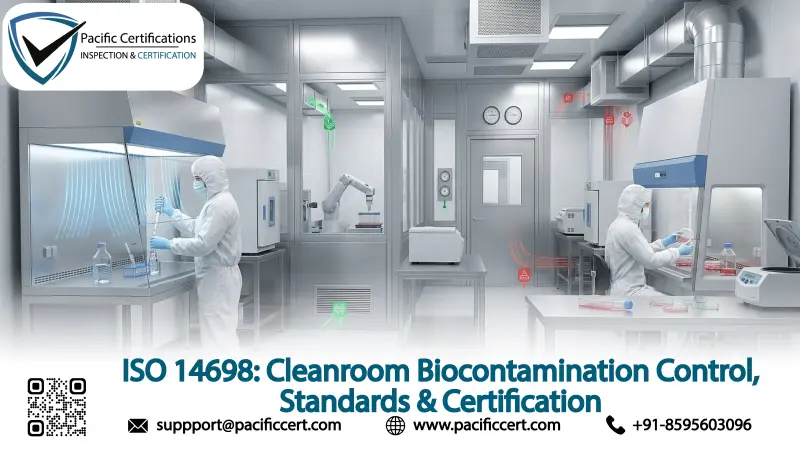
ISO 14698 helps cleanroom organizations control biocontamination risks through structured monitoring, data review, corrective action and contamination prevention - Pacific Certifications
Cleanroom Contamination Control
Sources of Biocontamination
Biological contamination in cleanroom environments originates from multiple sources that must all be addressed within the contamination control program.
Personnel are the primary source of biocontamination in most cleanroom environments - human beings continuously shed skin cells, hair and respiratory droplets that carry viable microorganisms into the controlled environment.
Materials and components entering the cleanroom - including raw materials, packaging, equipment and consumables - may carry surface biocontamination that must be controlled through entry procedures, cleaning and disinfection.
The facility itself - including air handling systems, surfaces, drains and utilities - can harbor and amplify microbial populations if not properly designed, cleaned and disinfected. Equipment and process fluids introduce biocontamination risk through surfaces, seals and internal passages that are difficult to clean and disinfect effectively.
Control Hierarchy
ISO 14698-1 establishes a hierarchical approach to biocontamination control - addressing contamination through design and engineering controls first, procedural controls second and monitoring third.
Design controls include cleanroom classification appropriate to the process, HVAC system design providing unidirectional airflow in critical zones, smooth and cleanable surface finishes, appropriate pressure differentials to prevent cross-contamination between zones and facility layout that separates high-biocontamination-risk activities from critical process areas.
Procedural controls include personnel gowning and behavior procedures, cleaning and disinfection schedules and validated methods, material entry controls and process design that minimizes the exposure of product to the environment.
Monitoring provides the evidence that control measures are effective and delivers the early warning of control failures that allows corrective action before product quality is compromised.
Writer’s view: Effective biocontamination control depends on preventing microbial risks before they affect product safety, process reliability or patient protection.
Biocontamination Risk Assessment
ISO 14698-1 requires that biocontamination risk assessment covers the following elements:
Hazard Identification
Identification of all potential sources of biocontamination in the controlled environment - including personnel, materials, equipment, utilities and the environment itself.
Hazard identification must consider both the normal operating state of the facility and foreseeable abnormal conditions - including equipment failures, maintenance activities, cleaning procedure deviations and personnel behavior non-conformances.
Risk Evaluation
Assessment of the likelihood that each identified hazard will result in a biocontamination event and the potential consequence of that event on product quality, patient safety, or process integrity.
Risk evaluation must consider the susceptibility of the product or process to the specific microorganisms likely to be present, the route by which biocontamination could reach the product and the detectability of biocontamination events through the monitoring program.
Risk Control
Selection and implementation of contamination control measures proportionate to the identified risks - covering engineering controls, procedural controls, personnel training and monitoring.
The risk assessment must confirm that the selected controls, when implemented effectively, reduce biocontamination risk to an acceptable level and that the monitoring program provides sufficient sensitivity to detect control failures before product quality is compromised.
Risk Review
Biocontamination risk assessments must be reviewed and updated at defined intervals and following any significant change to the facility, process, personnel, or equipment that could affect the biocontamination risk profile - including equipment modifications, facility refurbishments, changes to cleaning and disinfection agents and process changes.
Tip: Biocontamination risk assessment should consider personnel behavior, air handling, surfaces, materials, equipment, cleaning practices and process exposure.
Monitoring Plans
ISO 14698-1 requires that the monitoring plan addresses:
Monitoring Locations
Monitoring locations must be selected based on the risk assessment - covering critical process areas where biocontamination poses the greatest risk to product quality or patient safety, high-risk biocontamination sources such as personnel work positions and material transfer points and representative locations throughout the controlled environment.
The number and distribution of monitoring locations must be sufficient to characterize the biocontamination environment and detect localized contamination events.
Monitoring Frequency
Monitoring frequency must be defined for each monitoring location - based on the risk assessment findings, the criticality of the area, the history of biocontamination monitoring results and any applicable regulatory requirements.
Critical aseptic processing areas typically require monitoring during every production operation, while lower-risk support areas may be monitored on a periodic schedule.
Alert and Action Levels
The monitoring plan must define alert and action levels for each monitoring location - numerical biocontamination limits that trigger investigation and corrective action when exceeded. Alert levels indicate a potential trend toward loss of control and require investigation.
Action levels indicate a potential loss of control and require immediate investigation, corrective action and assessment of the impact on product quality. Alert and action levels must be set below the applicable regulatory limits - providing early warning before regulatory limits are breached.
Trending and Analysis
Monitoring data must be trended and analyzed at defined intervals - identifying patterns of increasing biocontamination, seasonality effects, personnel-related trends and location-specific issues that are not apparent from individual monitoring results.
Trending is the most powerful tool for detecting gradual deterioration of biocontamination control before alert or action levels are exceeded.
Practical Tip: Monitoring programs should reflect cleanroom classification, process criticality, contamination trends and the risk level of each controlled area.
Sampling Methods
Active Air Sampling
Active air sampling draws a defined volume of air through a collection medium - typically an agar-filled impactor plate - at a defined flow rate, collecting airborne viable particles for culture-based enumeration. ISO 14698-1 provides guidance on sampler types - including slit-to-agar impactors, centrifugal samplers and impingement samplers - and the selection criteria for each.
Active air sampling provides quantitative data on airborne microbial concentrations and is the primary method for monitoring critical aseptic processing areas.
Passive Air Sampling - Settle Plates
Settle plates - open agar plates exposed for a defined period - collect microorganisms that settle from the air onto the agar surface by gravity and inertial deposition.
Settle plates are simple, low-cost and do not require specialized equipment, making them practical for routine monitoring in large numbers of locations simultaneously. They provide semi-quantitative data and are used in conjunction with active air sampling in most monitoring programs.
Surface Sampling - Contact Plates and Swabs
Contact plates - agar-filled plates pressed against flat surfaces - and swabs - moistened swabs used to sample irregular surfaces, equipment components and difficult-to-access areas - are used to assess surface biocontamination.
Surface sampling is applied to equipment surfaces, environmental surfaces and personnel monitoring - assessing the biocontamination on gloves, gowns and other personnel-worn items after cleanroom exit.
Personnel Monitoring
Personnel monitoring - including glove contact plates, gown contact samples and finger dabs - provides direct assessment of the biocontamination attributable to individual personnel and is a critical component of monitoring programs in aseptic processing areas.
Personnel monitoring results are used to assess training effectiveness, gowning procedure compliance and individual aseptic technique.
Writer’s view: Sampling is only useful when locations, frequency, methods and acceptance limits are scientifically justified and consistently followed.
ISO 14698 vs ISO 14644
Pharmaceutical and MedTech Applications
Sterile Pharmaceutical Manufacturing
Manufacturers of sterile injectable medicines, ophthalmic products and other sterile dosage forms operate under EU GMP Annex 1 and FDA aseptic processing guidance - both of which reference ISO 14698 principles for biocontamination monitoring.
The 2022 revision of EU GMP Annex 1 introduced the Contamination Control Strategy as a mandatory overarching document - requiring manufacturers to demonstrate that all contamination risks, including biocontamination, are systematically identified, assessed, controlled, monitored and reviewed.
Sterile Medical Device Manufacturing
Manufacturers of sterile medical devices - implants, surgical instruments, wound dressings, infusion sets and parenteral delivery systems - operate under ISO 13485 quality management system requirements and applicable regulatory requirements including EU MDR and FDA 21 CFR Part 820.
Cleanroom biocontamination control under ISO 14698 is a core element of the production environmental controls required by ISO 13485.
Biotechnology and Cell Therapy
Manufacturers of biological medicines, vaccines, cell and gene therapy products and monoclonal antibodies operate in classified cleanroom environments where biocontamination control is critical to both product sterility and the prevention of adventitious agent contamination that could compromise the therapeutic activity of biological products.
Hospital Sterile Processing and Operating Theatres
Hospital operating theatres and sterile services departments apply ISO 14698 principles for biocontamination monitoring - supporting the demonstration that surgical environments meet the hygiene standards required for patient safety and that sterile processing environments provide adequate biocontamination control for the reprocessing of surgical instruments.
Practical Tip: Cleaning and disinfection programs should define agents, contact times, rotation plans, responsibilities and verification records.
ISO 14698 Certification Cost
Cleanroom manufacturing organizations - particularly those in pharmaceutical and medical device sectors - typically operate with complex production processes, extensive documented procedures, large volumes of monitoring and quality records and rigorous regulatory compliance obligations that result in proportionally more audit preparation and audit effort than less-regulated manufacturing environments.
Pacific Certifications provides transparent, fixed-fee proposals covering all certifications in scope so your organization has complete cost visibility before the process begins.
Cost planning should consider cleanroom size, classification, sampling complexity, number of controlled areas, employee count and existing contamination control maturity.
Certification Timeline
This includes 2 to 4 weeks for risk assessment review and gap analysis against ISO 14698 requirements, 4 to 8 weeks for monitoring plan development covering location selection, frequency definition and alert and action level establishment and 4 to 8 weeks for sampling method qualification, analyst training and data management system setup.
The ISO 14698 monitoring program implementation work feeds directly into the ISO 13485 and ISO 9001 evidence base - particularly Clause 6.4 work environment controls and Clause 8.1 operational planning and control - reducing duplication of effort across the quality and environmental monitoring programs. Assigning a dedicated quality and cleanroom compliance coordinator, aligning ISO 14698 risk assessment activities with the EU GMP Contamination Control Strategy development where applicable and completing the internal audit program at least four weeks before the Stage 2 certification assessment are the most effective ways to keep the combined program on track.
A Practical Tip from Pacific Certifications: Cleanroom organizations can avoid delays by preparing risk assessments, monitoring plans, trend data, validation records and CAPA evidence early.
How Pacific Certifications Can Help?
Independent certification audits for ISO 13485, ISO 9001, ISO 14001, ISO 45001 and ISO 22301
Integrated management system audits covering multiple standards in coordinated, efficient audit visits
Stage 1 and Stage 2 audit execution across pharmaceutical, medical device and biotechnology manufacturing sites
Clear, transparent audit reports with conformity findings and certification decisions
Issuance of internationally recognized ISO certificates upon successful audit completion
Annual surveillance and triennial recertification audits to maintain certificate validity
Pacific Certifications does not provide consultancy - our role is strictly that of an independent auditor, ensuring your certificate carries full credibility with regulatory authorities, notified bodies, procurement organizations and institutional clients in every market you operate in.
Contact Us
To get started with your cleanroom manufacturing certification program or initiate your audit, contact us at support@pacificcert.com or +91-8595603096.
For training programs, contact us at trainings@pacificcert.com. Visit www.pacificcert.com for more information.
Read more: ISO 13485 Certification Guide for Medical Devices and Quality Management