Introduction
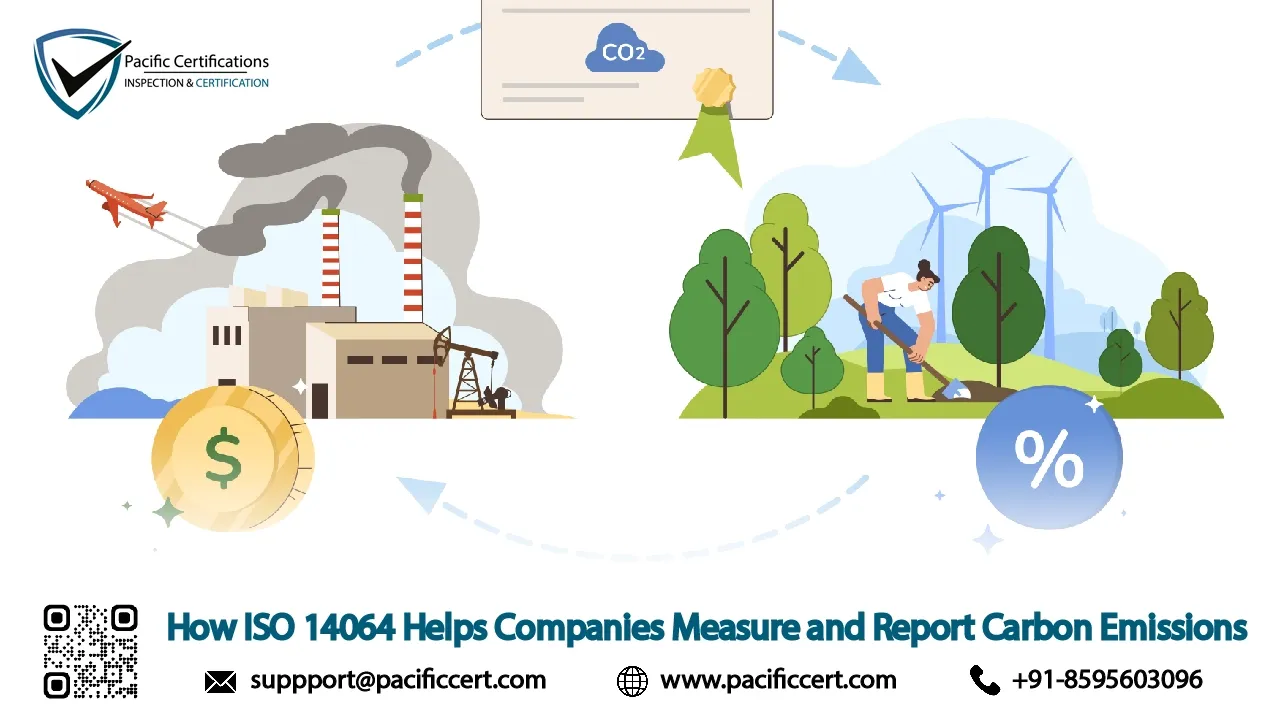
In today’s global economy, reducing carbon emissions has become central to building trust with regulators, investors and customers. Institutions across industries are under pressure to quantify their greenhouse gas (GHG) emissions, report progress transparently and align with sustainability targets set by international agreements. However, without a standardized framework, measuring and reporting emissions can be inconsistent, inaccurate and open to challenge.
This is where ISO 14064 comes in. It provides institutions with internationally recognized methods for quantifying, monitoring and reporting GHG emissions. By adopting ISO 14064, institutions can build reliable inventories of their emissions, set reduction goals and provide third-party verifiable reports that support environmental, social and governance (ESG) commitments. It also positions them competitively in markets where carbon disclosures are increasingly demanded.
Quick summary
ISO 14064 is a globally recognized standard for greenhouse gas accounting and reporting. It helps institutions measure direct and indirect emissions, verify carbon footprints and provide evidence for sustainability claims. Organizations use ISO 14064 to support compliance with regulations, attract investors and strengthen credibility in sustainability reporting.
Explore how ISO 14064 could structure your carbon inventory: Consider how defining organizational boundaries, emission sources, and scopes would clarify your overall greenhouse gas footprint.
Why ISO 14064 matters for carbon reporting?
ISO 14064 matters because it brings consistency and credibility to carbon reporting. Unlike internal methods, the standard ensures that emissions inventories are created using globally accepted definitions, boundaries and formulas. This makes reporting comparable across industries and regions.
It also links closely with climate regulations, carbon trading schemes and sustainability reporting frameworks like the GRI (Global Reporting Initiative) and CDP (Carbon Disclosure Project). Institutions certified to ISO 14064 carbon footprint can prove to regulators, investors and stakeholders that their reported emissions are verified and reliable, supporting both compliance and reputation.
Clause-wise Structure of ISO 14064 parts 1, 2 and 3
What are the requirements for ISO 14064?
To comply with ISO 14064, institutions must build a structured emissions accounting system. The main requirements include:

Define organizational boundaries (e.g., whole institution, subsidiaries, or specific facilities).
Identify emission sources including direct emissions, energy use, transportation and supply chain activities.
Select methodologies for calculating and verifying emissions in line with ISO 14064.
Collect data and evidence such as fuel usage logs, energy bills, transportation data and waste records.
Prepare an emissions inventory covering Scope 1, Scope 2 and relevant Scope 3 categories.
Set KPIs like emissions per product, energy intensity per unit output and carbon reduction rates.
Implement internal audits to confirm accuracy and completeness.
Correct nonconformities identified during reviews and update processes.
Leadership reviews to confirm objectives, targets and reduction strategies.
Provide transparent reports for external verification and disclosure.
How to prepare for ISO 14064 certification?
Preparation involves aligning current carbon accounting practices with ISO 14064 requirements and building credible evidence. The steps include:
Conduct a gap analysis of existing carbon measurement and reporting methods.
Develop policies on emissions monitoring, verification and reporting.
Train teams responsible for data collection and reporting.
Establish data systems to track fuel use, energy, logistics and waste emissions.
Integrate KPIs into sustainability dashboards for continuous monitoring.
Run trial audits to test data reliability and fix weaknesses.
Engage leadership to approve boundaries, targets and resource allocation.
Certification audit
Stage 1 audit: Reviews boundaries, methodologies, emissions inventory and supporting records.
Stage 2 audit: Evaluates implementation across operations, data systems and reporting practices.
Nonconformities: Must be corrected with evidence before certification approval.
Management review: Confirms leadership commitment to emissions monitoring and reduction targets.
Final certification: Awarded once compliance gaps are resolved.
Surveillance audits: Conducted annually to verify continued accuracy of emissions data.
Recertification audits: Required every three years to maintain long-term validity.
What are the benefits of ISO 14064?
Certification under ISO 14064 carbon footprint provides credibility, market access and operational insights. Institutions can track emissions reduction efforts with KPIs and SLAs that tie directly to sustainability goals. The main benefits include:

Global recognition of carbon reporting aligned with international standards
Improved accuracy in emissions data through standardized methods
Support for compliance with regulations and carbon trading schemes
Investor confidence backed by third-party verified sustainability reports
Market differentiation through credible carbon footprint claims
Performance monitoring with KPIs such as emissions per unit of output
Better reputation as a responsible, transparent institution
In recent years, ISO 14064 has gained momentum as more governments mandate emissions reporting and investors demand ESG accountability. Institutions are increasingly integrating ISO 14064 with ISO 50001 for energy management and ISO 14001 for environmental management to create comprehensive sustainability frameworks.
Another trend is the use of digital tools to collect and analyse emissions data in real time, allowing institutions to publish live dashboards with KPIs such as emissions intensity, carbon offset progress and audit closure times. Institutions also link SLAs with suppliers to ensure accurate reporting of upstream emissions. This demonstrates that ISO 14064 is no longer just about compliance but about measurable, transparent sustainability performance.
Contact us
Pacific Certifications, accredited by ABIS, provides ISO 14064 certification services for institutions worldwide. Our audits help strengthen sustainability reporting, improve emissions measurement and build credibility with regulators and investors.
Request your ISO audit plan and fee estimate, we will help you map Stage-1/Stage-2 timelines and evidence requirements for your institution. Contact us at support@pacificcert.com or visit www.pacificcert.com.
Author: Alina Ansari
Read more: Pacific Blogs