Introduction
Coverage of the revision has so far been limited, which is somewhat surprising given how directly it touches two areas companies are already under mounting pressure to address: biodiversity and the circular economy.
For organizations already managing sustainability disclosure obligations under frameworks like the Corporate Sustainability Reporting Directive (CSRD), this revision arrives at a genuinely useful moment.
Tip: Align sustainability and quality teams to streamline environmental data collection across EMS requirements and existing ESG reporting activities.
ISO 14001:2026 Edition
What has changed is the scope of environmental conditions organizations are expected to consider, and the introduction of a new clause on managing change.
Specifically, Clause 4.1 now requires organizations to consider climate change, biodiversity, ecosystem health, pollution levels and the availability of natural resources when determining the context of the organization — expanding well beyond the climate-only focus introduced through the 2024 amendment to the 2015 edition. A new Clause 6.3, Planning of Changes, introduces the kind of systematic change management already familiar from ISO 9001 and ISO 45001, requiring organizations to plan and control changes that affect the environmental management system.
The informative Annex A has also been substantially expanded, providing more detailed explanation and practical examples to support interpretation of requirements throughout the standard.
ISO 14001 revision changes
Restructured risk and opportunity planning. Identification of environmental risks and opportunities is now separated more clearly from the planning of actions to address them, giving organizations a cleaner structure to follow and audit against.
Stronger life-cycle perspective. Environmental aspects, risks and emergency preparedness must now account for impacts across the full life cycle of products and services, not just facility-level activity.
Greater control over externally provided processes and services. Organizations are expected to extend oversight further into their supply chains, covering both upstream suppliers and downstream partners.
More visible leadership accountability. Top management is expected to manage environmental aspects more actively and to visibly drive continual improvement in environmental performance, rather than delegating this entirely to an EMS coordinator.
Clarified documentation and audit requirements. Internal audits now require more explicit definition of objectives, criteria and scope for each audit conducted.
Taken together, these changes are described by most certification bodies as an evolution rather than a fundamental overhaul, the 2015 structure remains, but the substance of what organizations must actually consider and evidence has expanded meaningfully.
ISO 14001 Biodiversity
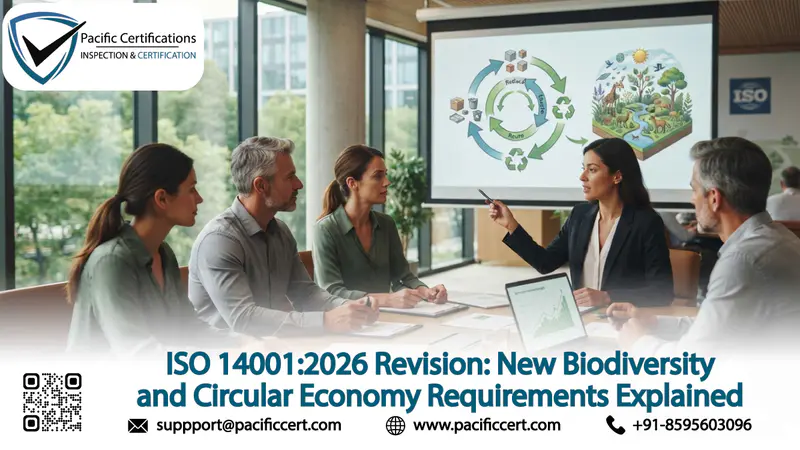
Under the revised Clause 4.1, organizations must now factor biodiversity and ecosystem health into their assessment of organizational context, alongside climate change, pollution and resource availability.
This is not a token addition. Organizations are expected to consider how their operations, products and value chains affect biodiversity, whether through land use, water consumption, emissions affecting ecosystems, or supply chain sourcing from biodiversity-sensitive regions. For manufacturing, agriculture, forestry, construction and extractive industries, this is likely to represent a substantive new area of assessment.
For office-based or service organizations with lighter direct environmental footprints, the expectation is more likely to focus on understanding indirect biodiversity impacts through the supply chain, procurement decisions and any land or facility-related activity.
Practically, incorporating biodiversity into an existing EMS typically involves:
Identifying whether the organization's operations or supply chain intersect with biodiversity-sensitive areas or ecosystems.
Assessing whether current environmental aspects registers already capture biodiversity-related impacts, even indirectly, or whether this is a genuine gap.
Engaging procurement and supply chain teams to understand biodiversity risk further upstream, particularly for organizations sourcing raw materials from agriculture, forestry or extractive sectors.
Setting objectives or targets related to biodiversity where relevant impacts are identified, rather than treating biodiversity as a narrative addition with no measurable commitment behind it.
Circular economy ISO
This connects directly to the standard's strengthened life-cycle perspective: organizations are now expected to think about resource use, waste generation, and end-of-life impacts of their products and services as part of a continuous loop, rather than a linear extract-use-dispose model.
In practice, this shows up through several requirements working together rather than a single standalone circular economy clause. Resource availability is now explicitly named as an environmental condition to be considered under Clause 4.1. The strengthened life-cycle perspective under environmental aspects planning pushes organizations to examine how products and services are designed, used and eventually disposed of or recovered. And the extended requirements around externally provided processes and services mean circular economy thinking needs to extend into supplier relationships as well, since material recovery, reuse and recycling frequently depend on choices made earlier in the supply chain.
Organizations building circular economy considerations into their EMS should focus on:
Reviewing how materials and resources are consumed across the product or service lifecycle, and where reduction, reuse or recycling opportunities exist.
Assessing waste streams not just for compliant disposal, but for genuine recovery or circularity potential.
Engaging design and product development functions, where relevant, since circularity is often determined at the design stage rather than at end-of-life.
Reviewing supplier and procurement criteria to reflect circular economy expectations, particularly where packaging, materials sourcing or take-back schemes are involved.
Takeaway: Apply circular economy thinking across ISO 14001:2026 context, environmental aspects, life-cycle considerations and supplier controls rather than treating it separately.
Environmental management 2026: who is affected and what needs updating
New applicants pursuing certification can now certify directly against the 2026 edition, since it is the current published version. For organizations reviewing their existing EMS documentation, the priority areas to update include:
Context and environmental aspects registers. Expand the review of organizational context to explicitly include biodiversity, ecosystem health, pollution levels and resource availability, alongside the climate considerations already required since 2024.
Life-cycle assessments. Extend environmental aspects identification and risk planning across the full life cycle of products and services, including upstream sourcing and downstream use or disposal.
Change management documentation. Establish or formalize a process, satisfying the new Clause 6.3, for planning and controlling changes that could affect the EMS — this does not need to be an elaborate standalone procedure, but evidence of planned, controlled change needs to exist.
Supplier and procurement documentation. Update criteria and oversight processes to reflect extended accountability for externally provided processes, products and services, including circular economy expectations where relevant.
Internal audit programs and checklists. Ensure each audit defines clear objectives, criteria and scope, and that audit questions now probe biodiversity, resource use and circular economy considerations alongside traditional environmental compliance topics.
Leadership engagement records. Document how top management is visibly driving environmental performance improvement, since the revision places clearer expectations on leadership accountability.
Connecting to CSRD and ESG reporting pressure
CSRD reporting under the European Sustainability Reporting Standards already requires companies to disclose material impacts, risks and opportunities related to biodiversity and ecosystems, resource use and circular economy, alongside climate.
An EMS built around ISO 14001:2026 now tracks data and impacts across largely the same categories, which means the environmental management system can become a genuine operational foundation for ESG disclosure rather than a separate compliance exercise running in parallel.
Organizations that integrate their ISO 14001:2026 update with their CSRD or broader ESG reporting preparation stand to benefit in both directions: EMS data on biodiversity impact, resource consumption and life-cycle considerations can feed directly into sustainability disclosures, while the rigor and audit trail CSRD reporting demands can, in turn, strengthen the credibility and completeness of the EMS itself.
Organizations that keep these two efforts siloed risk duplicating data collection and assessment work that could otherwise be shared across both.
How Pacific Certifications can help?
Pacific Certifications can provide:
Gap analysis support comparing an existing EMS against ISO 14001:2026, including the new biodiversity and circular economy considerations
Independent ISO 14001:2026 certification audits, subject to applicable accreditation and scope arrangements
Stage 1 documentation and certification-readiness audits
Stage 2 implementation and effectiveness audits
Transition audits for organizations moving from ISO 14001:2015
Annual surveillance audits and triennial recertification audits
Pacific Certifications conducts impartial certification audits and does not design, implement or manage environmental management systems for its certification clients, and does not provide ESG or CSRD reporting advisory services.
Contact Us
To request an ISO 14001:2026 certification priorities contact support@pacificcert.com or visit www.pacificcert.com.
Also read: ISO 14001 implementation guide for 2026