Introduction to ISO 14001:2026
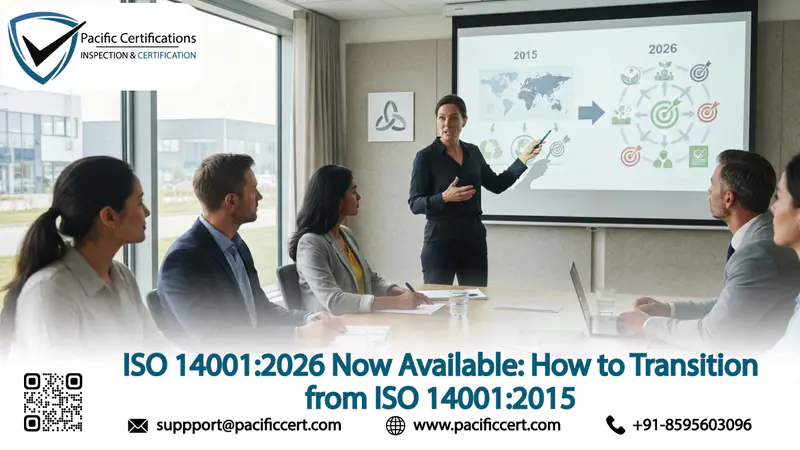
The new edition replaces ISO 14001:2015 and formally absorbs the climate change amendment issued in 2024, while adding refinements around biodiversity, life-cycle thinking, supply chain accountability and change management.
For the hundreds of thousands of organizations already certified to ISO 14001:2015, the priority now shifts from monitoring the revision process to actually managing the transition. The International Accreditation Forum has set a three-year transition period, meaning existing certificates must move to the new edition by approximately April or May 2029.
While that timeline feels distant, certification bodies typically recommend starting the gap analysis well in advance so the transition can be folded into a regular surveillance or recertification audit rather than treated as a separate, disruptive exercise.
Tip: Complete the transition during a scheduled surveillance or recertification audit where practical, avoiding the need for a separate transition audit.
Key Changes from ISO 14001
The key differences organizations should plan around are:
Climate change integration: The 2024 amendment to Clauses 4.1 and 4.2 is now built into the core standard rather than existing separately.
Broader context factors: Clause 4.1 now names biodiversity, ecosystem health, pollution levels and natural resource availability alongside climate change.
New change management clause: Clause 6.3 requires organizations to plan and control changes that could affect the EMS widely considered the most significant structural addition.
Restructured risk and opportunity planning: Identifying risks and opportunities now sits in Clause 6.1.4, separate from planning actions to address them in Clause 6.1.5.
Strengthened life-cycle perspective: A new note in Clause 6.1.2 extends environmental aspects and risk planning across the full value chain, upstream and downstream.
Defined internal audit scope: Clause 9.2.2 now requires documented objectives, criteria and scope for each internal audit.
ISO 14001 Transition Timeline
Now: Obtain the final published text of ISO 14001:2026 and brief leadership and the EMS team on what has changed.
Within the next few months: Conduct a formal gap analysis comparing the current EMS against the new clause structure.
Following the gap analysis: Update EMS documentation, aspects registers, risk and opportunity planning, and the change management process.
Before the next scheduled audit: Train staff, particularly internal auditors, on the revised requirements.
Ahead of the transition audit: Conduct internal audits and a management review using the updated criteria.
At the scheduled cycle point: Complete the transition audit, ideally combined with a surveillance or recertification audit.
By April or May 2029: Ensure certification has formally transitioned to ISO 14001:2026, after which ISO 14001:2015 certificates will no longer be valid.
Organizations that delay the gap analysis until close to the deadline risk competing for certification body capacity with every other organization doing the same thing at the same time.
Conducting a Gap Analysis
It should cover:
Compare the current environmental context review (Clause 4.1) against the expanded list of factors: climate change, biodiversity, pollution and natural resource availability.
Review Clause 4.2 to confirm interested parties and their expectations are documented with the clarity the new edition expects.
Assess whether risk and opportunity identification and action planning are already separated in practice, or whether they need to be restructured to align with Clauses 6.1.4 and 6.1.5.
Evaluate current change management practices against the new requirements of Clause 6.3.
Review how life-cycle thinking is applied across scope-setting, environmental aspects and operational controls.
Check whether supplier and procurement processes reflect extended environmental accountability for externally provided processes, products and services.
Confirm internal audit planning documents define objectives, criteria and scope for each audit, per Clause 9.2.2.
Document every gap identified, along with an owner and target date for closure.
Updating EMS Processes and Documentation
Revising the environmental context and interested parties analysis to include the expanded factors.
Updating the aspects register to reflect life-cycle impacts across the value chain, not just facility-level activity.
Restructuring the risk and opportunity register to separate identification from action planning.
Formalizing a change management procedure or evidence trail to satisfy Clause 6.3 — this does not need to be a heavy, standalone procedure, but the organization must be able to show changes were planned and controlled.
Updating supplier qualification and procurement documentation to reflect broader environmental accountability.
Revising internal audit templates to capture defined objectives, criteria and scope for each audit.
Updating the EMS manual and policy statements to reflect the revised clause numbering and terminology.
Takeaway: Update and extend existing EMS documentation rather than starting from scratch, as much of the required information may already exist.
Training Employees and Internal Auditors
Effective training programs typically address:
A general awareness session for all employees covering what has changed and why it matters to their roles.
Focused training for environmental management system owners on the restructured clauses and expanded context factors.
Specific training for internal auditors on the new Clause 6.3 change management requirements and how to audit them.
Guidance for procurement and supply chain staff on the extended accountability for externally provided processes and services.
Refresher training for anyone responsible for defining internal audit objectives, criteria and scope under the revised Clause 9.2.2.
Practical exercises using real examples from the organization's own operations, rather than generic clause-by-clause reviews, to help staff connect the changes to daily work.
Internal Audit and Management Review
This should include:
Auditing whether the environmental context review reflects biodiversity, pollution and resource availability, not just climate change.
Testing whether risk and opportunity identification and action planning are genuinely separated and traceable to each other.
Reviewing evidence that EMS-relevant changes have been planned and controlled under Clause 6.3.
Confirming that life-cycle thinking is evident in aspects identification and operational controls, including supplier-related activity.
Verifying that each internal audit conducted has documented objectives, criteria and scope.
Feeding all findings into a management review that explicitly addresses readiness for the transition audit, along with resource needs and any outstanding gaps.
Preparing for the Transition Audit
Confirm timing with the certification body, ideally combining the transition with a scheduled surveillance or recertification audit.
Ensure all documentation reflects the revised clause numbering and terminology used in ISO 14001:2026.
Have evidence ready for the new change management clause, such as change forms, meeting records or workflow logs.
Prepare examples showing how the life-cycle perspective has been applied in practice, including supplier and procurement decisions.
Ensure internal audit records demonstrate the defined objectives, criteria and scope required under Clause 9.2.2.
Brief relevant staff so they can speak confidently to auditors about the changes in their own areas, rather than leaving all responses to a single EMS manager.
Close out any gap analysis findings that remain open, or have a documented plan and timeline for those still in progress.
Common Transition Mistakes
A frequent mistake is waiting too long to begin the gap analysis, which creates pressure close to the 2029 deadline and increases competition for certification body audit slots.
Another common mistake is treating Clause 6.3 as a purely documentary exercise, creating a procedure that exists on paper but is not actually followed when changes occur in practice.
Organizations also sometimes underestimate how far the life-cycle perspective now needs to extend, continuing to focus assessments on their own facilities while overlooking upstream suppliers and downstream use or disposal.
Finally, some organizations update documentation without correspondingly training internal auditors, leaving audits that still test against the old 2015 clause structure rather than the revised requirements.
Transition Checklist
Has the final ISO 14001:2026 text been obtained and reviewed against the current EMS?
Is a documented gap analysis complete, covering all restructured clauses?
Does the environmental context review now address biodiversity, pollution and resource availability?
Is there evidence that EMS-relevant changes are planned and controlled under Clause 6.3?
Has the life-cycle perspective been extended to scope, aspects and operational controls, including suppliers?
Have internal auditors been trained on the revised clause structure and new requirements?
Do internal audit records show defined objectives, criteria and scope for each audit?
Has a management review addressed transition readiness and any remaining gaps?
Has the transition audit been scheduled with the certification body?
Is there a clear plan to complete the transition well ahead of the April or May 2029 deadline?
How Pacific Certifications can help?
Pacific Certifications can support organizations transitioning from ISO 14001:2015 to ISO 14001:2026 with:
Gap analysis support comparing an existing EMS against ISO 14001:2026
Transition audits combined with scheduled surveillance or recertification audits
Stage 1 documentation and certification-readiness audits for new applicants
Stage 2 implementation and effectiveness audits
Annual surveillance audits and triennial recertification audits
Pacific Certifications conducts impartial certification audits and does not design, implement or manage environmental management systems for its certification clients.
Contact Us
To request an ISO 14001:2026 certification priorities contact support@pacificcert.com or visit www.pacificcert.com.
Also read: ISO 14001 implementation guide for 2026