# ISO 14001:2015 Meaning and Requirements for Environmental Management Success
Author: Pacific Certifications
Author URL: https://blog.pacificcert.com/author/pacific-certifications/
Published: 2025-12-23
Meta Title: ISO 14001:2015 Meaning & Success | 2026 Requirements Guide
Meta Description: Master ISO 14001:2015 requirements for EMS success. Expert guide to Clause 4.1 Climate Amendments, lifecycle thinking, and the 2026 standard revision.
Tags: ISO 14001, ISO 14001:2015, ISO 14001 meaning, ISO 14001 requirements
Tag URLs: ISO 14001 (https://blog.pacificcert.com/tag/iso-14001/), ISO 14001:2015 (https://blog.pacificcert.com/tag/iso-140012015/), ISO 14001 meaning (https://blog.pacificcert.com/tag/iso-14001-meaning/), ISO 14001 requirements (https://blog.pacificcert.com/tag/iso-14001-requirements/)
URL: https://blog.pacificcert.com/iso-14001-2015-meaning-and-requirements/
## **Introduction**
ISO 14001:2015 is the **most widely** used standard for environmental management systems. It gives organizations a structured way to manage environmental impacts, use resources wisely, control waste and meet environmental commitments. Instead of treating the environment as a side topic, it brings it into daily planning, operations and leadership review.
ISO 14001:2015 can be **applied** in manufacturing, construction, logistics, energy, services, agriculture, healthcare and many other sectors. The standard does not tell you what your environmental performance must be, it asks you to understand your impacts, set goals and run a system that keeps those goals in view.
If your organization is planning ISO 14001 certification, or wants to review its environmental management system for 2026, you can request an ISO audit plan from [Pacific Certifications](https://pacificcert.com/) to discuss scope, timelines and evidence requirements.
## **Quick summary**
[_ISO 14001:2015_](https://pacificcert.com/iso-14001-2015-environmental-management-systems/) _is the international standard for environmental management systems and a key tool for ISO certification and implementation. It helps organizations identify environmental aspects, understand risks and opportunities, plan controls, set objectives, monitor performance and review results at leadership level. When used well, ISO 14001:2015 reduces waste and incidents, supports resource savings and builds confidence with customers, regulator and communities._
For more information on how we can assist your ISO 14001 certification, please contact us at [**support@pacificcert.com**](mailto:support@pacificcert.com).
## **Why ISO 14001:2015 matters for organizations?**
Customers, investors and communities now look much **more closely** at how organizations manage energy, waste, emissions and resource use. Many contracts and project approvals include environmental conditions. At the same time, energy and material costs affect margins and long-term planning.
ISO 14001:2015 matters because it turns environmental topics into a **structured system**, instead of isolated projects. It helps you identify where your activities interact with the environment, decide which impacts are most important, plan controls and check whether they work.
## **What ISO 14001:2015 means in practice?**
In practical terms, ISO 14001:2015 asks you to **build** an environmental management system that fits your size and activities. The system should cover how you plan work, manage changes, control operations, respond to problems and review performance. It is based on the **Plan–Do–Check–Act** cycle, which means you plan your environmental approach, run it, check results and adjust.
The standard does not require every organization to meet the same targets. Instead, it **expects** you to know your own significant environmental aspects, such as emissions, waste, water, chemicals, noise or land use, then plan goals and controls around those.
## What are the ISO 14001 requirements?
Before implementing ISO 14001:2015, organizations should understand that it is a full management system, not just a set of procedures. Below are some of the key ISO 14001 requirements:
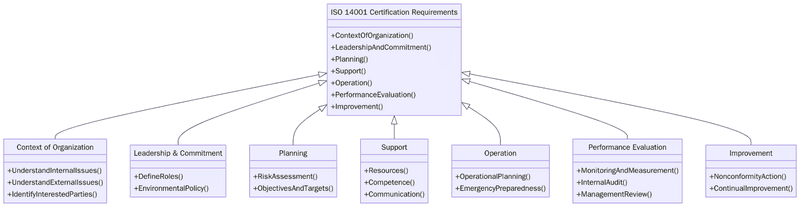
1. **Define** the scope of the environmental management system, including sites, activities, products and services covered.
2. **Understand** internal and external context, including legal duties, market pressures and environmental conditions relevant to your operations.
3. **Identify** interested parties such as regulators, customers, neighbors, employees and owners, and understand their environmental needs.
4. **Identify** environmental aspects and impacts for your activities is a core requirement in ISO 14001 implementation.
5. **Establish** an environmental policy that includes commitment to protection of the environment, compliance duties and continual improvement of the EMS.
## **How to prepare for ISO 14001:2015 implementation?**
Preparation for ISO 14001:2015 should start with understanding your real environmental impacts and existing controls. Below are some of the key preparation steps:
1. **Map** your activities and processes, and list where they interact with air, water, soil, materials and waste.
2. **Collect** information on current environmental controls, such as permits, monitoring results, waste contracts and maintenance routines.
3. **Review** training needs so that people who influence environmental performance understand their responsibilities.
4. **Plan** an internal audit programme that will assess the EMS and environmental controls across the chosen scope.
5. **Prepare** for management review by deciding which environmental indicators and reports leadership should see, and how often.
## **Certification audit**
**Stage 1 audit:** Review of EMS scope, environmental policy, identified aspects and impacts, compliance obligations, objectives, documented processes and readiness for Stage 2.
**Stage 2 audit:** Verification of implementation across operations, including evidence of controls for significant aspects, monitoring records, training, emergency readiness, compliance evaluations and internal audits.
**Nonconformities:** Must be corrected with clear root cause analysis, improved processes or controls, updated documentation and records showing that new practices are in use.
**Management review:** Confirmed as a planned activity where leadership reviews environmental performance, objectives, audit results, incidents, compliance status and improvement actions.
**Recertification audits:** Required every three years to review the EMS as a whole, including new activities, sites, environmental aspects and legal or market changes.
## **What are the benefits of ISO 14001?**
When ISO 14001 is applied in a practical way, environmental topics become part of routine management rather than occasional campaigns. Below are some of the key benefits:
1. **Better** control of environmental risks linked with emissions, waste, spills and resource use.
2. **Clearer** understanding of legal and other environmental duties, and how they are managed.
3. **Improved** planning of energy, water and material use, which delivers measurable cost saving and support long-term sustainability.
4. **Better** control of environmental risks and costs.
5. **Stronger** readiness for environmental incidents through defined procedures and drills.
6. More consistent environmental performance across different sites and shifts.
7. **Easier** access to tenders, contracts and export markets that require environmental certification.
8. **Easier** communication with regulators, customers and communities about environmental efforts.
## Market Trends
Organizations are increasingly linking **ISO 14001:2015** with climate goals, energy planning and supply chain decisions. Data from meters, sensors and production systems is being used to track environmental performance more closely, rather than relying only on manual logs. Many companies are also combining **ISO 14001:2015 with** [**ISO 9001:2015**](https://pacificcert.com/iso-9001-2015-quality-management-system-certification/) **, ISO 45001:2018** and **ISO 50001** in integrated systems, so that quality, environment, health and safety and energy are reviewed together. In coming years, pressure from customers and investors is likely to keep growing, especially around emissions, resource use and life cycle thinking.
## **Training and courses**
Pacific Certifications provides accredited training programs. If your organization is looking for ISO 14001 training, our team is equipped to help you.
- [**Lead Auditor Training**](https://pacificcert.com/lead-auditor-training/): supports professionals who assess environmental management systems, including aspects, compliance obligations, controls and performance evaluation.
- [**Lead Implementer Training**](https://pacificcert.com/lead-implementer/): supports teams that design, upgrade or extend an environmental management system in line with ISO 14001.
## **How Pacific Certifications can help?**
Pacific Certifications provides accredited audit and certification services for ISO 14001:2015. We review EMS scope, environmental aspects and impacts, legal and other obligations, objectives, operational controls, monitoring, internal audits and management reviews. We also support ISO 14001 integration with ISO 9001 and ISO 45001 where organizations run an integrated management system. We issue Certificates of Conformity following impartial audits, and we do not provide consultancy or EMS design services.
### Contact Us
To request an ISO audit plan and certification quote, or discuss environmental management certification for your organization, contact [support@pacificcert.com](mailto:support@pacificcert.com) or visit [www.pacificcert.com](https://pacificcert.com/).
**Author: Alina Ansari**
Read more: [Pacific Blogs](https://blog.pacificcert.com/)
ISO 14001:2015 Meaning, Standard and Core Requirements
## FAQs
Q: Who can use ISO 14001?
A: Any organization that wants a structured way to manage environmental impacts and duties.
Q: Is ISO 14001 only for heavy industry?
A: No, it can be used in services, offices, logistics, healthcare and public sector as well.
Q: Does ISO 14001 set fixed performance targets?
A: No, it asks you to set your own objectives based on your aspects and context.
Q: What is ISO 14001?
A: It is the international standard for environmental management systems.
Q: How long does ISO 14001 certification take?
A: Most small and mid-sized organizations need around 4–9 months from gap analysis to certification, multi-site or complex operations can take 9–18 months depending on scope and readiness.
Q: Do we need an environmental manager to get certified?
A:
You need clear responsibilities and competence, which can be held by one or more people.
Q: Does ISO 14001 cover legal compliance?
A: It requires you to identify and manage your compliance obligations, and review them regularly.
Q: Can ISO 14001 be integrated with ISO 9001 and ISO 45001?
A: Yes, many organizations run an integrated management system covering several standards.
Q: Is monitoring and measurement required under ISO 14001?
A: Yes, you must monitor key environmental parameters and objectives and keep records.
Q: What is the first step toward ISO 14001?
A:
Define your scope, then build a simple ISO 14001 implementation roadmap covering gap review, aspect and impact analysis, objectives, controls and internal audit preparation.
---
This blog is powered by Superblog. Visit https://superblog.ai to know more.
---