# ISO 14000 Family - Environmental Management for Sustainable Business
Author: Pacific Certifications
Author URL: https://blog.pacificcert.com/author/pacific-certifications/
Published: 2025-11-13
Meta Title: ISO 14000 Family Guide | Sustainable Environmental Management
Meta Description: Master the ISO 14000 family. Expert guide to ISO 14001:2026 updates, Climate Action mandates, eco-design and life-cycle assessments for sustainable business.
Tags: ISO for Environmental Science, ISO 14001, Environmental Management, ISO 14001 Sustainable Business, ISO 14001 Family
Tag URLs: ISO for Environmental Science (https://blog.pacificcert.com/tag/iso-for-environmental-science/), ISO 14001 (https://blog.pacificcert.com/tag/iso-14001/), Environmental Management (https://blog.pacificcert.com/tag/environmental-management/), ISO 14001 Sustainable Business (https://blog.pacificcert.com/tag/iso-14001-sustainable-business/), ISO 14001 Family (https://blog.pacificcert.com/tag/iso-14001-family/)
URL: https://blog.pacificcert.com/iso-14000-family-environmental-management/
## Introduction
Environmental responsibility is **no longer** an option, it is a business necessity. The ISO 14000 family of standards provides organizations with the tools and frameworks to manage environmental responsibilities systematically and responsibly. It helps companies reduce waste, conserve resources and achieve compliance with environmental regulations while enhancing operational credibility and long-term sustainability.
In recent years, industries **worldwide**, from manufacturing to logistics and energy, are adopting ISO 14000 standards to meet sustainability goals, lower emissions and align with international environmental expectations. These standards establish structured environmental management systems (EMS) that go beyond compliance and drive measurable performance improvement.
Assess ISO 14000 Standards For Your Organization
## **Quick summary**
The [ISO 14000](https://pacificcert.com/iso-14001-2015-environmental-management-systems/) family focuses on environmental management systems, life cycle assessment, performance evaluation and environmental labelling. The most recognized among them, ISO 14001, defines the requirements for establishing, implementing, maintaining and improving an EMS. Other standards, such as ISO 14004, ISO 14040 and ISO 14044, provide specific guidance on environmental strategies, life cycle analysis and environmental footprint measurement. Together, they support organizations in achieving environmental compliance, transparency and sustainable growth.
## **Why ISO 14000 standard matters?**
Environmental degradation, carbon emissions and resource depletion are among the **most pressing** global challenges. The ISO 14000 series enable organizations to identify, monitor and control environmental aspects associated with their operations.
Certification ensures organizations reduce waste generation, manage resources responsibly and communicate sustainability performance credibly to customers and regulators. It also **helps** institutions integrate environmental management with quality, safety and energy standards for unified compliance.
> ISO 14000 transforms environmental accountability into measurable results, turning compliance into opportunity.
## **Key Standards within the ISO 14000 Family**
**Standard**
**Purpose**
**Focus Area**
**ISO 14001**
Requirements for Environmental Management Systems
Establishes EMS structure and policy framework
**ISO 14004**
General guidelines for EMS implementation
Practical guidance for continual improvement
**ISO 14006**
Eco-design integration into product development
Encourages sustainable product innovation
**ISO 14020–14025**
Environmental labelling and declarations
Ensures credible environmental communication
**ISO 14031**
Environmental performance evaluation
Sets indicators for monitoring environmental performance
**ISO 14040 & 14044**
Life Cycle Assessment (LCA) framework and requirements
Measures total environmental impact of products and services
**ISO 14064**
Greenhouse gas accounting and verification
Quantifies and manages emissions for carbon neutrality
Match ISO 14001 Certification To Your Scope
## **What are the requirements for ISO 14001 certification?**
To implement ISO 14001, institutions must establish an EMS that defines policies, objectives and controls related to environmental aspects. Below are the primary requirements:
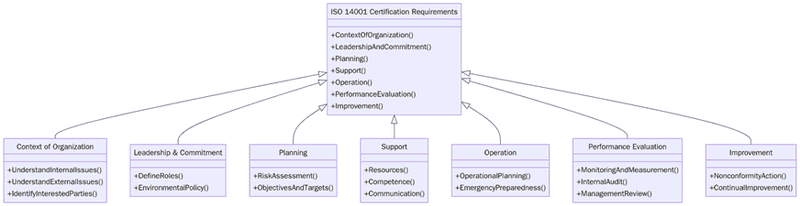
- **Identify** environmental aspects and evaluate their impacts.
- **Determine** compliance obligations and legal requirements.
- **Set** measurable environmental objectives and programs.
- **Develop** documentation for policies, controls and emergency response.
- **Allocate** resources and define roles for EMS implementation.
- **Conduct** training and awareness for all staff.
- **Monitor** performance and conduct periodic internal audits.
- **Implement** corrective actions and ensure continual improvement.
- **Conduct** management review meetings at planned intervals.
- **Maintain** transparent communication with stakeholders.
> **Tip:** Use digital environmental tracking systems to record data for energy use, waste management and emissions for easier reporting during audits.
## **How to prepare for ISO 14001 certification?**
Organizations must integrate environmental performance into their daily operations. Preparation involves both planning and system alignment.
1. **Conduct** a gap analysis against ISO 14001:2015 requirements.
2. **Develop** or refine the organization’s environmental policy.
3. **Create** an environmental aspect-impact register.
4. **Train** key personnel on EMS implementation.
5. **Establish** monitoring tools for energy, waste and water management.
6. **Perform** trial internal audits and identify nonconformities.
7. **Engage** management for review and policy approval before audit.
## **Certification audit**
1. **Stage 1 audit**: Review EMS documentation, environmental policy and scope.
2. **Stage 2 audit**: Assess implementation, monitoring and operational control.
3. **Nonconformities**: Address gaps through corrective actions with supporting evidence.
4. **Management review**: Confirms leadership involvement and performance evaluation.
5. **Final certification**: Issued upon successful compliance validation.
6. **Surveillance audits**: Conducted annually to monitor environmental performance.
7. **Recertification audits**: Required every three years to maintain compliance.
## **What are the benefits of ISO 14000 certification?**
Implementing ISO 14000 standards improves environmental responsibility, operational consistency and brand reputation. Below are the main benefits:
- **Reduced** environmental impact and improved resource management
- **Compliance** with national and international environmental laws
- **Lower** operational costs through waste reduction and energy efficiency
- **Improved** corporate image and stakeholder confidence
- **Better** environmental risk management and emergency preparedness
- **Easier** integration with ISO 9001, ISO 45001 and ISO 50001 systems
- **Data**-driven decision-making with environmental KPIs and audits
- **KPIs**: carbon footprint reduction rate, waste diversion percentage, audit closure cycle
- **SLAs**: environmental report submission time, incident response duration, energy review frequency
Strengthen ISO 14000 Sustainability Certification Value
## Market Trends
Organizations are adopting integrated sustainability systems combining **ISO 14001, ISO 50001** and **ISO 14064** for unified environmental performance tracking. Digital monitoring and AI analytics are being used to predict emissions, monitor waste patterns and validate supplier compliance. ISO 14001-certified companies are increasingly reporting results in ESG disclosures and sustainability indices.
**By 2030, ISO 14000 certifications** will become essential for ESG-driven investment eligibility and supply chain contracts. Companies will use blockchain-enabled traceability systems to document sustainability data transparently. AI-assisted audits and digital twin modelling will help predict environmental risks and reduce audit preparation time.
## **Training and courses**
Pacific Certifications offers accredited programs for the ISO 14000 family, with focus on ISO 14001:
- [**Lead Auditor Training**](https://pacificcert.com/lead-auditor-training/) **:** For individuals performing environmental management audits and assessing EMS implementation.
- [**Lead Implementer Training**](https://pacificcert.com/lead-implementer/): For professionals responsible for establishing and maintaining EMS aligned with ISO 14001 and related standards.
To enroll in training programs or workshops, contact [**support@pacificcert.com**](mailto:support@pacificcert.com).
## **How do Pacific Certifications help?**
Pacific Certifications provides accredited ISO 14001 certification and audit services under the ISO 14000 family of standards. Our audits assess environmental performance, operational control, legal compliance and documentation alignment with ISO requirements.
We issue Certificates of Conformity after impartial audits to confirm system alignment and credibility without offering consultancy services.
### Contact Us
For an ISO 14001 certification plan and audit proposal, reach us at [**support@pacificcert.com**](mailto:support@pacificcert.com) or visit [**www.pacificcert.com**](https://pacificcert.com/).
Read more: [Pacific Blogs](https://blog.pacificcert.com/)
Contact us
Environmental Management for Sustainable Business
## FAQs
Q: What is the ISO 14000 family?
A:
It is a series of international standards covering environmental management, life cycle assessment and environmental performance.
Q: Is ISO 14001 mandatory?
A:
No, but it is globally recognized and often required for environmental tenders and ESG compliance.
Q: How long does certification take?
A:
Usually between 6–9 months depending on system readiness and complexity.
Q: Can ISO 14001 be integrated with other standards?
A:
Yes, it easily integrates with ISO 9001, ISO 45001 and ISO 50001.
Q: What are the main documents required?
A:
Environmental policy, aspect-impact register, compliance obligations and audit reports.
Q: Does certification improve energy performance?
A:
Yes, through structured monitoring and continual improvement.
Q: How often are audits required?
A:
Annual surveillance and three-year recertification audits are standard.
Q: What are the key performance indicators in EMS?
A:
Waste reduction percentage, emissions trend, energy consumption rate and corrective action closure time.
Q: Who can apply for ISO 14001 certification?
A: Any organization, manufacturing, services, or public sector, aiming to improve environmental performance.
Q: Why choose Pacific Certifications?
A:
Accredited by ABIS, Pacific Certifications provides impartial, globally recognized environmental certification services.
---
This blog is powered by Superblog. Visit https://superblog.ai to know more.
---