Post by Alina Ansari | June, 2026
What Is ISO 13623?
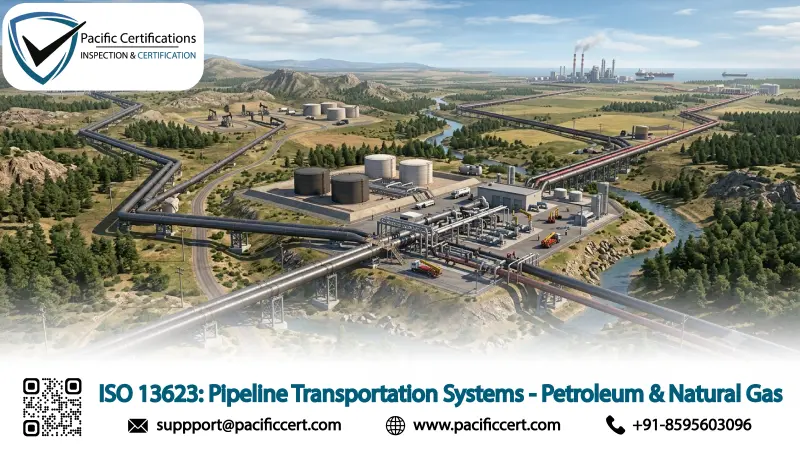
Published by ISO under ISO/TC 67 - the technical committee for materials, equipment and offshore structures for the petroleum, petrochemical and natural gas industries - it is the globally recognized technical reference for the engineering and management of hydrocarbon transmission pipeline systems.
The standard covers the complete lifecycle of a pipeline system - from conceptual design and detailed engineering through material procurement, construction, commissioning and into the operational phase covering maintenance, inspection, integrity management and ultimately the abandonment and decommissioning of pipeline assets at end of life. It applies to pipeline systems transporting crude oil, petroleum products, natural gas, liquefied petroleum gas and other hydrocarbon fluids under pressure - including the associated facilities that form part of the pipeline system such as compressor stations, pump stations, metering stations and pig launching and receiving facilities.
ISO 13623 helps petroleum and natural gas pipeline operators manage design, construction, testing, operation, maintenance and abandonment through a lifecycle safety framework - Pacific Certifications
What is the Scope of Pipeline Systems?
Included Pipeline Systems
ISO 13623 applies to onshore and offshore transmission pipeline systems - the high-pressure, long-distance transportation infrastructure that moves hydrocarbons between production facilities, processing plants, storage terminals and distribution systems. This includes crude oil trunk lines, refined product pipelines, natural gas transmission pipelines, gas gathering systems, liquefied petroleum gas pipelines and multi-product pipelines.
Associated Facilities
ISO 13623 applies not only to the pipeline itself but to the associated facilities that form integral parts of the pipeline system - including compressor stations and pump stations that maintain operating pressure, block valve stations and mainline valves that enable isolation of pipeline sections, metering and measurement stations, pigging facilities for inspection and cleaning, cathodic protection systems and SCADA and control systems governing pipeline operations.
Excluded Systems
ISO 13623 explicitly excludes from its scope: pipework within processing plants and refineries; wellhead equipment and flow lines within a production facility boundary; distribution systems downstream of city gate stations; subsea production systems and flowlines connecting wellheads to subsea manifolds; and storage facilities including tank farms, LNG terminals and underground storage - each of which is governed by its own applicable standards.
Practical Tip: Define the pipeline scope clearly, including transmission lines, associated facilities, stations, pigging systems, corrosion protection and control systems.
What are the Design and Construction Requirements of Pipeline Systems?
Design Philosophy and Safety Concept
ISO 13623 adopts a risk-based design philosophy - requiring that pipeline design is based on a systematic assessment of all hazards associated with the pipeline system and the environments through which it passes and that the design incorporates the measures needed to reduce risk to acceptable levels.
Safety Classes
A defining feature of ISO 13623's design framework is the safety class concept - which classifies pipeline sections according to the potential consequences of a failure. Safety class is determined by the location class of the pipeline - reflecting the density of population and land use in the pipeline corridor - and by the fluid category being transported.
Wall Thickness and Design Factor
Pipe wall thickness is calculated from the hoop stress equation, with the maximum allowable operating pressure determined by applying a design factor to the specified minimum yield strength of the pipe material - the design factor being determined by the safety class of the pipeline section. ISO 13623 specifies design factor values for each safety class - ranging from 0.50 for the highest consequence locations to 0.80 for locations remote from population centers.
Material Requirements
Linepipe materials must meet defined requirements for yield strength, tensile strength, impact toughness, hardness and weldability - aligned to industry standards including API 5L, ISO 3183 and equivalent national standards. ISO 13623 specifies requirements for material traceability, heat treatment and inspection at the mill - ensuring that materials incorporated in the pipeline system conform to their specified properties and can be traced throughout the system's life.
Welding and Construction
Construction must be conducted in accordance with documented welding procedures that have been qualified to the applicable standard, by welders and welding operators who have been tested and certified. Non-destructive examination of welds - including radiographic or ultrasonic testing of girth welds - must be conducted at defined inspection frequencies based on safety class.
Commissioning and Hydrostatic Testing
Before being placed in service, every new pipeline must be subjected to a pressure test - typically a hydrostatic test using water - at a test pressure above the maximum allowable operating pressure, held for a defined duration. The hydrostatic test verifies the structural integrity of the pipeline system and provides confidence that no significant defects are present. ISO 13623 specifies minimum test pressure ratios and test duration requirements for each safety class.
Final Remark: Pipeline safety begins with engineering decisions that account for pressure, material properties, route conditions, safety class and foreseeable hazards.
What are the Operations and Maintenance of Pipeline Systems?
Operating Pressure Management
The maximum allowable operating pressure (MAOP) must be established for each pipeline section and documented - the pipeline must not be operated above its MAOP at any location. Pressure control systems - including pressure safety valves, pressure relief valves and SCADA-controlled pressure monitoring - must be maintained in operational readiness at all times.
Leak Detection and Emergency Response
Pipeline operators must implement systems capable of detecting leaks and taking immediate action to minimize the consequences of a release - including isolating the affected section, mobilizing emergency response resources and notifying regulatory authorities and affected parties. ISO 13623 requires that emergency response plans are developed, documented, communicated to all relevant personnel and exercised at defined intervals to verify their effectiveness. The emergency response plan must address all foreseeable scenarios - including small leaks, major ruptures, fires and third-party damage incidents.
Cathodic Protection
All buried or submerged metallic pipeline sections must be protected against external corrosion by a cathodic protection system - in conjunction with an external corrosion protection coating system. ISO 13623 requires that cathodic protection systems are designed to maintain pipeline potentials within defined protective ranges at all locations along the pipeline and that cathodic protection surveys are conducted at defined intervals to verify that protection is being achieved and maintained.
Maintenance Program
A documented maintenance program must be established covering all safety-critical equipment and systems associated with the pipeline - including compressor and pump station equipment, block valves, instrumentation, corrosion protection systems and control systems. Maintenance activities must be documented and records retained as part of the pipeline's operational history.
Final Remark: Operational safety depends on maintaining pressure control, emergency readiness, corrosion protection and safety critical equipment throughout the pipeline life.
What is Integrity Management of Pipeline Systems?
Inspection and Assessment
ISO 13623 requires that pipeline operators conduct periodic inspections of their pipeline systems - assessing the condition of the pipe, welds, coatings, cathodic protection systems and associated facilities against defined criteria. Inline inspection - using intelligent pigging tools that traverse the pipeline interior measuring wall thickness, detecting corrosion, dents and cracks - is the primary inspection method for transmission pipelines and provides the comprehensive condition data needed to support fitness-for-service assessment.
Defect Assessment and Fitness for Service
When inspection reveals defects - corrosion metal loss, mechanical damage, cracking, or geometric deformation - a fitness-for-service assessment must be conducted to determine whether the defect is acceptable, requires remediation, or requires immediate repair before continued operation. ISO 13623 provides the framework for defect assessment - referencing the methods of ISO 24817 for repair of metallic pipelines and the established assessment methodologies of documents such as BS 7910 for fracture and fatigue assessment.
Data Management
Effective integrity management depends on the availability of accurate, complete and current pipeline data - including as-built design parameters, material certificates, construction records, inspection history, repair records, operational history and incident records. ISO 13623 requires that pipeline data is managed systematically - maintained in accessible records, updated following any modification or significant operational event and available for use in integrity assessment and regulatory reporting throughout the pipeline's operational life.
ISO 13623 integrity management helps operators prove that pipeline condition is known, deterioration is controlled and continued operation remains safe - Pacific Certifications
What is Risk Assessment of Pipeline Systems?
Hazard Identification
ISO 13623 requires that a systematic hazard identification is conducted for each pipeline system - identifying all foreseeable threats that could cause a loss of containment or other safety-significant event. The threat taxonomy for transmission pipelines includes: external corrosion; internal corrosion; stress corrosion cracking; mechanical damage from third-party excavation; manufacturing defects in pipe or welds; construction defects; incorrect operation.
Risk Evaluation and Tolerability
Pipeline risk must be evaluated against defined tolerability criteria - covering both individual risk to members of the public and workers in the vicinity of the pipeline and societal risk reflecting the total harm potential of a major pipeline failure. ISO 13623 requires that risk is expressed in quantitative terms where practicable.
Risk-Based Inspection
The risk assessment framework is directly applied to the planning of inspection and maintenance activities - using the assessed likelihood and consequence of each failure threat to prioritize inspection resources on the highest-risk sections and threat mechanisms. Risk-based inspection planning is widely recognized as more effective than time-based inspection schedules - concentrating resources where they deliver the greatest safety benefit rather than distributing them uniformly across a pipeline system regardless of risk profile.
Third-Party Damage Prevention
Third-party mechanical damage from excavation activities is one of the most significant causes of pipeline incidents globally - and ISO 13623 requires that pipeline operators implement a comprehensive damage prevention program covering: marking and notification of pipeline routes; liaison with planning authorities to ensure that excavation activities in the pipeline corridor are notified to the operator; patrol and surveillance of the pipeline right of way; and appropriate burial depth and additional protective measures in areas of high excavation risk.
Practical Tip: Pipeline risk assessment should connect hazard identification, consequence analysis, inspection planning and damage prevention into one documented process.
ISO 13623 Pipeline Systems Certification Cost
Pipeline operators with large, geographically dispersed systems spanning multiple regions or jurisdictions will require multi-site audit programs that reflect the scope and complexity of operations.
Adding ISO 22301 for business continuity and ISO/IEC 27001 for operational technology security extends the program to cover all dimensions of pipeline operational governance under internationally recognized certifications. Pacific Certifications provides transparent, fixed-fee proposals covering all certifications in scope so your organization has complete cost visibility before the process begins.
Cost planning should consider employee count, operational sites, pipeline geographic spread, control centers, pump or compressor stations and selected ISO standards.
Certification Timeline - ISO 13623
This includes 3 to 5 weeks for gap analysis and management system documentation review, 8 to 12 weeks for system development covering procedure documentation, risk assessment updates, legal compliance registers and operational control procedures aligned to the requirements of all three standards and 3 to 4 weeks for Stage 1 and Stage 2 certification audits. Organizations building management systems from a minimal documentation baseline - or those incorporating multiple operational sites or jurisdictions within a single certification program - should plan for 6 to 9 months.
The SCADA and control system security requirements of ISO/IEC 27001 for pipeline operators involve specialist operational technology security assessment that is distinct from standard IT security ISMS work - organizations should ensure that the implementation team includes personnel with both pipeline control system expertise and information security management competence. Assigning a dedicated integrated management system coordinator with cross-functional authority across operations, engineering, HSSE and IT functions is the single most effective organizational measure for keeping a complex multi-standard certification program on track.
A Practical Tip from Pacific Certifications: Pipeline operators can avoid delays by preparing risk assessments, operational controls, emergency plans, inspection records and multi-site audit evidence early.
How Pacific Certifications Can Help?
Independent certification audits for ISO 9001, ISO 14001, ISO 45001, ISO 22301, ISO/IEC 27001 and ISO 55001
Integrated management system audits covering multiple standards in coordinated, efficient audit visits
Stage 1 and Stage 2 audit execution across pipeline operators, engineering contractors and oilfield services organizations
Clear, transparent audit reports with conformity findings and certification decisions
Issuance of internationally recognized ISO certificates upon successful audit completion
Annual surveillance and triennial recertification audits to maintain certificate validity
Pacific Certifications does not provide consultancy - our role is strictly that of an independent auditor, ensuring your certificate carries full credibility with operating company clients, project financiers, regulatory authorities and government bodies in every jurisdiction you operate in.
Contact Us
To get started with your management system certification program or initiate your audit, contact us at support@pacificcert.com or +91-8595603096.
For training programs, contact us at trainings@pacificcert.com.
Visit www.pacificcert.com for more information.
Also Read: ISO Certifications for Pipeline Transport Businesses, Requirements and Benefits