# Implementing ISO 13485 for Medical Devices and Key Mistakes
Author: Pacific Certifications
Author URL: https://blog.pacificcert.com/author/pacific-certifications/
Published: 2025-11-26
Meta Title: ISO 13485 Implementation Guide 2026 | Steps & Common Mistakes
Meta Description: Master ISO 13485:2016 for medical devices. Expert guide to 2026 implementation, FDA QMSR alignment, risk management (14971), and avoiding costly audit mistakes.
Tags: ISO 13485 for Medical Devices, ISO 13485:2016, ISO 13485 Certification, ISO 13485 Implementation, Medical devices ISO
Tag URLs: ISO 13485 for Medical Devices (https://blog.pacificcert.com/tag/iso-13485-for-medical-devices/), ISO 13485:2016 (https://blog.pacificcert.com/tag/iso-134852016/), ISO 13485 Certification (https://blog.pacificcert.com/tag/iso-13485-certification/), ISO 13485 Implementation (https://blog.pacificcert.com/tag/iso-13485-implementation/), Medical devices ISO (https://blog.pacificcert.com/tag/medical-devices-iso/)
URL: https://blog.pacificcert.com/implementing-iso-13485-for-medical-devices-and-key-mistakes/
## **Introduction**
The medical device industry continues to expand as institutions work to meet global expectations for safety, traceability and product reliability. **ISO 13485** has become the central quality requirement for manufacturers, component suppliers, testing facilities, sterilization partners and distributors who want to establish strong control over design, production and post-market performance. As regulatory scrutiny continues to increase and global supply chains become more interconnected, adopting ISO 13485 is shifting from optional to necessary. Institutions that implement the standard successfully gain structured control over operations, reduce defect risks and build credibility with regulators, buyers and healthcare partners.
For many organizations, implementation becomes **challenging** when the QMS is treated as a documentation exercise rather than an operational system. ISO 13485 demands clarity in design controls, risk management, sterile processing, procurement oversight and complaint handling. When implemented correctly, it creates reliability throughout the device life cycle and sets a strong foundation for compliance with national and international medical device regulations.
## **Quick summary**
[_ISO 13485_](https://pacificcert.com/iso-13485-2016-medical-devices-qms/) _establishes a structured quality management system for medical device organizations, focusing on risk-based decision-making, product traceability, design and development controls, supplier oversight, sterile processing, market feedback handling and documentation consistency. Implementing the standard allows institutions to align their QMS with regulatory expectations and support high-quality, safe medical device production._
[**Explore your current risk areas:**](https://pacificcert.com/contact-us/) Take a step back and identify which parts of your business would be most affected by sudden disruption.
## **Why ISO 13485 matters for medical device institutions?**
Institutions manufacturing or supporting medical device supply chains operate in environments where even minor errors can lead to patient harm, delayed approvals, or regulatory intervention. ISO 13485 sets the foundation for **maintaining** consistency across design, procurement, production, testing, labelling, distribution and post-market oversight. By adopting the standard, organizations can structure processes, synchronize documentation and monitor performance reliably across the entire device lifecycle.
It also **supports** regulatory alignment by helping institutions demonstrate control over device compliance requirements, risk mitigation actions and complaint handling performance. For buyers and regulators, ISO 13485 certification shows that the QMS follows an internationally accepted medical device framework.
> Institutions that treat ISO 13485 as an operational system, not paperwork, gain stronger control over device safety, performance consistency and regulatory alignment.
## **What are the requirements for ISO 13485?**
Before implementing ISO 13485, institutions must understand that the system requires consistency in design controls, risk management, supplier oversight and post-market processes. The requirements ensure a traceable and controlled workflow across the entire product lifecycle. Below are the key requirements:
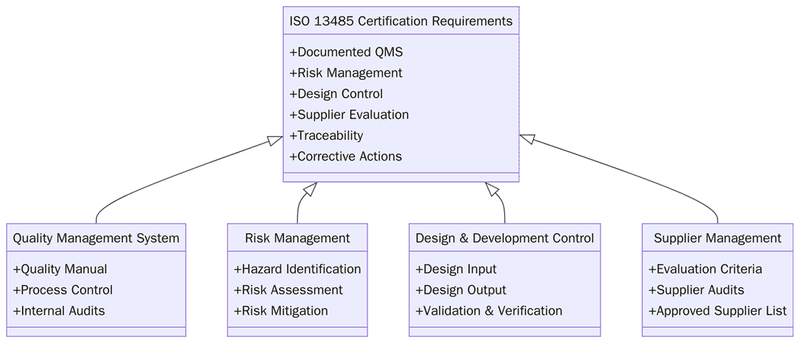
01. **Define** the scope of devices, services and processes included in the QMS.
02. **Establish** a quality policy and measurable device-related quality objectives.
03. **Maintain** documented procedures for design and development controls.
04. **Conduct** risk management activities aligned with device hazards and intended use.
05. **Ensure** supplier evaluation, monitoring and documented purchasing controls.
06. **Maintain** validated production, sterilization and cleaning processes where applicable.
07. **Establish** device traceability procedures for components and finished products.
08. **Manage** calibration and maintenance of equipment and measuring instruments.
09. **Implement** controls for complaint handling, nonconformities and corrective actions.
10. **Conduct** internal audits and management reviews at planned intervals.
**Tip:** _Create traceability matrices linking design inputs, risk assessments, verifications and validations to visualize lifecycle control clearly._
## **How to prepare for ISO 13485 implementation?**
Preparing for ISO 13485 involves more than writing policies. Institutions must align processes, responsibilities and quality records with device requirements.
1. **Conduct** a structured gap analysis comparing current operations with ISO 13485 clauses.
2. **Prepare** a quality manual outlining the structure of your QMS.
3. **Document** procedures and work instructions for design, purchasing, manufacturing and testing.
4. **Train** personnel on device-specific QMS responsibilities.
5. **Validate** manufacturing or cleaning processes that affect device performance.
6. **Strengthen** supplier controls using qualification, monitoring and performance records.
7. **Conduct** internal audits to confirm readiness for certification.
## **Certification audit**
**Stage 1 audit:** Review of documentation, design control files, QMS structure and device records.
**Stage 2 audit:** Verification of implementation across production, testing and traceability.
**Nonconformities:** Must be resolved with evidence and corrective action records.
**Management review:** Confirms leadership involvement and QMS effectiveness.
**Final certification:** Issued once controls meet ISO 13485 requirements.
**Surveillance audits:** Conducted annually to verify continued control.
**Recertification audits:** Required every three years to renew compliance.
## **What are the benefits of ISO 13485?**
ISO 13485 provides strong quality assurance for institutions, improves device safety and supports market access. When implemented fully, it builds operational discipline and reduces variability throughout device development and production. Below are the key benefits:
01. **Reduced** device defects and improved consistency in production.
02. **Better** control over design and development activities.
03. **Stronger** regulatory alignment across global medical device markets.
04. **Improved** supplier oversight and component reliability.
05. **Enhanced** device traceability in case of failures or recalls.
06. **Improved** complaint and feedback management.
07. **Better** performance visibility through QMS KPIs.
08. **KPIs:** defect rate trend, supplier rejection rate, complaint closure time, validation cycle time.
09. **SLAs:** supplier response timelines, corrective action closure deadlines, document review cycles.
10. **Better** readiness for regulatory inspections and market approval.
## Market Trends
Medical device institutions are moving toward stronger **risk-based QMS structures** aligned with lifecycle performance. Digital quality management tools are improving design documentation, traceability and complaint analytics. Institutions are increasingly using remote audits, cloud-based documentation and predictive performance indicators. Integrated QMS structures combining **ISO 13485** with **ISO 14971** and **ISO 9001** are also becoming more common as device expectations evolve.
In the coming years, institutions will rely heavily on data-driven validation, predictive risk modelling and integrated QMS platforms. **Digital traceability systems** using RFID and blockchain-based audit trails will support visibility across supply chains. **Regulatory systems** are expected to align more closely with **ISO 13485** structures, making certification a central requirement for market entry, faster approval cycles and international distribution.
## **Six most common mistakes institutions make during ISO 13485 implementation**
Institutions implementing ISO 13485 encounter recurring mistakes that affect compliance and readiness. Addressing these early makes the QMS more reliable.
1. **Treating** ISO 13485 as a documentation project instead of an operational system.
2. **Weak** risk management with inconsistent linkages to design and process controls.
3. **Incomplete** supplier oversight and missing verification records.
4. **Poor** traceability across components, batches, or finished devices.
5. **Not** validating processes that directly affect device performance.
6. **Insufficient** training and unclear role-based responsibilities.
## **Training and courses**
Pacific Certifications provides accredited training programs for ISO 13485:
- [**Lead Auditor Training**](https://pacificcert.com/lead-auditor-training/) **:** For professionals evaluating device design controls, risk management and traceability.
- [**Lead Auditor Training**](https://pacificcert.com/lead-auditor-training/) **:** For teams establishing or strengthening QMS operations for medical device manufacturing and lifecycle control.
For QMS training tailored to medical device requirements, contact [**support@pacificcert.com**](mailto:support@pacificcert.com).
## **How Pacific Certifications can help?**
Pacific Certifications provides accredited audit and certification services for ISO 13485. We assess design control files, manufacturing processes, risk management, complaint handling and documentation to verify alignment with the standard. We issue Certificates of Conformity following impartial audits and do not provide consultancy or QMS design services.
### Contact Us
To request an audit plan or discuss certification scope, contact [support@pacificcert.com](mailto:support@pacificcert.com) or visit [www.pacificcert.com](https://pacificcert.com/).
### Author: Alina
Read more: [Pacific Blogs](https://blog.pacificcert.com/)
Implementing ISO 13485 for Medical Devices and Key Mistakes
## FAQs
Q: Who needs ISO 13485 certification?
A: Medical device manufacturers, component suppliers, calibration labs, sterilization services and distribution partners.
Q: Does ISO 13485 apply to design as well as manufacturing?
A: Yes, it covers the entire lifecycle including design, production, testing and post-market activities.
Q: How long does ISO 13485 certification take?
A: Timelines depend on documentation readiness, design complexity and production scope.
Q: Can ISO 13485 be integrated with ISO 14971?
A: Yes, it strongly aligns with risk management requirements.
Q: Is ISO 13485 required by regulators?
A: Many regulatory bodies expect compliance for device market access.
Q: Are suppliers included in certification scope?
A: Suppliers must be evaluated and monitored but are not certified under your scope.
Q: Do small manufacturers need ISO 13485?
A: Yes, it applies to institutions of any size involved in device activities.
Q: Is a quality manual still required?
A: Yes, ISO 13485 still requires a documented quality manual.
Q: Is ISO 13485 similar to ISO 9001?
A:
It is based on ISO 9001 principles but is specialized for medical device safety and regulatory control.
Q: What evidence is needed for certification audits?
A: Design files, risk management reports, validation data, training records, calibration logs and traceability evidence.
---
This blog is powered by Superblog. Visit https://superblog.ai to know more.
---