# How to Choose the Right ISO Standard for Your Industry?
Author: Pacific Certifications
Author URL: https://blog.pacificcert.com/author/pacific-certifications/
Published: 2025-09-11
Meta Title: How to Choose the Right ISO Standard 2026 | Industry Guide
Meta Description: Expert guide to selecting ISO 9001, 14001, 27001 or 45001. Learn about 2026 revisions, industry-specific standards, and the 2025 Climate Amendments.
Tags: ISO 9001:2015, iso certifications, ISO 14001:2015, Get ISO Certified, Right ISO standard
Tag URLs: ISO 9001:2015 (https://blog.pacificcert.com/tag/iso-90012015/), iso certifications (https://blog.pacificcert.com/tag/iso-certifications/), ISO 14001:2015 (https://blog.pacificcert.com/tag/iso-140012015/), Get ISO Certified (https://blog.pacificcert.com/tag/get-iso-certified/), Right ISO standard (https://blog.pacificcert.com/tag/right-iso-standard/)
URL: https://blog.pacificcert.com/how-to-choose-right-iso-standard-for-your-industry/
## **Introduction**
Choosing which ISO standard to **follow** may be one of the most critical choices an institution makes in their desire to improve quality, safety, security, or sustainability. There are now more than 24,000 ISO standards, each standard is assigned to a distinct area. Institutions can be confused about which certification will provide the most beneficial return on investment. For example, a manufacturer may be focused on product quality and occupational safety, while a data centre may focus on data security, information security and uptimes guarantee. For health care institutions, patient safety and continuity of care are paramount. In the finance industry, standards may focus on data protection and risk management. The decision on which ISO standard to **follow** needs to be made upon considering the type of services offered, industry compliance and clients' expectations. This makes developing a clear decision-making process for selecting ISO standards important for ensuring long-term confidence and competitiveness.
ISO standards exist to **develop** global frameworks that will allow institutions to deliver on customer expectations while meeting legislation and managing risks. With all the ISO standards developed, it is not unusual for an institution to struggle to identify which standard is applicable. Worse, if an organisation selects the wrong standard it can result in wasted resources. On the positive side, selecting the right standard increases credibility for their organisation while assuring clients of continuous measurable improvement.
A systematic approach is warranted. In selecting an ISO standard, institutions need to consider the relevant risks in their sector, legal requirements and any contract obligations. They should consider long-term client trust for collaboration, as many sectors require recognised certification to work together. When an institution has the right ISO certification, it can enhance the possible growth, resiliency and global consideration in its activities.
## **Quick summary**
Selecting the right standard of ISO requires understanding the risks, regulatory responsibilities, and expectations of customers in your industry. For instance, when considering standards for manufacturing, ISO 9001 and ISO 45001 may be of most importance among ISO standards.
[Review how industry regulations and client expectations shape your choices](https://pacificcert.com/contact-us/): Reflect on the certifications commonly requested in tenders, contracts, and regulatory frameworks in your sector.
## **Why selecting the right ISO standard matters?**
Certification is not just about earning a badge, it represents the institution’s commitment to maintaining reliable systems. Choosing the correct standard ensures that certification efforts address real risks and align with industry needs. For example, a logistics provider without [ISO 28000](https://pacificcert.com/iso-28000-2022-security-and-resilience/) for supply chain security may face difficulties in winning contracts, while a hospital without [ISO 13485](https://pacificcert.com/iso-13485-2016-medical-devices-qms/) or [ISO 9001](https://pacificcert.com/iso-9001-2015-quality-management-system-certification/) may lose credibility in medical device management.
## **ISO Standards by Industry**
**Industry**
**Relevant ISO Standards**
**Focus**
**Manufacturing**
ISO 9001, [ISO 14001](https://pacificcert.com/iso-14001-2015-environmental-management-systems/), [ISO 45001](https://pacificcert.com/iso-45001-lead-auditor-training/)
Product quality, environmental responsibility, worker safety
**Healthcare & Medical Devices**
ISO 13485, ISO 9001, [ISO 22301](https://pacificcert.com/iso-22301-2019-business-continuity-management-systems/)
Medical device quality, patient safety, continuity of care
**Data Centres & Cloud Providers**
[ISO/IEC 27001](https://pacificcert.com/iso-iec-27001-2022-information-security-management-systems/), ISO 22301, [ISO 20000-1](https://pacificcert.com/iso-iec-20000-1-2018-information-technology/)
Information security, business continuity, IT service management
**Finance & Banking**
ISO/IEC 27001, ISO 22301, ISO 9001
Data protection, continuity, quality management
**Construction & Engineering**
ISO 9001, ISO 14001, ISO 45001
Quality in projects, sustainability, occupational safety
**Education & Training**
[ISO 21001](https://pacificcert.com/iso-21001-2018-educational-organizations/), ISO 9001, ISO/IEC 27001
Learner-focused management, institutional quality, information security
**Energy & Utilities**
[ISO 50001](https://pacificcert.com/iso-50001-energy-management/), ISO 14001, ISO 22301
Energy management, environmental responsibility, resilience
**Logistics & Supply Chain**
ISO 28000, ISO 9001, ISO 22301
Supply chain security, service quality, continuity
## **What are the requirements when selecting the right ISO standard?**
The selection process must have certain criteria for institutions to correctly choose the appropriate certifications. These will ensure that any certification selected addresses real needs and can sustain. Below is a list of criteria to consider:
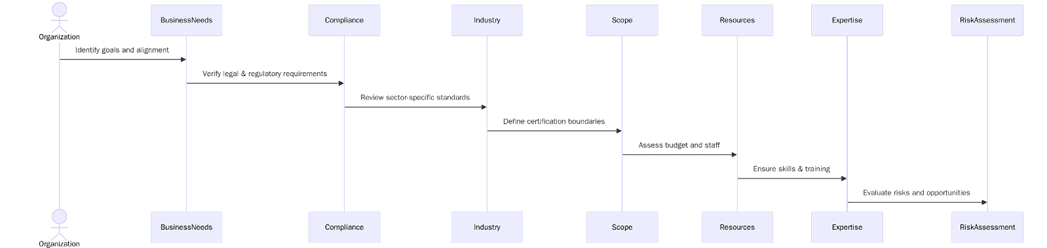
01. **Identify** industry-specific risks such as data breaches, product failures or issues related to patient safety.
02. **Scope** the certification concerning services, location, or departmental impact.
03. **Scrutinise** your regulatory obligations, as well as any specific laws for your sector that require certification.
04. **Define** who the stakeholders are, be sure to include leadership, customers and regulators.
05. **Perform** a gap analysis mapping your current practices to relevant ISO standards.
06. **Document** any priorities such as quality, security, safety and continuity.
07. **Provide** proof that the standards selected are relevant to institutional imperatives such as SLA monitoring/auditing for compliance.
08. **Assess** costs and resources needed for training, documentation and audits.
09. **Plan** for non-duplicated efforts and possibly overlap with existing certifications.
10. **Stay** committed to continual review as industry risks and regulations change over time.
## **Certification audit**
Certification is verified through a two-stage audit by an accredited body:
**Stage 1 audit:** Reviews documentation, policies, and risk assessments.
**Stage 2 audit:** Checks implementation across services, infrastructure and staff responsibilities.
**Nonconformities** must be addressed before certification is granted.
**Management review:** It ensures leadership oversight.
**Final certification:** It is awarded after successful compliance.
**Surveillance:** Audits take place annually.
**Recertification:** Audits occur every three years.
## **What are the benefits of choosing the right ISO standard?**
Picking the right ISO standard for your organization is beneficial beyond simply getting certified - it confirms that your resources were applied to the areas deserving the most attention of your clients and regulators. Your organization can track other improvements using key performance indicators (KPIs) like service level agreement (SLA) compliance, incident response time and customer satisfaction or the amount of time to close audit findings. The primary benefits include:
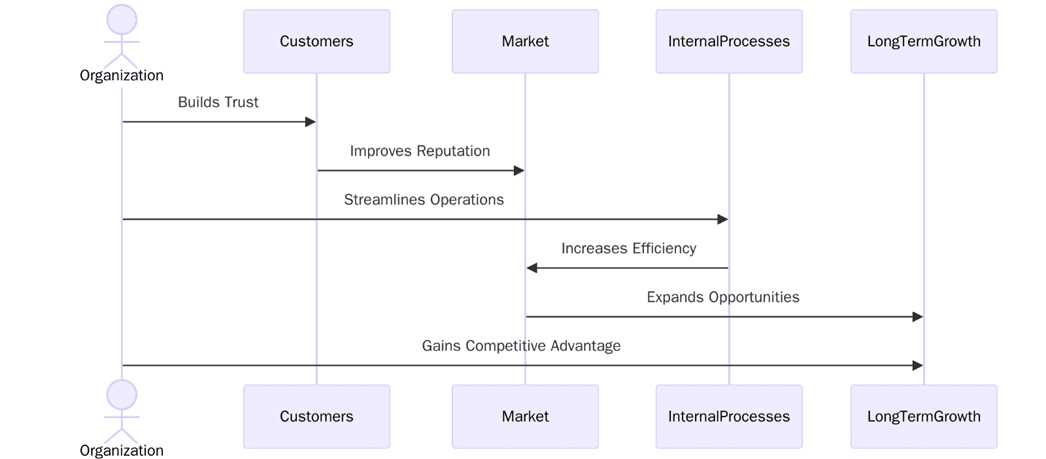
- **Enhanced** credibility with clients and regulators
- **Market access** through compliance with required buyer and industry requirements
- **Reduction** of risk through the mitigation of industry specific vulnerabilities
- A more **strong governance** framework that includes documented systems and accountability
- **Improved** staff training tied to industry priorities
- **Sustainability** through measuring outcomes and ongoing improvement.
In recent years, organizations are beginning to adopt integrated management systems, unifying multiple ISO standards into one system. For example, cloud providers generally adopt ISO/IEC 27001, ISO 22301 and ISO 20000-1 at the same time. Manufacturers combine ISO 9001, ISO 14001 and ISO 45001. This unification minimizes duplication and streamlines audits.
There is also greater emphasis on the utilization of ISO certifications to complement an organization's ESG (environmental, social and governance) commitments or focuses. As ISO 14001 and ISO 50001 gain momentum, institutions check KPIs and documentation for concepts such as downtime rate, service level agreement (SLA) reporting and resolution times % to ensure that certification is not merely cosmetic and actually improving how they function.
## **How can Pacific Certifications help?**
Pacific Certifications provides accredited ISO certification services tailored to every sector. Our audits help institutions identify the right standards, build resilience, and meet client and regulatory expectations.
Request your ISO audit plan and fee estimate, we will help you map Stage-1/Stage-2 timelines and evidence requirements for your institution.
### Contact Us
Contact us at [support@pacificcert.com](mailto:support@pacificcert.com) or visit [www.pacificcert.com](https://pacificcert.com/).
### Author: Alina Ansari
**Read More at:** [**Blogs by Pacific Certifications**](https://blog.pacificcert.com/)
How to Choose the Right ISO Standard
## FAQs
Q: How do I know which ISO standard is right for my industry?
A:
By reviewing risks, regulations, and client requirements, then aligning them with relevant ISO standards.
Q: Can one institution hold multiple ISO certifications?
A: Yes, many institutions combine standards into integrated management systems to cover multiple needs.
Q: Do clients require specific ISO standards?
A:
Yes, many contracts specify mandatory certifications such as ISO 27001 for cloud providers or ISO 9001 for manufacturers.
Q: How long does certification take once the standard is chosen?
A:
It usually takes 6 to 12 months, depending on readiness and scope.
Q: What are the costs of certification?
A:
Costs vary by size, scope, and audit requirements but are outweighed by long-term benefits.
Q: Can small institutions get ISO certified?
A:
Yes, ISO standards are scalable and apply to institutions of all sizes.
Q: How do KPIs and SLAs fit into ISO certification?
A:
They help measure reliability, uptime, and performance, providing evidence of compliance.
Q: Is ISO certification the same as accreditation?
A: No, accreditation applies to the certification body, while ISO certification applies to the institution.
Q: Do ISO certifications expire?
A:
Yes, certifications are valid for three years with annual surveillance audits.
Q: Can ISO certification improve global competitiveness?
A:
Yes, certification supports access to international markets and builds long-term credibility.
---
This blog is powered by Superblog. Visit https://superblog.ai to know more.
---