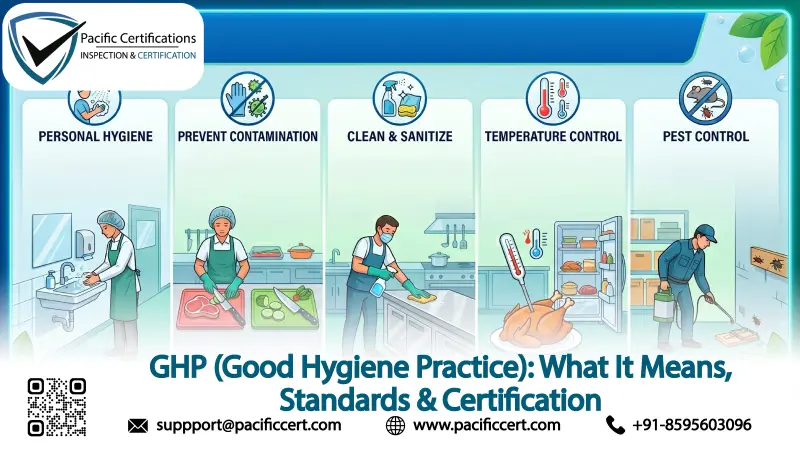
What is GHP?
Good Hygiene Practice, commonly referred to as GHP, defines the fundamental measures and conditions applied at every step within the food chain to produce safe and suitable food for consumption. Whether it applies to a primary production farm, a processing facility, a packaging unit, or a distribution center, GHP establishes the baseline hygiene requirements that all food businesses must meet before any advanced food safety system can be built on top.
The Codex Alimentarius Commission, which is the international body for food safety standards under the FAO and WHO, defines GHP as all practices regarding the conditions and measures necessary to ensure the safety and suitability of food at all stages of the food chain from primary production through to the handling of the final product. In practical terms, GHP means keeping people, surfaces, equipment, water, waste and facilities in a state that prevents contamination from reaching food at any point.
For food industry professionals, understanding what GHP means is the starting point for any compliance journey and for food businesses seeking certification, GHP compliance is a prerequisite that must be in place before certifying against HACCP, ISO 22000, or FSSC 22000.
GHP Principles
GHP is built around eight core areas as defined by the Codex Alimentarius Commission. These areas collectively cover the entire operating environment of a food business:

GHP vs GMP vs HACCP
GHP, GMP and HACCP are three distinct but interconnected frameworks in food safety. Understanding how they differ and how they relate to each other is essential before determining which certification your business needs.
GHP in Food Industry
In a food manufacturing environment, GHP translates into a set of daily operational practices that govern how people, equipment and facilities interact with food at every production stage. Food manufacturers are required to implement GHP not as a one-time exercise but as a continuously maintained operational standard.
Key GHP applications in food manufacturing include controlling staff health and hygiene, managing the flow of raw materials and finished products to prevent cross-contamination, maintaining calibrated temperature monitoring systems, ensuring water used in production meets potable standards and applying documented sanitation procedures to all food contact surfaces between production runs. Manufacturers supplying to major retailers, food service chains, or export markets are expected to demonstrate GHP compliance through documented evidence and third-party audits.
GHP compliance also directly supports regulatory requirements across jurisdictions. In the European Union, Regulation (EC) No 852/2004 on the hygiene of foodstuffs mandates GHP-aligned prerequisite programs for all food business operators. In India, FSSAI regulations require GHP implementation as part of the food safety management system. In the United States, FDA's Current Good Manufacturing Practice (cGMP) regulations under 21 CFR Part 117 overlap significantly with GHP requirements.
GHP Checklist
A practical GHP checklist covers the following areas across your facility and operations. This can be used as a self-assessment tool before pursuing formal certification:
Facility and Infrastructure
Food handling areas are constructed from cleanable, non-absorbent materials
Adequate lighting, ventilation and drainage are in place in all food zones
Pest entry points are sealed and active pest control programs are documented
Waste is segregated, stored away from food areas and removed at defined frequencies
Equipment and Utensils
All food-contact equipment is made from food-grade, non-toxic materials
Cleaning and disinfection schedules are documented for all equipment
Equipment is maintained and calibrated at defined intervals with records kept
Water and Utilities
Water used in food processing meets potable quality standards
Ice and steam used in food contact applications are produced from potable water
Water testing records are maintained and reviewed periodically
Personal Hygiene
All food handlers follow defined handwashing procedures at critical points
Staff with communicable illness or open wounds are excluded from food handling
Clean protective clothing, footwear and hair coverings are worn in food areas
No eating, drinking, or smoking is permitted in food handling zones
Cleaning and Sanitation
A Master Cleaning Schedule covers all areas, equipment and frequencies
Cleaning chemicals are food-safe, stored separately and used at correct dilutions
Post-cleaning verification is documented before production resumes
Temperature Control
Refrigerated and frozen storage areas are monitored and records are maintained
Hot holding and cooking temperatures meet defined minimum requirements
Traceability and Documentation
Incoming raw material records include supplier details and lot identification
Finished product batch records enable full traceability in the event of a recall
Staff Hygiene Controls
Staff hygiene is one of the most critical and most frequently non-conforming areas in GHP audits. Food businesses must implement documented, verifiable controls that govern the behavior and health status of all personnel who enter food handling areas.
Effective staff hygiene controls include a pre-employment health screening policy that identifies conditions that could pose a contamination risk, a clear procedure for staff to report illness or injury before commencing work and a documented induction training program covering personal hygiene requirements. All staff must be trained in correct handwashing technique, covering the full 20-second method at defined critical control points such as after toilet use, after handling raw materials, after touching waste and after any break period.
Protective clothing requirements must be defined in writing and enforced consistently. This includes clean outer garments, hair nets or caps, beard snoods where applicable and dedicated footwear for food handling zones. Visitors and contractors entering food areas must follow the same controls as permanent staff and records of their induction and compliance must be maintained.
Sanitation Procedures
A documented sanitation program is a non-negotiable GHP requirement. Sanitation in food manufacturing covers both cleaning, the physical removal of soil, residue and debris and disinfection- the reduction of microbial loads to safe levels on food-contact surfaces.
Effective sanitation procedures must specify the surface or equipment being cleaned, the cleaning agent and concentration to be used, the method and tools required, the contact time for disinfectants, the rinse requirements, the frequency of the procedure and the person responsible for completing and verifying the task. Each procedure must be documented in a Master Cleaning Schedule and completion must be signed off by the operative and verified by a supervisor or quality team member.
Pre-operational checks- conducted before production begins each day or shift, must confirm that all food-contact surfaces and equipment are visibly clean, free from chemical residue and sanitized. Where microbiological verification is required by the food safety plan, environmental swab testing programs must be implemented and results trended over time.
Auditor’s Practical Advice: Organizations preparing for a GHP audit should conduct a site inspection under normal operating conditions rather than reviewing documentation only. Interview employees, observe hygiene practices during production and trace a sample of records from the written procedure through to actual implementation.
How to Get GHP Certification?
GHP certification confirms that your food business has implemented and maintains the hygiene prerequisites required for safe food production. The certification process involves an independent third-party audit conducted by an accredited certification body against the applicable GHP standard, which may be referenced within Codex Alimentarius guidelines, national food safety regulations, or as the prerequisite program component of ISO 22000 or FSSC 22000. The process to achieve GHP certification follows these steps:
Step 1:Gap Analysis:
Assess your current hygiene practices against GHP requirements. Identify gaps in documentation, infrastructure, staff training, cleaning programs, pest control and operational controls.
Step 2: Prerequisite Program Development:
Document all GHP-related prerequisite programs (PRPs) - including cleaning schedules, personal hygiene policies, pest control procedures, waste management and supplier controls - in a format that is accessible, implementable and auditable.
Step 3: Staff Training:
Deliver and record GHP training for all food handlers and supervisors. Training must be role-specific and refreshed at defined intervals or when procedures change.
Step 4: Implementation and Evidence Generation:
Operate your GHP programs for a defined period - generating objective evidence such as cleaning records, temperature logs, pest control reports and staff training records - before applying for external audit.
Step 5: Internal Audit:
Conduct a structured internal audit against GHP requirements. Identify and resolve non-conformances before the external audit.
Step 6: Stage 1 Audit (Documentation Review):
The certification body reviews your GHP documentation to confirm that your prerequisite programs are complete, appropriate and ready for on-site assessment.
Step 7: Stage 2 Audit (On-Site Assessment):
Auditors assess your facility, operations, records and staff practices against GHP requirements. Conformance findings and any non-conformances are documented.
Step 8: Certification Decision and Issuance:
Upon successful completion of the audit, the certification body issues your GHP certificate, valid for three years subject to annual surveillance audits.
Certification Cost
The cost of GHP certification depends on the size of your food facility, the number of production lines or sites in scope, the complexity of your operations and the number of standards being pursued simultaneously. For a small food manufacturing unit pursuing standalone GHP assessment or GHP as a prerequisite component of ISO 22000, the investment is relatively accessible. For larger facilities with multiple production lines, cold storage areas and high employee counts, audit days and therefore cost will be proportionally higher.
The primary cost variables are audit days, which are determined by employee count, site complexity and certification scope. Where organizations pursue integrated certification, such as GHP alongside ISO 22000, ISO 9001, or HACCP integrated audits reduce total audit days and provide better value than separate certification processes for each standard. Organizations that engage an external consultant for GHP system development will incur additional implementation costs, though these are entirely separate from the certification body's audit fees. Pacific Certifications provides transparent, fixed-fee proposals so your organization has full visibility of audit costs before the process begins.
Certification Timeline
The time required to achieve GHP certification depends on your facility's current hygiene baseline, the completeness of existing documentation and the number of standards in scope. For a food business with basic hygiene infrastructure already in place and partial documentation available, GHP certification can be achieved in approximately 2 to 4 months. This includes 2 to 4 weeks for gap analysis and prerequisite program documentation, followed by 4 to 8 weeks for full implementation and evidence generation and then 1 to 2 weeks for the Stage 1 and Stage 2 audits conducted by the certification body. Certificate issuance follows within 1 to 2 weeks of a successful Stage 2 audit.
For food businesses starting from a minimal hygiene baseline, where infrastructure upgrades, full staff training programs and new documentation systems need to be built from the ground up - the timeline extends to 4 to 6 months. Where GHP certification is being pursued as part of a broader ISO 22000 or HACCP certification program, the timeline aligns with the more comprehensive standard, which for most food manufacturers runs between 4 and 9 months in total. Consistent daily implementation and thorough record-keeping from the start of the process are the most effective ways to stay within the target timeframe.
How Pacific Certifications Can Help?
Pacific Certifications is an ABIS-accredited independent certification body that provides GHP and food safety certification services to food manufacturers, processors, distributors and logistics providers globally. Accredited by ABIS, Pacific Certifications conducts impartial, evidence-based audits. Our services for food businesses include:
Independent GHP certification audits for food manufacturing and processing facilities
Certification audits for ISO 22000, HACCP and integrated food safety management systems
Stage 1 and Stage 2 audit execution across single and multi-site food operations
Clear, transparent audit reports with conformity findings and certification decisions
Issuance of internationally recognized certificates upon successful audit completion
Annual surveillance and triennial recertification audits to maintain certificate validity
Where nonconformities are identified, additional time must be allowed for correction, root-cause analysis, corrective-action submission and verification by the certification body. Certification cannot be recommended until applicable certification requirements have been satisfactorily fulfilled.
Pacific Certifications does not provide consultancy, our role is strictly that of an independent auditor, ensuring your certificate carries full credibility with regulators, retailers and trade partners.
Contact Us
To get started with your GHP certification or initiate your food safety audit, contact us at support@pacificcert.com or +91-8595603096. For training programs, contact us at trainings@pacificcert.com. Visit www.pacificcert.com for more information.
Read more: Pacific Blogs

