# The Future of ISO Certifications: AI, Cybersecurity and Global Supply Chains
Author: Pacific Certifications
Author URL: https://blog.pacificcert.com/author/pacific-certifications/
Published: 2025-08-21
Meta Title: The Future of ISO Certifications 2026 | AI, Cyber & Supply Chains
Meta Description: Explore the 2026 ISO landscape. Expert guide to AI governance (ISO 42001), cybersecurity (27001:2022), and resilient global supply chains (ISO 28000).
Tags: ISO 42001 for AI, ISO for Cybersecurity, ISO certifications for AI, ISO 9001 for Global Supply, ISO for Global Supply Chain
Tag URLs: ISO 42001 for AI (https://blog.pacificcert.com/tag/iso-42001-for-ai/), ISO for Cybersecurity (https://blog.pacificcert.com/tag/iso-for-cybersecurity/), ISO certifications for AI (https://blog.pacificcert.com/tag/iso-certifications-for-ai/), ISO 9001 for Global Supply (https://blog.pacificcert.com/tag/iso-9001-for-global-supply/), ISO for Global Supply Chain (https://blog.pacificcert.com/tag/iso-for-global-supply-chain/)
URL: https://blog.pacificcert.com/future-of-iso-certifications-ai-cybersecurity/
## **Introduction**
ISO certifications are becoming more and **more important** as organizations find themselves in an ever-changing business landscape characterized by new technological influence and global connectivity. Today, standards move beyond traditional quality or environmental management to eventually being able to be applied to advanced sectors including artificial intelligence, cybersecurity and supply chain management. The implementation of ISO standards offers organizations the **opportunity** to establish improved trust, minimize business disruption and inform their actions with the responsibility to comply with global regulatory demands.
As AI systems become more **prevalent** in decision making, while cyber threats remain continually evolving and as supply chains encompass multiple nations, organizations are being called to leverage established frameworks to meet the ongoing demand for accountability, trust, transparency, and resilience. ISO certifications can arm organizations with the tools and framework needed to readdress these issues and remain a strategic asset to organizations as **they live** into their responsibility to remain competitive and continue to be seen as a responsible corporate citizen in the recent years.
For more information, Reach out to us at [support@pacificcert.com](mailto:support@pacificcert.com).
## **AI and ISO: Setting Standards for Responsible Automation**
Artificial Intelligence is changing the way we work as well as new efficiencies; there are also new risks to manage. ISO standards for AI, like [ISO 42001](https://pacificcert.com/iso-iec-42001-2023-artificial-intelligence-management-system/), give organizations a **structure** for managing the operational, ethical and security risks from deploying AI systems. These standards will help organizations implement policies on responsible AI, define roles and accountability, monitor AI systems and decision-making, and ensure AI systems are not biased.
Organizations that are developing AI projects under ISO are able to show their regulators, customers, and partners that they are following international best practices, as there is some transparency with their AI deployment. [ISO standards](https://www.iso.org/home.html) will make AI deployments more trustworthy and in line with the organization's **business strategy**. ISO standards will also help organizations to engage in futures- thinking, in anticipation of regulatory developments related to AI governance; using ISO standards gives businesses a proactive approach to compliance and risk management.
## **Global Supply Chains: ISO for Resilience and Compliance**
Today’s supply chains are complicated, generally involving multiple countries and many different parties. Modern ISO standards around supply chain management, like [ISO 28000](https://pacificcert.com/iso-28000-2022-security-and-resilience/) for supply chain security management and [ISO 20400](https://pacificcert.com/iso-20400-2017-sustainable-procurement/) for sustainable procurement, give organizations recognized standards to identify risks, show compliance with customers and regulators, and ensure continuity of operations.
They help organizations determine **weaknesses** in their supply chains, help implement appropriate security measures, and ensure transparent processes are documented and made available at all stages in the supply chain. In addition, certifying against these ISO standards is a shows commitment to the ethical sourcing of goods, meeting compliance standards, and contributing to social responsibility. A certification also gives customers and investor’s confidence that an organization has viable systems to cater for unforeseen disruptions caused by geopolitical status, environmental conditions or failures of a supplier. Adopting supply chain ISO standards gives organizations opportunities to create a flexible operations model, whilst also establishing credibility in global markets.
## **Review the Requirements of the Standard**
Transparent processes in AI decision-making, secure information handling, and accountable supply chain management build credibility and confidence. Below are the key requirements of the standard:
1. **Establish** governance structures for AI, cybersecurity, and supply chain management aligned with ISO standards.
2. **Develop** documented procedures and policies to ensure compliance with relevant ISO frameworks.
3. **Conduct** risk assessments for AI systems, information security threats, and supply chain vulnerabilities.
4. **Implement** training programs to educate staff and stakeholders on compliance responsibilities.
5. **Monitor**, audit, and continually improve processes to meet ISO requirements.
6. **Maintain** records of corrective actions, process improvements, and compliance audits.
7. **Address** non-conformities promptly to ensure readiness for external certification audits.
For more information, Reach out to us at [support@pacificcert.com](mailto:support@pacificcert.com).
## **What are the Benefits of ISO Certifications?**
Implementing ISO standards in AI, cybersecurity, and supply chain management offers profound advantages that extend across organizational operations and external stakeholder confidence. Below are some of the key benefits:
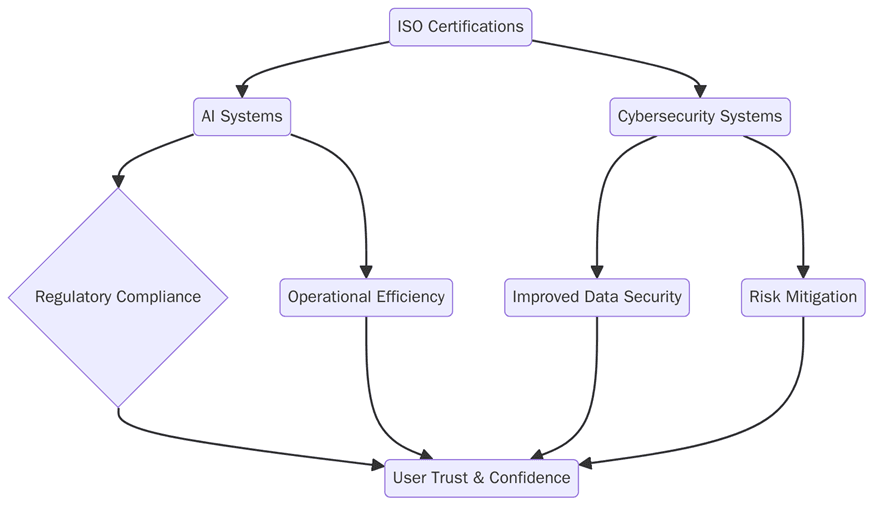
1. **Standardized** procedures and risk management practices help reduce errors, security breaches, and supply chain disruptions. ISO certification ensures critical processes are consistently monitored, controlled, and maintained for continuity.
2. **Certifications** like ISO 42001 for AI governance and ISO/IEC 27001 for cybersecurity show stakeholders, customers, and regulators that the organization follows internationally recognized standards. Transparent processes in AI decision-making, secure information handling, and accountable supply chain management build credibility and confidence.
3. **Organizations** can proactively identify potential risks in AI applications, cybersecurity systems, and supply chain dependencies. Implementing ISO standards reduces operational, financial, and reputational exposure while ensuring readiness for emerging regulations.
4. **Regular audits** and monitoring create a culture of accountability where gaps are identified, corrective actions are implemented, and processes evolve with technology and market demands.
5. **ISO certification** signals commitment to quality, security, and responsible practices. Certified organizations are better positioned to access partnerships, investor interest, and international markets that value adherence to global standards.
6. Staff are **trained** in ISO-aligned processes, increasing awareness of roles, responsibilities, and compliance expectations. This improves organizational efficiency and ensures everyone contributes to maintaining standards.
## **How to Prepare for ISO Certification?**
- **Proper** preparation is important for successful ISO certification. Organizations should start with an overreaching gap analysis to identify weaknesses in existing AI systems, information security controls, and supply chain management processes.
- Policies, procedures, and responsibilities must be **clearly** documented and communicated to all relevant personnel. Conducting internal audits prior to external evaluation allows organizations to correct deficiencies, address potential non-conformities and ensure all processes align with ISO requirements.
- **Employee training** is critical to ensure understanding of ethical AI practices, cybersecurity protocols and supply chain responsibilities.
- **Maintaining** accurate records of risk assessments, compliance checks, and corrective actions is necessary to show readiness. Partnering with an accredited certification body can provide guidance throughout the process, making the audit smooth and reducing the risk of delays in certification.
## **How can** Pacific Certifications help?
Pacific Certifications provides accredited ISO certification services for AI governance, cybersecurity management, and global supply chains. Our team supports organizations through every stage of the certification process, including preparation, internal audits, and external evaluations.
### Contact **Us**
If you need support with ISO certification in AI, Cybersecurity and Global Supply Chains, contact us at [**support@pacificcert.com**](mailto:support@pacificcert.com).
**Read More at:** [**Blogs by Pacific Certifications**](https://blog.pacificcert.com/)
The Future of ISO: AI, Cybersecurity & Global Supply Chain
## FAQs
Q: Can one certification cover AI, cybersecurity, and supply chains together?
A: Organizations usually pursue separate certifications for each area, though integrated management systems are possible.
Q: Can small businesses adopt AI and cybersecurity ISO standards?
A:
Yes, ISO standards are scalable and can be implemented by organizations of any size, including startups and SMEs.
Q: How frequently should audits be conducted?
A:
Internal audits should occur regularly, often quarterly or semi-annually, while external certification audits typically happen annually or per the certification body’s requirements.
Q: Are AI ISO standards mandatory?
A:
Currently, AI-related ISO standards are voluntary, but they are widely recognized as best practices for responsible AI deployment.
Q: How does ISO 28000 improve supply chain resilience?
A:
It provides a structured approach to manage security risks, ensure traceability, and maintain operational continuity across global supply chains.
Q: Do ISO certifications guarantee regulatory compliance?
A:
ISO standards align with global regulations and help organizations show compliance, but they do not replace legal obligations.
Q: How long does certification take?
A:
Certification timelines depend on the size and complexity of operations but generally range from 3 to 6 months with thorough preparation.
Q: What happens if non-conformities are discovered during an audit?
A:
Non-conformities must be addressed through corrective actions within the specified timeframe to achieve or maintain certification.
Q: Is ongoing training required after certification?
A:
Yes, continuous training ensures staff remain compliant and processes evolve with new standards and risks.
Q: How does Pacific Certifications assist with ISO audits?
A:
We provide guidance for audit readiness, internal assessments, documentation review, and coordination with accredited certification bodies.
---
This blog is powered by Superblog. Visit https://superblog.ai to know more.
---