# Energy Management Systems Explained: The Plan, Do, Check, Act Cycle
Author: Pacific Certifications
Author URL: https://blog.pacificcert.com/author/pacific-certifications/
Published: 2025-11-04
Meta Title: ISO 50001 PDCA Cycle 2026 | Energy Management Explained
Meta Description: Master the Plan-Do-Check-Act cycle for ISO 50001:2018. Expert guide to 2026 climate amendments, energy baselines (EnB), and EnPIs for net-zero compliance.
Tags: ISO 50001, Energy Management, Energy Management Systems, EnMS PDCA, ISO 50001 PDCA
Tag URLs: ISO 50001 (https://blog.pacificcert.com/tag/iso-50001/), Energy Management (https://blog.pacificcert.com/tag/energy-management/), Energy Management Systems (https://blog.pacificcert.com/tag/energy-management-systems/), EnMS PDCA (https://blog.pacificcert.com/tag/enms-pdca/), ISO 50001 PDCA (https://blog.pacificcert.com/tag/iso-50001-pdca/)
URL: https://blog.pacificcert.com/energy-management-plan-do-check-act-cycle/
## **Introduction**
Energy is no longer just a cost, it’s a measurable indicator of performance, sustainability and competitiveness. As industries transition toward low-carbon operations, managing energy use systematically has become vital. The **Plan-Do-Check-Act (PDCA) model**, which underpins **ISO 50001**, provides a clear roadmap for organizations to improve their energy performance in a structured and verifiable way. It converts energy savings from isolated projects into a continuous improvement cycle where every action is measured, reviewed and refined.
Start an ISO 50001 readiness discussion with [Pacific Certifications](https://pacificcert.com/) to assess how the PDCA cycle can strengthen your energy management practices.
## **Quick summary**
The PDCA cycle ensures that energy management is not a one-time initiative but an ongoing process. It helps organizations plan improvements, implement controls, monitor performance and adjust based on results. [ISO 50001](https://pacificcert.com/iso-50001-energy-management/) builds this model into every clause, linking leadership commitment, energy policy, objectives, data analysis and performance evaluation under one management system. When applied consistently, PDCA reduces energy consumption, stabilizes costs and improves carbon performance.
[**Evaluate how you ‘check’ and learn from results**](https://pacificcert.com/contact-us/): Consider how monitoring, internal reviews, and corrective actions are used to confirm whether energy initiatives are working as intended.
## **Why the PDCA model matter in energy management?**
Many organizations struggle to maintain energy efficiency beyond the initial savings phase. The PDCA **approach prevents** backsliding by creating a repeatable loop of planning, execution, evaluation and refinement. It embeds accountability and makes energy management part of day-to-day decisions rather than an occasional initiative.
This structure allows energy teams to work in sync with finance, operations and maintenance while aligning with broader ESG and carbon-reduction goals.
> PDCA transforms energy efficiency from a project-based effort into a culture of measurable improvement, built on data and leadership accountability.
## **ISO 50001 Clauses Aligned with the PDCA Cycle**
**PDCA Phase**
**ISO 50001 Clauses**
**Key Actions**
**Example KPIs/SLAs**
Plan
Clauses 4–6: Context, Leadership, Planning
Define energy policy, establish baselines, set objectives, identify risks
Baseline variance %, energy intensity ratio, energy-saving target progress
Do
Clause 7–8: Support and Operation
Implement controls, train staff, operate energy-using systems efficiently
Operational control compliance %, training completion rate
Check
Clause 9: Performance Evaluation
Monitor, measure, analyse and audit energy data
Meter data accuracy, report submission timeliness, audit closure time
Act
Clause 10: Improvement
Address nonconformities, apply corrective actions, review performance
Corrective action closure rate, management review frequency
## **Plan - Building the foundation**
The planning phase sets direction. It begins with understanding the context of the organization and the energy-related factors that influence performance. Leadership must establish an energy policy, define measurable objectives and identify significant energy uses (SEUs). Baselines are created to compare current consumption with improvement targets.
Key activities include:
1. **Define** the scope and boundaries of the energy management system.
2. **Identify** major energy-consuming assets and systems.
3. **Establish** measurable energy objectives and KPIs.
4. **Conduct** an energy review and create an action plan.
5. **Allocate** resources and responsibilities for energy performance.
## **Do - Implementing the plan**
The Do phase focuses on executing the energy management strategy. This includes developing operational controls, training staff and ensuring systems are maintained for optimal performance. Communication and awareness play a critical role, as every employee influence energy use.
Key actions include:
1. **Implement** operational controls for SEUs.
2. **Conduct** regular equipment maintenance and calibration.
3. **Train** operators on efficient equipment use and data collection.
4. **Integrate** energy efficiency into procurement and design decisions.
5. **Establish** procedures for emergency energy situations.
## **Check - Measuring and evaluating performance**
The Check phase validates whether energy performance objectives are being met. Data analysis, internal audits and management reviews help identify gaps and opportunities for improvement.
Key actions include:
1. **Measure** and monitor energy consumption at asset and process levels.
2. **Verify** data accuracy through calibration and validation processes.
3. **Conduct** internal audits and analyse deviations from baselines.
4. **Evaluate** the effectiveness of implemented controls.
5. **Report** findings to management for review.
## **Act - Improving and sustaining performance**
The Act phase closes the loop by addressing nonconformities, implementing corrective actions and ensuring that lessons learned inform future planning. This is where continuous improvement takes hold—transforming data insights into long-term energy gains.
Key actions include:
1. **Review** audit results and identify recurring nonconformities.
2. **Implement** corrective and preventive actions with deadlines.
3. **Update** objectives, policies and procedures based on findings.
4. **Communicate** results to staff and recognize achievements.
5. **Feed** outcomes into the next PDCA cycle for renewed action.
Common SLAs include corrective action closure within 30 days and quarterly management reviews.
## **What are the benefits of applying PDCA in energy management?**
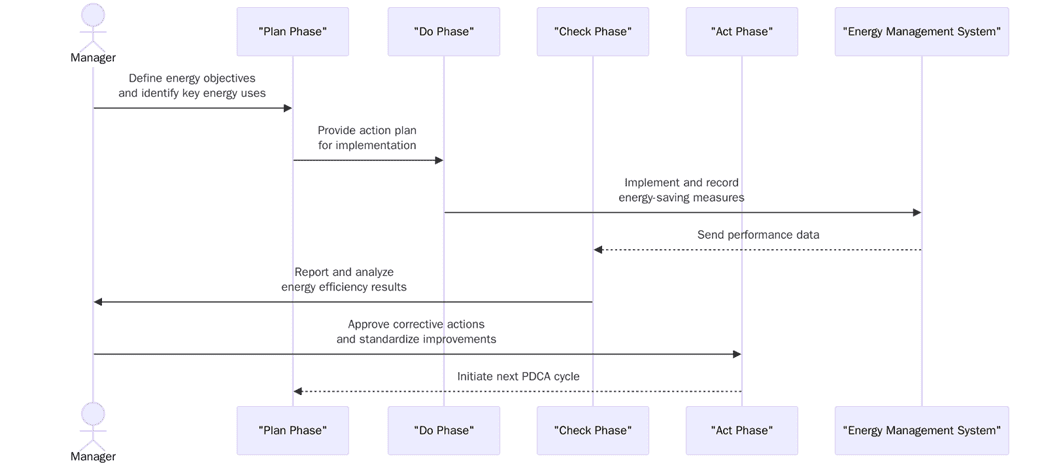
A structured PDCA approach helps organizations embed discipline into energy management and build lasting savings. Below are the major benefits:
1. **Consistent** improvement in energy efficiency and cost reduction
2. **Reliable** data-driven decisions based on verified performance metrics
3. **Stronger** cross-departmental communication and ownership of energy results.
4. **Better** control of operating costs and reduced carbon footprint
5. **Improved** alignment with ISO 9001, ISO 14001 and sustainability reporting
6. **Greater** transparency for investors and regulators through measurable KPIs
7. **Reduced** downtime due to proactive maintenance and monitoring
8. **Enhanced** employee awareness and accountability in energy practices
9. **Clear** SLAs for data integrity, monitoring frequency and audit closures
## Market Trends
In recent years, organizations are integrating real-time energy analytics, IoT sensors and AI-driven forecasting into their PDCA cycles. Energy dashboards automate the “ **Check**” and “ **Act**” phases, providing predictive alerts for unusual consumption patterns. Companies are also linking **ISO 50001** systems with carbon accounting platforms to meet **Scope 1** and **Scope 2** reporting requirements.
By **2030**, the PDCA cycle will evolve through continuous digital feedback loop where **AI** and **automation** drive improvement autonomously. Smart grids, blockchain-based energy tracking and digital twins will help institutions predict consumption and reduce waste before it occurs. Organizations that embed PDCA in both operations and design will lead in resilience, cost control and compliance with carbon neutrality goals.
## **Training and courses**
Pacific Certifications provides accredited training programs for ISO 50001 and PDCA-based energy management systems:
- [**Lead Auditor Training**](https://pacificcert.com/lead-auditor-training/) **:** Focuses on planning and conducting energy audits, reviewing data accuracy and verifying performance against ISO 50001 clauses.
- [**Lead Implementer Training**](https://pacificcert.com/lead-implementer/): Guides professionals through building and operating an energy management system aligned with the PDCA model, covering baselines, SEUs, KPIs and continual improvement methods.
For enrolment or customized training programs, contact [**support@pacificcert.com**](mailto:support@pacificcert.com).
## **How Pacific Certifications can help?**
Pacific Certifications provides ISO 50001 certification and audit services that assess the effectiveness of your energy management system and PDCA implementation. Our audits evaluate baselines, objectives and monitoring controls to verify continual improvement.
We issue Certificates of Conformity after impartial audits, helping organizations validate their energy and sustainability commitments globally.
### **Contact** **Us**
Request your ISO 50001 certification audit plan at [support@pacificcert.com](mailto:support@pacificcert.com) or visit [www.pacificcert.com](https://pacificcert.com/).
### Author: Alina Ansari
**Read More at:** [**Blogs by Pacific Certifications**](https://blog.pacificcert.com/)
Energy Management Systems
## FAQs
Q: What is the purpose of the PDCA cycle in energy management?
A: It helps organizations manage energy systematically by planning, implementing, monitoring and improving performance continuously.
Q: Is PDCA only for large companies?
A: No. It can be applied to organizations of any size or sector.
Q: How does PDCA link to ISO 50001?
A: ISO 50001 is built entirely on the PDCA cycle, making it the foundation for continual improvement.
Q: What data should be monitored in the Check phase?
A: Energy consumption, baseline variance, operational control performance and maintenance metrics.
Q: How often should management reviews occur?
A: At least once a quarter or as needed when significant energy deviations are detected.
Q: What tools support PDCA?
A: Energy dashboards, metering software and data analytics platforms.
Q: Can PDCA improve equipment reliability?
A: Yes, by ensuring regular monitoring, calibration and condition-based maintenance.
Q: What are common nonconformities found during audits?
A: Missing baselines, poor data accuracy, incomplete corrective action tracking and lack of review records.
Q: Does PDCA align with carbon reduction goals?
A: Yes, because it provides measurable data for carbon reporting and reduction targets.
Q: Why choose Pacific Certifications?
A: Accredited audits, measurable improvement tracking and globally recognized certification supporting energy efficiency leadership.
---
This blog is powered by Superblog. Visit https://superblog.ai to know more.
---