Post by Alina Ansari | June, 2026
What Is EN 13814?
Developed by CEN/TC 152 - the European Committee for Standardization's technical committee for fairground and amusement park machinery and structures. The EN 13814 series applies to mobile, temporary and permanently installed machinery and structures intended for use by persons as a leisure activity - including roundabouts, swings, boats, Ferris wheels, roller coasters, chutes, grandstands, membrane and textile structures, booths, stages, side shows and structures for artistic aerial displays.
The three parts of the series are: EN 13814-1 for design and manufacture, EN 13814-2 for operation and maintenance and EN 13814-3 for inspection. Together the three parts provide the complete technical and procedural framework for amusement device safety governance across the European market and beyond.
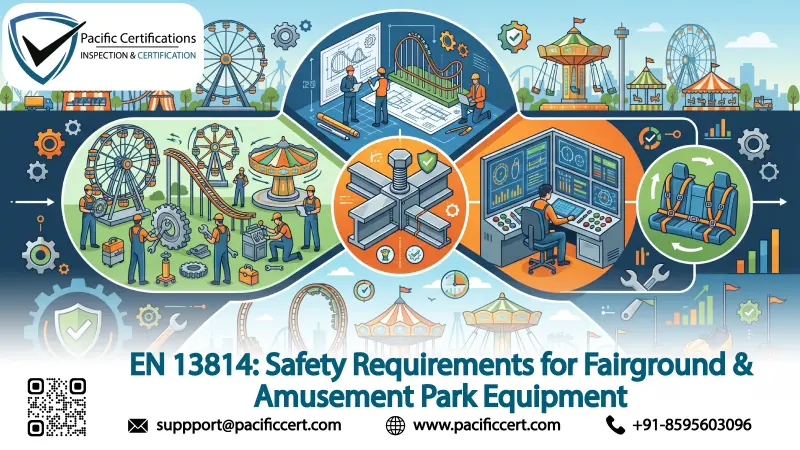
EN 13814 helps amusement ride manufacturers and operators manage safety across design, manufacture, installation, operation, maintenance and inspection - Pacific Certifications
The EN 13814 Series Structure
Practical Tip: Treat EN 13814 as a full lifecycle safety framework, where Part 1 controls design, Part 2 controls operation and Part 3 controls inspection.
EN 13814 Design and Manufacturing Requirements
It establishes the engineering principles and technical parameters that designers and manufacturers must apply to ensure that amusement devices are structurally sound, mechanically reliable and safe for intended use under all foreseeable operating conditions.
Structural Design and Calculation
EN 13814-1 requires that the structural design of amusement rides and devices is based on documented engineering calculations covering all relevant load cases - including static loads from passenger weight and device self-weight, dynamic loads from acceleration and deceleration forces, wind loads appropriate to the deployment environment and fatigue loads from repeated operational cycles over the design life of the device. The standard specifies minimum safety factors and material standards applicable to structural components and requires that fatigue analysis is conducted for all components subject to cyclic loading - recognizing that fatigue failure is one of the primary structural failure mechanisms in amusement devices operated through millions of load cycles over their service life.
Passenger Containment and Safety Systems
The design of passenger containment systems - restraints, lap bars, over-shoulder harnesses, seat belts and interlocking gates - must meet defined performance requirements covering the forces that containment systems must resist, the conditions under which they must remain locked and the procedures for verifying their correct engagement before each ride cycle. EN 13814-1 requires that safety-critical control systems - including the systems that verify restraint engagement and control ride start - meet defined safety integrity requirements appropriate to the hazard level of the ride.
Materials and Manufacturing Quality
Materials used in structural and safety-critical components must meet defined specifications covering strength, toughness, weldability and corrosion resistance. Manufacturing processes - including welding, heat treatment, surface protection and assembly - must be documented and controlled, with inspection and testing activities at defined stages of manufacture to verify conformance with design specifications. The standard requires that each device is accompanied by a technical file containing the design documents, calculation records, material certificates, manufacturing inspection records and test results that demonstrate conformance with EN 13814-1.
Installation Requirements
EN 13814-1 covers the requirements for the installation of amusement devices - including foundation design for permanently installed rides, assembly procedures for mobile and temporary installations and the pre-opening inspection and testing activities required to verify that the installed device meets its design specification before it is opened to the public.
Writer’s view: Safe amusement equipment begins with documented engineering calculations, controlled manufacturing processes and verified safety critical components.
EN 13814 Installation and Operation Safety
Operational Safety Procedures
EN 13814-2 requires that operators establish and implement documented operating procedures for each device - covering pre-opening checks, passenger loading and unloading procedures, restraint verification, ride cycle management, emergency stop procedures and post-incident protocols. Operators must ensure that all staff responsible for operating amusement devices are trained to the documented procedures and that training records are maintained.
Pre-Opening Inspection
Before opening to the public each operating day, the device must be subjected to a defined pre-opening inspection covering visual checks of structural integrity, mechanical systems, passenger containment, safety devices and operational controls. The results of pre-opening inspections must be recorded and retained as part of the device's operational log. Any defect or abnormality identified during pre-opening inspection must be resolved before the device is opened.
Emergency Procedures
EN 13814-2 requires that operators develop and maintain emergency procedures for all foreseeable emergency scenarios - including passenger entrapment, ride stoppage mid-cycle, fire and medical emergency. Emergency procedures must be documented, communicated to all operational staff and exercised at defined intervals to verify their effectiveness.
Operational Records and Device Diary
Operators must maintain a device diary - a comprehensive operational record covering pre-opening inspection results, maintenance activities, defects identified and resolved, modifications made, incidents and near-misses and the results of periodic inspections. The device diary is the operational history record of the device and forms a critical input to the periodic inspection process under EN 13814-3.
EN 13814 works best when daily operation, staff training, emergency response and inspection records are managed as one safety system.
EN 13814 Inspection and Maintenance
Independent inspection is one of the most critical safety governance mechanisms in the amusement device sector - providing an independent technical assessment of device safety that goes beyond the operator's own pre-opening checks and routine maintenance program.
Initial Inspection and Approval
The initial approval of any amusement device consists of a comprehensive inspection, review and testing program conducted by an independent inspection body before the device is placed in service for the first time. This covers review of all safety-related design documents - confirming that the design meets EN 13814-1 requirements - assessment of the completed device against its design documents and initial testing under defined load and operating conditions.
Periodic Inspection
Amusement devices are subject to periodic independent inspection at defined intervals throughout their service life - typically annually at a minimum, with the specific interval determined by the risk classification of the device and any applicable national regulatory requirements. Periodic inspection covers structural and mechanical condition assessment, non-destructive testing of safety-critical components, electrical system inspection and verification.
Non-Destructive Testing
EN 13814-3 places significant emphasis on non-destructive testing (NDT) of safety-critical structural components - including welds, axles, pins and high-stress structural joints. NDT methods applicable to amusement device inspection include magnetic particle inspection, dye penetrant testing, ultrasonic testing and eddy current testing - with the specific methods and coverage specified in the inspection schedule defined for each device type.
Maintenance Requirements
EN 13814-2 requires that operators implement a documented maintenance program covering all safety-critical mechanical, structural, electrical and hydraulic systems of each device. The maintenance program must be based on the manufacturer's maintenance instructions provided in the technical documentation accompanying the device, supplemented by maintenance intervals and procedures informed by the device's operational experience and the findings of periodic inspections.
Final Remark: Independent inspection and planned maintenance help ensure amusement devices remain safe beyond their first day of operation.
EN 13814 Conformity Assessment
The conformity assessment process is particularly important in the context of the Machinery Directive and its successor the EU Machinery Regulation, under which amusement rides are classified as machinery and subject to CE marking requirements. The conformity assessment process for EN 13814 compliance involves:
Design documentation review: An independent inspection body reviews all design documents - structural calculations, drawings, material specifications, safety system design and risk assessment - against EN 13814-1 requirements
Manufacturing process control assessment: Review and audit of the manufacturer's production quality controls, welding procedures, material traceability and inspection records during manufacture
Type testing: Physical testing of the completed device or representative components against defined performance requirements - covering structural load testing, safety device functionality testing and electrical system testing
Initial inspection: On-site inspection and testing of the installed device before first opening to the public, as required by EN 13814-3
Ongoing surveillance: Periodic independent inspection at defined intervals throughout the device's service life, maintaining the ongoing conformity of the device with EN 13814-2 operational and maintenance requirements
Conformity assessment turns technical design, manufacturing controls, testing and inspection evidence into a structured proof of EN 13814 compliance.
CE Marking Implications
Compliance with EN 13814-1 provides the presumption of conformity with the essential health and safety requirements of the Machinery Directive applicable to amusement devices - making EN 13814-1 the primary harmonized standard for CE marking purposes in this product category. CE marking of an amusement ride requires:
Technical file: Assembly of the complete technical documentation covering design calculations, drawings, risk assessment, material specifications, manufacturing inspection records, test results and instructions for installation, operation and maintenance
Risk assessment: A documented risk assessment covering all foreseeable hazards associated with the device - conducted in accordance with the methodology of EN ISO 12100 and demonstrating that risks have been reduced to acceptable levels through design, safeguarding and information
Declaration of Conformity: A signed EU Declaration of Conformity in which the manufacturer declares that the device meets all applicable essential requirements of the Machinery Directive and identifies the applicable harmonized standards - including EN 13814-1
Third-party involvement: For amusement rides classified as high-risk machinery under the Machinery Directive, involvement of a Notified Body is required for conformity assessment - with the Notified Body conducting an EC Type Examination or reviewing the complete design documentation and issuing an approval before CE marking is applied
The CE mark on an amusement device is the manufacturer's declaration that the device meets all applicable EU safety requirements - it is not a certification mark issued by a third party, but its application requires the technical evidence base assembled through EN 13814-1 compliance and, where applicable, Notified Body involvement.
Tip: CE marking should be supported by a complete technical file, risk assessment, Declaration of Conformity and applicable third party assessment where required.
EN 13814 Certification Process
The management system certification process for amusement device manufacturers and operators follows a structured sequence:
Step 1: Gap Analysis
The organization's existing management system documentation, procedures and practices are assessed against the requirements of the target ISO standard. Gaps are identified and a prioritized implementation plan is developed covering all clause areas.
Step 2: Implementation and Training
The documented management system is implemented across all functions in scope. Staff training is completed covering management system requirements, procedure awareness, internal audit competence and non-conformance reporting.
Step 3: Internal Audit
A full internal audit is conducted across the management system to identify any remaining non-conformances before the Stage 1 certification audit.
Step 4: Stage 1 Audit
The certification body conducts a documentation review of the management system - assessing completeness and adequacy against the requirements of the applicable ISO standard and confirming readiness for the Stage 2 audit.
Step 5: Stage 2 Audit
The certification body conducts an on-site implementation audit - verifying that the documented management system is effectively implemented in practice across all functions in scope. Findings are documented and non-conformances must be resolved before certification is granted.
Step 6: Certificate Issuance
Following a successful Stage 2 audit, the certification body issues the ISO certificate covering the defined scope. The certificate is valid for three years subject to annual surveillance audits.
A smooth certification process starts with gap analysis, staff training, internal audit readiness and clear evidence before Stage 1 and Stage 2 audits.
EN 13814 Certification Cost
A specialist amusement ride manufacturer with a focused product range and a single manufacturing facility will have a contained audit investment. A larger manufacturer with multiple product lines, complex supply chains and multi-site operations will require proportionally more audit days.
Pacific Certifications provides transparent, fixed-fee proposals covering all certifications in scope so your organization has complete cost visibility before the process begins.
Cost planning should consider the number of employees, sites, product complexity, audit scope, selected ISO standards and existing system maturity.
To get a customized quote based on your organization's size, sector position and target certifications, contact Pacific Certifications at support@pacificcert.com or visit www.pacificcert.com.
EN 13814 Certification Timeline
This includes 2 to 4 weeks for gap analysis and management system documentation development, 6 to 10 weeks for full implementation covering procedure documentation, document control setup, staff training and internal audit program establishment and 2 to 3 weeks for Stage 1 and Stage 2 certification audits.
For organizations pursuing an integrated ISO 9001 and ISO 45001 program simultaneously - the recommended approach for most amusement device sector organizations - the implementation timeline extends to 4 to 6 months, with the combined audit program adding 1 to 2 weeks to the audit phase compared to a single-standard audit. Adding ISO 14001 to create a full integrated management system typically extends the timeline by a further 4 to 6 weeks.
A Practical Tip from Pacific Certifications: Amusement ride manufacturers and operators can avoid delays by preparing documentation, staff training, internal audits and technical evidence early.
How Pacific Certifications Can Help?
Pacific Certifications is an independent certification body providing ISO management system certification services to amusement ride manufacturers, amusement park operators, fairground organizations, ride inspection bodies and leisure infrastructure companies globally. Accredited by ABIS, Pacific Certifications conducts impartial, evidence-based audits against applicable ISO standards in full conformance with ISO/IEC 17021. Our services for amusement device sector organizations include:
Independent certification audits for ISO 9001, ISO 45001, ISO 14001, ISO 22301 and ISO 50001
Integrated management system audits covering multiple standards in coordinated, efficient audit visits
Stage 1 and Stage 2 audit execution across manufacturing, operational and inspection organizations
Clear, transparent audit reports with conformity findings and certification decisions
Issuance of internationally recognized ISO certificates upon successful audit completion
Annual surveillance and triennial recertification audits to maintain certificate validity
Pacific Certifications does not provide consultancy, our role is strictly that of an independent auditor, ensuring your certificate carries full credibility with regulatory authorities, procurement bodies, insurers and enterprise clients in every market you operate in.
Contact Us
To get started with your ISO certification program or initiate your audit, contact us at support@pacificcert.com or +91-8595603096. For training programs, contact us at trainings@pacificcert.com. Visit www.pacificcert.com for more information.
Read more: ISO 27099: Public Key Infrastructure