# Benefits of Integrating ISO 45001 with ISO 9001
Author: Pacific Certifications
Author URL: https://blog.pacificcert.com/author/pacific-certifications/
Published: 2025-11-11
Meta Title: Benefits of ISO 45001 & 9001 Integration 2026 | Pacific Cert
Meta Description: Master the synergy of ISO 9001:2026 and 45001. Expert guide to 30% cost savings, unified risk management, and the 2026 Climate Action Amendments.
Tags: ISO 9001 Certification, ISO 45001 Certif, Integrating QMS and OHSAS, ISO 9001 and ISO 45001
Tag URLs: ISO 9001 Certification (https://blog.pacificcert.com/tag/iso-9001-certification/), ISO 45001 Certif (https://blog.pacificcert.com/tag/iso-45001-certif/), Integrating QMS and OHSAS (https://blog.pacificcert.com/tag/integrating-qms-and-ohsas/), ISO 9001 and ISO 45001 (https://blog.pacificcert.com/tag/iso-9001-and-iso-45001/)
URL: https://blog.pacificcert.com/benefits-of-integrating-iso-45001-with-iso-9001/
## **Introduction**
Organizations today are **recognizing** that safety and quality are not separate objectives, they are two sides of operational excellence. When combined, ISO 45001 (Occupational Health & Safety Management System) and ISO 9001 (Quality Management System) create a unified approach that strengthens leadership, reduces risks and builds long-term sustainability.
Integrating these two systems helps **institutions** avoid duplicated work, align policies and create a single management framework that drives both employee safety and customer satisfaction. In recent years, industries across manufacturing, logistics and energy are increasingly adopting integrated management systems (IMS) to manage compliance, efficiency and people well-being together.
Talk to [Pacific Certifications](https://pacificcert.com/) to understand how integrated ISO 45001 and ISO 9001 certification audits can streamline safety and quality management for your organization.
## **Quick summary**
An integrated approach to [ISO 45001](https://pacificcert.com/iso-45001-2018-health-safety/) and [ISO 9001](https://pacificcert.com/iso-9001-2015-quality-management-system-certification/) brings multiple organizational systems: safety, quality, documentation and process control under one structure. This alignment improves governance, resource use and decision-making while maintaining compliance with international standards. Integration also supports consistent internal audits, unified risk assessments and shared performance indicators.
[**Explore how an integrated QH&S system could work for you**](https://pacificcert.com/contact-us/): Consider where combining quality and occupational health & safety processes might reduce duplication and simplify day‑to‑day management.
## **Why integrating ISO 45001 and ISO 9001 matters?**
Modern organizations face **rising** expectations, from employees seeking safe workplaces to customers demanding consistent quality. Maintaining two separate systems for quality and safety often leads to overlaps, inconsistent data and wasted effort.
This alignment ensures that leadership, process owners and auditors follow a single structure of Plan-Do-Check-Act (PDCA), reducing duplication while improving accountability and transparency.
> “Integrating ISO 9001 and ISO 45001 creates one cohesive management culture, where safety defines performance and quality drives trust.”
## **ISO 9001 + ISO 45001 Integration Overview**
**Integration Area**
**Key Focus**
**Combined Benefit**
Policy and leadership
Unified direction on quality and safety
Stronger governance and accountability
Risk and opportunity management
Single process for identifying risks
Shared mitigation plans and faster decisions
Performance monitoring
Joint KPIs and audits
Improved visibility and reduced audit fatigue
Training and competence
Shared awareness programs
Consistent culture of safety and quality
Documentation
Integrated procedures and forms
Streamlined records and simplified audits
## **What are the requirements for integration?**
Integrating ISO 45001 and ISO 9001 requires aligning processes, leadership involvement and documentation under a unified framework. Below are the key steps to achieve successful integration:
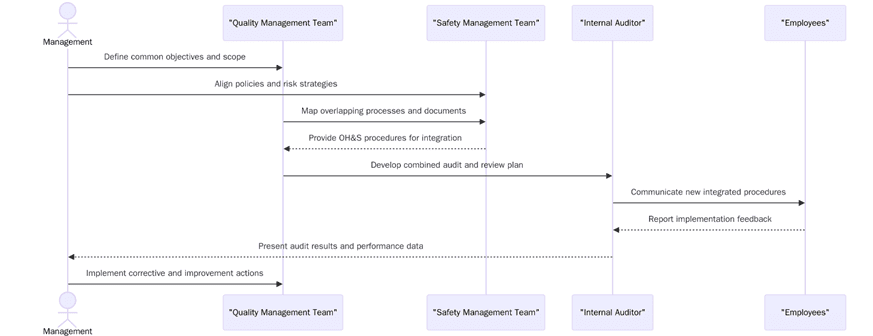
01. **Establish** an integrated policy that covers both quality and safety.
02. **Conduct** a joint context and stakeholder analysis.
03. **Define** shared objectives and KPIs for safety and quality.
04. **Combine** risk assessments covering both product defects and workplace hazards.
05. **Standardize** document and record control systems.
06. **Conduct** joint training for employees and managers.
07. **Integrate** internal audit and management review cycles.
08. **Harmonize** incident and nonconformity reporting methods.
09. **Update** process owners’ roles to include safety and quality accountability.
10. **Implement** continual improvement measures under one PDCA cycle.
**Tip:** _Maintain a unified risk register with entries for both operational safety and quality risks to improve transparency during audits._
## **What are the benefits of integrating ISO 45001 with ISO 9001?**
Integrating these systems strengthens both quality and safety outcomes while improving the organization’s overall performance. Below are the major benefits:
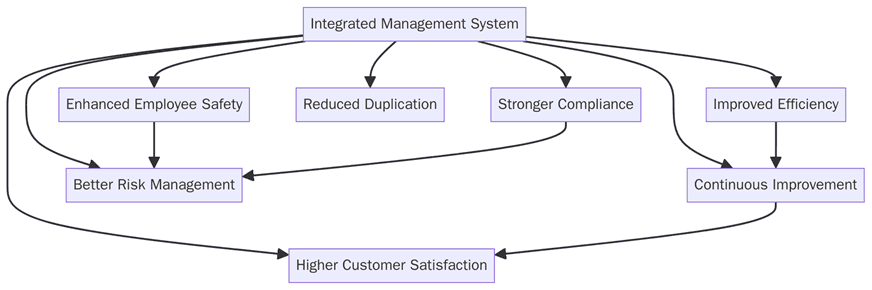
01. **Simplified** documentation and reduced duplication of policies and audits
02. **Clearer** leadership structure and resource management across departments
03. **Improved** employee awareness by linking product quality with workplace safety
04. **Reduced** audit time and certification costs through shared audits and evidence
05. **Streamlined** management reviews with unified objectives and reporting metrics
06. **Stronger** data-based decisions supported by shared KPIs and internal audits
07. **Enhanced** stakeholder trust through integrated governance and accountability
08. **Increased** consistency in operations, reducing both safety incidents and quality defects
09. **KPIs**: incident frequency rate, product rejection rate, internal audit closure cycle, customer satisfaction index
10. **SLAs**: corrective action closure within 30 days, supplier audit completion time, employee training refresh cycle
## Market Trends
Organizations are adopting integrated management systems to simplify compliance audits and **ESG** reporting. Integrated digital dashboards are being used to track both safety and quality performance in real time. Companies in automotive, healthcare and construction are using joint **ISO 45001-9001** frameworks to meet global buyer requirements and supplier audits efficiently.
**By 2030**, more certifications will be issued as integrated audits rather than separate standards. Artificial intelligence and automation will merge safety metrics, customer complaints and quality data into unified dashboards. Institutions that integrate early will **save audit costs**, improve data visibility and gain faster access to supplier approvals and government contracts.
## **Training and courses**
Pacific Certifications offers accredited training for professionals aiming to manage integrated systems for ISO 9001 and ISO 45001:
[**Lead Auditor Training**](https://pacificcert.com/lead-auditor-training/) **:** For those conducting integrated audits covering both quality and safety requirements.
[**Lead Implementer Training**](https://pacificcert.com/lead-implementer/): For personnel responsible for merging ISO 9001 and ISO 45001 systems into one structure.
To schedule an integrated management training program, contact [**support@pacificcert.com**](mailto:support@pacificcert.com).
## **How Pacific Certifications can help?**
Pacific Certifications provides accredited integrated certification audits for ISO 9001 and ISO 45001. Our team assesses quality, safety and leadership systems under a unified framework to help institutions maintain compliance and measurable performance improvement.
We issue Certificates of Conformity following impartial integrated audits and ensure that organizations meet both quality and safety expectations consistently.
### Contact **Us**
If you need support with ISO certification, contact us at [**support@pacificcert.com**](mailto:support@pacificcert.com).
**Read More at:** [**Blogs by Pacific Certifications**](https://blog.pacificcert.com/)
Benefits of Integrating ISO 45001 with ISO 9001
## FAQs
Q: Why integrate ISO 9001 and ISO 45001?
A:
It reduces duplicate documentation, aligns policies and creates a stronger culture of quality and safety.
Q: Can the same audit cover both standards?
A:
Yes, integrated audits evaluate both standards simultaneously to save time and cost.
Q: What are common challenges in integration?
A:
Resistance to change, unclear responsibilities and non-aligned documentation systems.
Q: Is integration suitable for small organizations?
A:
Yes, small institutions often benefit most from simplified documentation and shared audits.
Q: How long does integration take?
A:
Typically between 6 to 12 months, depending on system maturity and leadership involvement.
Q: Does integration affect existing certification validity?
A: No, it enhances current systems without affecting validity.
Q: What are the performance indicators to track?
A:
Safety incidents, product defect rate, training completion and audit closure time.
Q: Can ISO 9001 and ISO 45001 integrate with ISO 14001?
A: Yes, many organizations run all three as part of an Integrated Management System (IMS).
Q: How does integration support ESG goals?
A:
It aligns people safety, product quality and sustainability metrics under one system.
Q: Why choose Pacific Certifications?
A:
Independent, accredited audits and recognized certification for global credibility.
---
This blog is powered by Superblog. Visit https://superblog.ai to know more.
---